Boutique Fitness Studio Cleaning vs. Large Gym: Key Differences
Boutique fitness studios and large gyms require fundamentally different cleaning strategies—from scope of work and team size to operational budgets. Learn what makes each model unique.
Boutique fitness studios and large gyms require fundamentally different cleaning strategies—from scope of work and team size to operational budgets. Learn what makes each model unique.
Cleaning a boutique fitness studio differs fundamentally from servicing a large multipurpose gym in terms of scope of work, cleaning team size, and operational budget. A boutique studio (yoga, pilates, crossfit) up to 200 m² typically requires 1–2 cleaning staff and a budget of PLN 600–1,200 net per month, while a large fitness club (500–2,000 m²) with a swimming pool and sauna needs 3–6 people and a budget of PLN 3,000–8,000 net per month.
Boutique studio owners often hesitate between hiring a professional cleaning company or handling work partially in-house. From our experience servicing sports facilities in Cracow and Katowice, we know this decision hinges primarily on scale of operations, owner availability, and client expectations regarding cleanliness standards.
In this article, we compare both models in terms of work specifics, operational costs, and practical solutions for fitness facility owners of varying sizes.
In Brief
- Boutique studio (<200 m²): 1–2-person team, PLN 600–1,200 net/month, focus on mats, mirrors, flooring
- Large gym (500–2,000 m²): 3–6-person team, PLN 3,000–8,000 net/month, full scope including wellness zone
- Frequency: daily evening after last classes; in large gyms, additional daytime refresh
- Key differences: number of zones to clean, sanitary requirements (pool, sauna), scale of equipment and chemical consumption
- Professional outsourcing pays for itself from ~150 m² usable space or with intensive schedules (>40 hours/week)
How Does a Boutique Studio Differ from a Large Fitness Club?
A boutique fitness studio is typically a specialized facility of 80–200 m², focused on one or two disciplines—yoga, pilates, stretching, crossfit, barre, spinning. It's characterized by an intimate atmosphere, classes of 15–20 people, and high-quality finishes. The owner often teaches classes or employs 2–4 trainers.
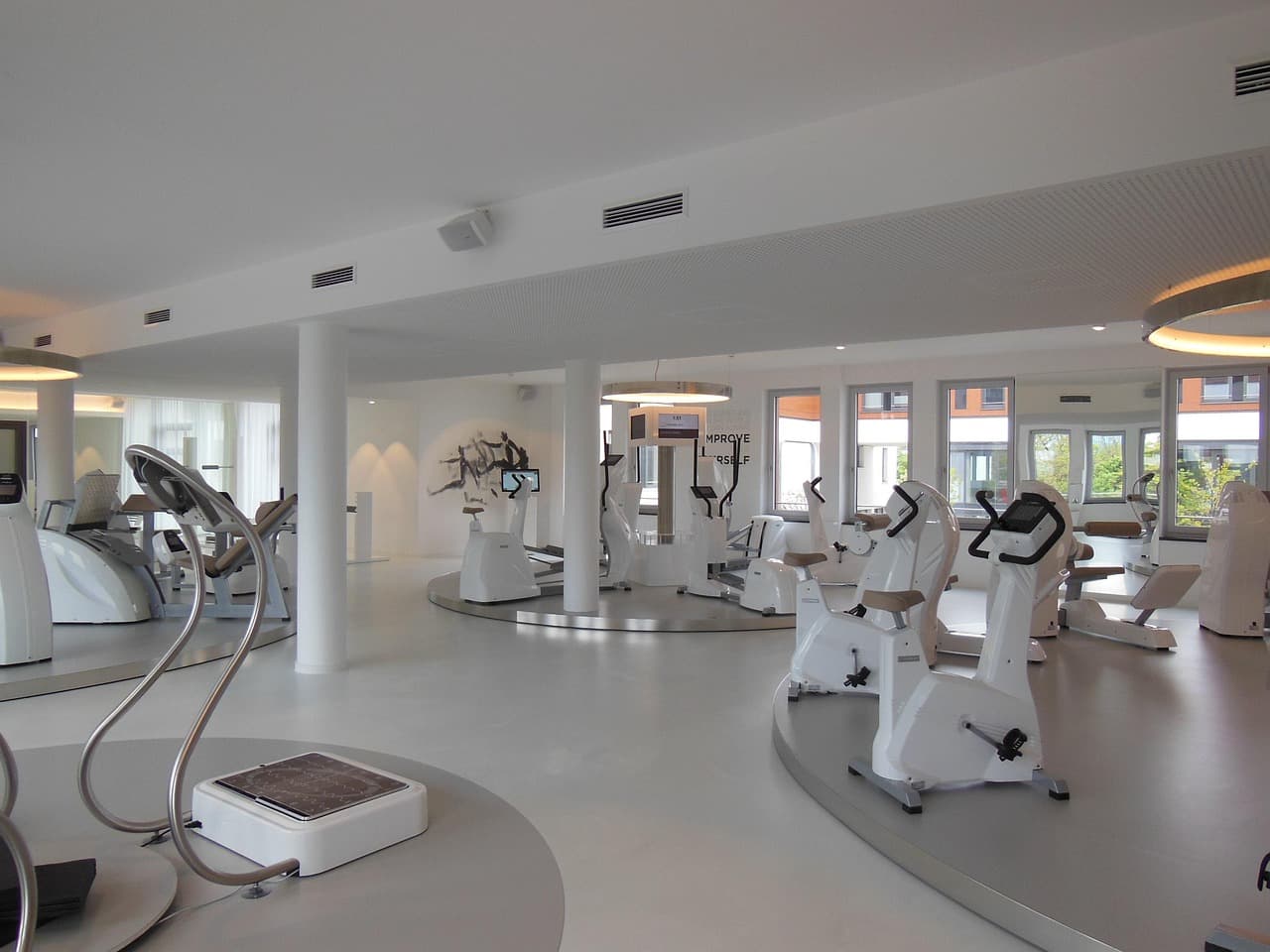
A large fitness club is a multipurpose facility of 500–2,000 m² (or more for franchise chains), featuring multiple training zones: a weight area, aerobic studios, cardio zone, locker rooms, often a swimming pool, sauna, jacuzzi. It serves 50–200 people simultaneously, employs 10–30 staff, and operates either on an open-entry model (any time access) or with many group classes throughout the day.
From a cleaning perspective, the most important differences are:
- Number of zones to clean: a boutique studio typically has one main room, reception, locker room, and restroom; a large gym has minimum 5–10 distinct zones requiring different sanitary standards.
- Traffic intensity: a studio serves 30–80 people daily during scheduled classes; a large gym serves 150–500 people across scattered hours.
- Sanitary requirements: a studio rarely has a wellness zone; a large gym with a pool must comply with State Sanitary Inspection (PIS) requirements for disinfection and microbiological controls.
How Much Does Boutique Fitness Studio Cleaning Cost?
For a studio of 80–150 m² with one training room, locker room, and reception, the typical cost of professional cleaning in 2026 in Cracow and Katowice is PLN 600–1,000 net per month for daily evening cleaning (5–6 days per week). A 150–200 m² studio with two rooms: PLN 1,000–1,200 net per month.
This budget covers:
- Daily vacuuming and floor washing (wood, laminates, rubber, vinyl)
- Mirror cleaning on walls (often covering 30–50% of wall area in a room)
- Disinfection of fitness mats, blocks, straps, and other small equipment
- Locker room and restroom cleaning (floor washing, disinfection of sinks and toilets, restocking consumables)
- Waste removal and bag replacement
- Reception and break area vacuuming
For comparison, owner-performed cleaning means 1–1.5 hours daily, which over 6 days per week equals ~36–54 hours monthly. If the owner values their time at a trainer's rate (PLN 100–150/hour gross), the opportunity cost comes to PLN 3,600–8,100 per month—many times higher than outsourcing.
Our experience in gym cleaning in Cracow shows boutique studio owners often opt for a hybrid model: outsourced evening cleaning (floors, mirrors, locker rooms), while the owner or trainer does quick refreshes between classes (wiping mats, organizing equipment).
How Much Does Large Fitness Club Cleaning Cost?
A large fitness club of 500–1,000 m² (main room, cardio zone, group studios, locker rooms, reception) requires a budget of PLN 3,000–5,000 net per month for daily cleaning. A facility of 1,000–2,000 m² with pool, sauna, and jacuzzi: PLN 5,000–8,000 net per month.
The team consists of 3–6 people, depending on area and intensity of use. A typical schedule includes:
- Evening main cleaning (after closing, 21:00–23:00): full floor washing, equipment disinfection, mirror cleaning, locker room and restroom cleaning, wellness zone
- Daytime refresh (2–3 times): quick pass through locker rooms and restrooms, restocking consumables, waste removal, reception cleaning
- Pool area cleaning (daily): floor washing in wet areas, disinfection of loungers, chemical level monitoring in the pool (coordinated with technical staff)
Costs scale proportionally:
- Larger area → more labor hours (3,000–4,000 m² may require 8–10 people on evening shift)
- Wellness zone → PIS compliance, specialized disinfectants, frequent inspections
- Operating hours 6:00–23:00 → daytime refresh needed (additional 1–2 people)
In large clubs, professional outsourcing is the standard because the scale makes in-house cleaning impossible without disrupting facility operations.
What Are the Key Differences in Scope of Work?
The table below compares typical cleaning scope in a boutique studio versus a large gym:
| Element | Boutique studio (80–200 m²) | Large fitness club (500–2,000 m²) |
|---|---|---|
| Training room | 1–2 rooms, mats and small equipment | 3–8 zones (weight area, cardio, group studios) |
| Mirrors | 20–50 m² of glass | 100–300 m² of glass |
| Flooring | Wood, laminate, vinyl—single type | Mix: rubber (free weights), wood (rooms), tile (locker rooms, pool) |
| Locker rooms and restrooms | 1–2 changing booths, 1 shower | 4–10 booths, 6–20 showers, lockers |
| Wellness zone | None or dry sauna | Pool, dry and steam sauna, jacuzzi |
| Disinfection equipment | Mats, blocks, straps (20–50 items) | Machines (50–150 items), dumbbells (100+ pairs), mats |
| Frequency | Daily evening | Daily evening + 2–3× daytime refresh |
| Team | 1–2 people | 3–6 people (evening) + 1–2 (daytime) |
An additional challenge in large clubs is coordination with class schedules. Group studios are occupied until 21:00–22:00, so cleaning must start the moment the last group leaves. This requires flexibility and communication systems—at Reefa, we use QR code systems allowing reception to flag which room is ready for cleaning.
How Often Should a Fitness Studio Be Cleaned?
Daily evening cleaning is the absolute minimum in both facility types. Sweat, dust, shoe marks, and bacteria accumulate throughout the day, and a fitness studio without daily cleaning loses its perceived standard within just 2–3 days.
In a boutique studio, a typical schedule looks like this:
- After last classes (20:00–22:00): full cleaning—vacuuming, floor washing, mirror cleaning, mat and equipment disinfection, locker room and restroom cleaning
- Between classes (optional, 2–3 times daily): quick refresh—mat wiping, equipment organizing, spot mirror cleaning
In a large fitness gym:
- Evening main cleaning (21:00–23:00 or 23:00–1:00 in facilities open until midnight): comprehensive cleaning of all zones
- Daytime refresh (3–4 times): focus on locker rooms, restrooms, reception—most heavily used areas
- Pool area cleaning: daily morning (before opening) and evening (after closing)
We service a pilates studio in Cracow on Podgórze (~120 m², 8 daily classes, 40–60 people/day). The owner initially cleaned herself after evening classes, spending 1.5 hours daily. After switching to outsourcing (PLN 800 net/month, 6 days/week), she could focus on additional classes, generating revenue exceeding the cleaning cost.
Does a Boutique Studio Need a Professional Cleaning Company?
This depends on three factors: scale of operation, owner availability, and client expectations.
Arguments for outsourcing:
- Owner's time value: if the owner teaches 4–8 classes daily, self-cleaning means overwork and burnout. Time is better spent on expanding offerings, marketing, client service.
- Quality and consistency: a professional company guarantees consistent standards regardless of owner stress. Boutique studio clients (often premium segment) notice details.
- Health and safety & liability: a cleaning company bears responsibility for potential damage (e.g., expensive flooring). Reefa holds liability insurance up to PLN 500,000, protecting your facility.
- Supplies and equipment: a professional company has specialized disinfectants for sports equipment, microfiber mops, cleaning machines—purchasing for a single studio often doesn't pay off.
Arguments for self-cleaning:
- Very small studio (<80 m²), few classes (2–3 daily), owner has time and interest
- Tight startup budget, studio testing market fit
- Owner wants full control over every aspect
From our experience, the breakeven point is ~150 m² or >6 daily classes. Below that, self-cleaning is economically justified; above it, outsourcing becomes cost-effective.
For owners considering outsourcing, we recommend a "soft start": outsource 3 days/week (e.g., Mon, Wed, Fri) and self-clean the rest. This tests the partnership with lower budget commitment (PLN 400–600 net/month).
What Are the Biggest Challenges in Fitness Facility Cleaning?
Regardless of facility size, fitness studio cleaning involves three key challenges:
Disinfection vs. Material Protection
Fitness mats made from PVC, TPE, or rubber require regular disinfection but are sensitive to harsh chemicals (alcohol >70%, sodium hypochlorite). Improper chemicals cause discoloration, cracking, or loss of anti-slip properties.
At Reefa, we use products with pH 6–8 certified by EU Ecolabel, safe for sports materials and user skin. Each mat is wiped on both sides after every class, and deep disinfection occurs every two weeks.
Mirrors—Large Surfaces Without Streaks
Boutique studios often have wall-sized mirrors (20–50 m² in small studios, 100–200 m² in large clubs). Standard glass cleaners leave streaks visible in daylight or LED lighting.
We use a two-step method: microfiber cloth dampened with glass cleaner (breaks down finger grease and sweat), then dry microfiber cloth (polish to shine). In air-conditioned facilities (low humidity), we use products with glycol additives to prevent fogging.
Schedule vs. Room Availability
Training rooms are occupied until late evening (last classes end at 20:30–21:30). The cleaning team must start immediately after the last group leaves to finish by 23:00 (noise restrictions in multipurpose buildings).
In facilities with intensive schedules (12–16 daily class hours), we use rotation: one person starts with locker rooms and restrooms (available immediately), another waits for the main room to open, a third cleans reception and hallways. Coordination requires experience and team flexibility.
Cleaning in Practice—Case Study of a Cracow Studio
Since early 2025, we service a boutique fitness studio in Cracow's Podgórze neighborhood, specializing in pilates and stretching. Space: 135 m² (main room 80 m², reception 15 m², locker room with 2 booths and shower 25 m², restroom 15 m²). Schedule: 8–10 classes daily (8:00–21:00), 50–70 people/day.
Scope (daily, 6 days/week, 21:00–22:30):
- Main room: vacuuming wood floor (80 m²), wet washing, disinfection of 25 pilates mats, mirror cleaning (32 m² glass), organizing 40 blocks and 30 straps
- Reception: vacuuming, wiping counter, cleaning accessory display case, waste removal
- Locker room: floor washing (tile), disinfection of benches and lockers, mirror cleaning, shower booth disinfection, restocking soap and paper towels
- Restroom: disinfection of toilet, sink, mirror, floor washing, restocking consumables
Team: 1 person (1.5 hours daily). Cost: PLN 820 net per month.
Results: the studio owner saved 9 hours per week, redirecting time to additional online classes and individual consultations. The studio received 4 positive Google reviews mentioning cleanliness within the first three months (previously zero cleanliness mentions). A key element was the photo report after each cleaning sent via WhatsApp—3–4 photos confirming completion. This gives the owner peace of mind and enables quick feedback.
When Is Professional Cleaning Worth Investing In?
The decision to outsource cleaning should consider not just direct cost but also opportunity cost (owner's time value) and brand impact.
Outsourcing pays for itself when:
- Studio exceeds 150 m² or has >6 daily classes
- Owner teaches classes and lacks 1.5–2 hours daily for cleaning
- Clients are premium segment (expect consistently high standards)
- Studio is in a multipurpose building with noise restrictions (cleaning must be quick and quiet)
- Facility has equipment requiring specialized disinfection (pilates reformers, crossfit gear)
In-house cleaning may suffice when:
- Studio is <100 m² with 2–4 daily classes
- Owner has time and energy after teaching
- Startup budget is tight (<PLN 5,000/month for all operating costs)
- Studio operates as a pop-up or pilot (no long-term lease commitment)
At Reefa, we service both small boutique studios (~100–200 m²) and larger fitness facilities in Cracow and surrounding areas. Our team is legally employed and insured, trained in occupational safety and sports surface disinfection. Every facility has a dedicated coordinator available by phone and WhatsApp.
How to Choose a Cleaning Company for Your Fitness Studio
Selecting a partner for sports facility cleaning should be based on five criteria:
1. Experience with Sports Facilities
Fitness studio cleaning requires knowledge of specifics: floor types (wood, rubber, vinyl), chemicals safe for mats and equipment, disinfection standards. An office cleaning company may not know how to care for TPE mats or rubber crossfit flooring.
Ask for references from similar facilities and request a trial cleaning (many firms offer 1–2 complimentary sessions).
2. Schedule Flexibility
Class schedules in studios change frequently (extra weekend workshops, holiday breaks). The company should adapt cleaning schedules without lengthy negotiations.
Reefa offers flexible contracts—ability to change cleaning days with 48-hour notice and ad-hoc cleaning (e.g., post-event) at set rates.
3. Liability Insurance and Legal Status of Staff
A fitness studio contains expensive equipment (custom mirrors, sports flooring, machines). A cleaning company should have liability insurance for at least PLN 100,000 (recommendation: PLN 500,000) and employ staff on employment contracts or B2B (not "cash in hand").
Verify the company can issue an invoice with VAT and is registered with CEIDG or KRS.
4. Cost Transparency and Scope Clarity
Avoid companies offering "studio cleaning from PLN 300" without specifying scope. Ask details: does the price include supplies, equipment disinfection, mirror cleaning, how often mops are changed.
A good company provides a written proposal breaking down tasks, frequency, and costs. At Reefa, each offer includes a task checklist and schedule.
5. Reporting and Communication System
Studio owners should verify cleaning quality without daily on-site presence. Photo reports, complaint apps, dedicated coordinators—these are standards distinguishing professional firms from casual crews.
Since 2020, Reefa uses a QR code system: clients scan a code in the studio and complete a brief quality survey or note concerns. The coordinator receives alerts and responds within 24 hours.
Frequently Asked Questions
How Much Does It Cost to Open a Fitness Studio?
Startup costs for a boutique fitness studio (80–150 m²) in Cracow or Katowice in 2026 include: facility lease (PLN 3,000–8,000/month), renovation and setup (PLN 30,000–80,000 one-time), training equipment (mats, blocks, straps, pilates reformer: PLN 15,000–50,000), online booking system (PLN 200–500/month), liability insurance (PLN 100–300/month), startup marketing (PLN 5,000–15,000). Total initial investment: PLN 60,000–150,000; monthly operating costs (excluding trainer salaries) are PLN 5,000–12,000. Professional cleaning (PLN 600–1,200/month) represents 8–15% of operating costs, justified by cleanliness' impact on client retention in the premium segment.
Is Cleaning a Workout?
Cleaning is moderate-intensity physical activity (3–4 MET—metabolic equivalent of task), comparable to walking at 5 km/h. An hour of vacuuming, mopping, and wiping burns 150–250 calories depending on body weight and work pace. However, it's not a substitute for structured training (strength or cardio) due to low intensity, lack of progressive overload, and irregular effort. For a studio owner teaching 4–6 hours daily then spending 1.5 hours cleaning, this can lead to fatigue and injury (especially lower back strain from repeated bending). In terms of health and operational efficiency, time is better spent on rest or business development; outsource cleaning to professionals.
Is Cleaning Physical Work?
Yes, cleaning is physical work requiring muscular effort, endurance, and movement coordination. Professional fitness studio cleaning (vacuuming, mopping, mirror cleaning, equipment disinfection) for 1.5–2 hours daily equals 200–400 calories of energy expenditure. It primarily engages leg, back, shoulder, and arm muscles. Common occupational injuries include lower back pain (bending, lifting buckets), wrist strain (repetitive wiping), and knee stress (kneeling for floor washing). Professional cleaning staff should receive ergonomics training, use equipment to reduce strain (telescopic mops, carts), and carry occupational injury insurance. At Reefa, our team receives occupational safety training and uses professional-grade equipment to minimize injury risk.
How Much Does a Fitness Club Owner Earn?
A fitness club owner's income depends on facility size, business model (monthly memberships vs. class passes), and operating costs. A small boutique studio (80–150 m², 100–200 active clients) in Cracow with average revenue of PLN 150–250 per person per month generates PLN 15,000–50,000 monthly revenue. After operating costs (lease, utilities, cleaning, marketing, trainer salaries: 60–75% of revenue), net profit is PLN 4,000–12,000. A large gym (500–1,000 m², 500–1,500 members) at PLN 100–180/month membership generates PLN 50,000–270,000 revenue, but operating costs are higher (lease, staff, cleaning, pool/sauna maintenance: 70–80% of revenue), yielding net profit of PLN 10,000–50,000. Profitability heavily depends on client retention—a 5% increase can double profits. Cleanliness is a key satisfaction and retention driver, making cleaning savings a false economy.
How Often Should Mops and Cloths Be Changed in a Fitness Studio?
Microfiber mops and cloths used in fitness studio cleaning should be washed after each use at minimum 60°C without fabric softener (damages microfiber properties). New mops: every 3–6 months with daily use (after ~100–200 washes, microfiber loses water absorption and dust-capturing ability). Disinfection cloths: replace every 2–3 months. In practice, professional companies maintain rotating sets (minimum 3 per facility), allowing laundering while others are in use. At Reefa, we use Vileda Professional microfiber mops certified by EU Ecolabel, laundered industrially at 60°C, ensuring bacteria elimination and no cross-contamination between facilities.
Can Fitness Studio Cleaning Be Eco-Friendly?
Yes, eco-friendly fitness studio cleaning is possible and increasingly preferred by environmentally conscious owners and clients. Key elements include: cleaners certified by EU Ecolabel or Nordic Swan (biodegradable, non-toxic, phosphate and chlorine-free), reusable microfiber mops and cloths (vs. disposable wipes), concentrates (smaller packaging, less plastic), liquid soap dispensers (vs. single-use packages). Mat and equipment disinfection can use lactic or acetic acid-based products (pH 3–4) instead of alcohol or bleach—equally effective against bacteria and fungi but safer for materials and users. At Reefa, we standardly use eco-friendly products for all sports facilities, particularly appreciated by yoga and pilates studios with wellness focus. Eco-friendly products cost 10–20% more, but this minimally impacts client pricing.
Summary—Choosing a Cleaning Strategy Matched to Your Scale
Cleaning a boutique fitness studio and a large gym are two different worlds in terms of scale, budget, and logistics. A boutique studio can function with a hybrid model (partial outsourcing) or full professional care at PLN 600–1,200 net monthly. A large gym requires a dedicated team of 3–6 and a budget of PLN 3,000–8,000 net monthly.
The key question is: is the owner's time better spent teaching classes, developing offerings, and serving clients, or on daily 1.5-hour cleaning sessions? In most cases, the answer is clear—outsourcing provides operational freedom, consistent quality, and better time utilization.
If you're considering professional cleaning for your fitness studio in Cracow or Katowice, we invite you to contact Reefa's team. We'll provide a free quote tailored to your facility type, class schedule, and cleanliness expectations. Reach out via our contact form—we respond within 24 hours.