Hair Salon Cleaning — Hair, Cosmetics, Mirrors
Complete guide to hair salon cleaning: sweeping hair, polishing mirrors, disinfecting workstations, and health inspection requirements. Learn protocols, cleaning products, and outsourced service models.
Complete guide to hair salon cleaning: sweeping hair, polishing mirrors, disinfecting workstations, and health inspection requirements. Learn protocols, cleaning products, and outsourced service models.
Hair salon cleaning requires a combination of daily maintenance by stylists and regular deep cleaning by a specialized external company. The beauty industry's unique challenges—hair on floors after every client, mirror streaks, and cosmetic product residue on work surfaces—mean standard office cleaning protocols fall short. Salon owners must simultaneously meet State Health Inspectorate requirements, ensure client comfort, and maintain brand reputation in an industry where aesthetics form the foundation of trust.
A hair salon is a place where cleanliness and hygiene directly affect reputation. Clients judge professionalism not only by cut quality but also by floor freshness, mirror shine, and room fragrance. Delegating cleaning responsibilities to an external partner allows stylists to focus on service while guaranteeing deep cleaning during night hours when the salon is closed.
In brief
- Daily cleaning (hair, mirrors, work surfaces) performed by stylists between clients — minimum 6–10 times daily.
- Night deep cleaning by external company includes floor washing, chair disinfection, sink cleaning, and upholstery vacuuming — at least twice weekly.
- Health inspector requirements: tool disinfection, UV-C sterilizers, cleaning logs, biocidal agents compliant with Health Ministry regulations.
- Service cost for 50–80 m² salon is 800–1500 PLN net monthly in Cracow and Katowice.
- Hypoallergenic, skin-safe products without harsh odors—essential for client and staff comfort.
- Photo reports after each cleaning (QR code, push notification) build transparency and contractor accountability.
Why does a hair salon need specialized cleaning?
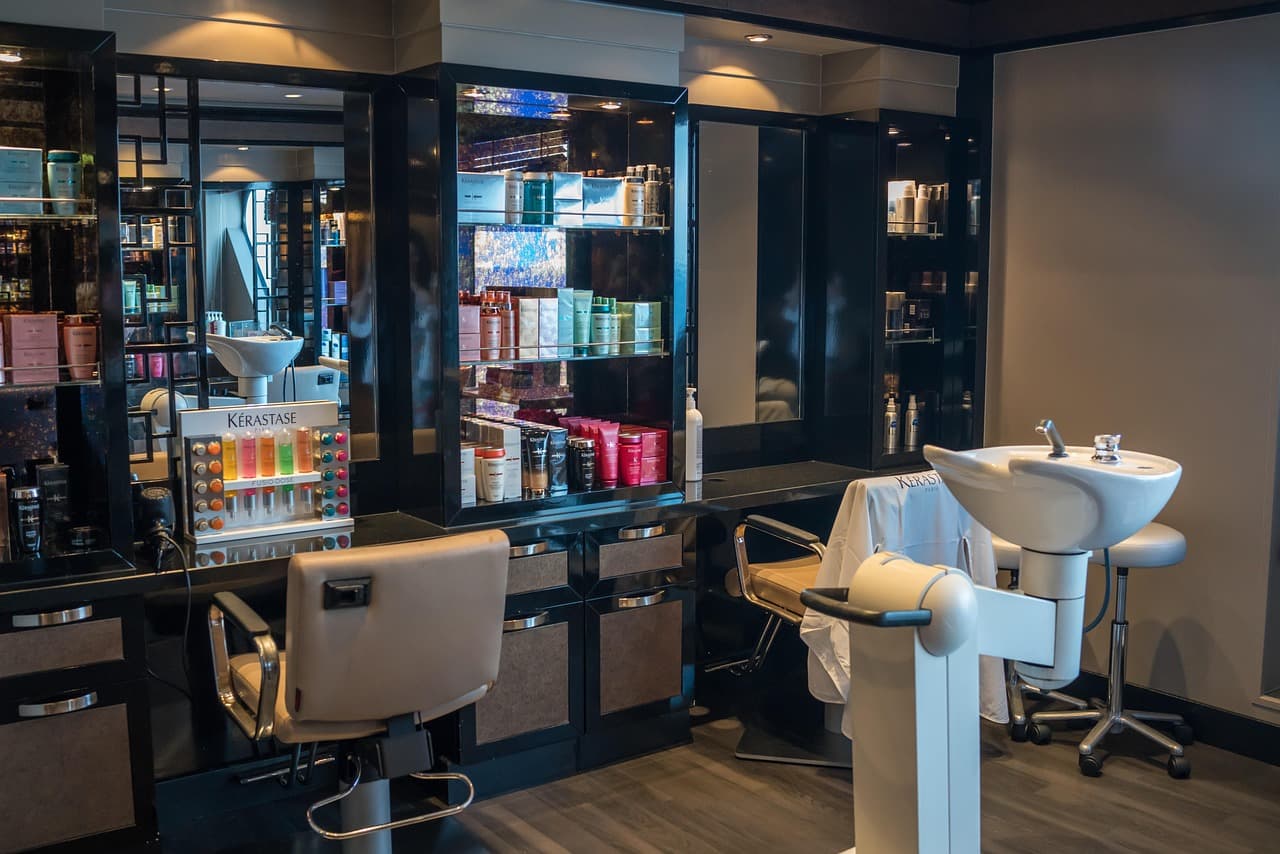
Hair salon work generates specific types of soiling absent from typical offices. Each client leaves several grams of hair on the floor—with 10–15 daily visits, that's 200–300 g of cut hair per workstation. Cosmetic products—spray lacquers, oxidizing dyes, conditioners—settle on mirrors, work surfaces, and furniture handles, creating a sticky layer difficult to remove with plain water. Hair salon sinks daily contact shampoo, conditioner, and dye residue, leaving streaks and deposits in drains.
An additional challenge is the upholstered swivel chairs made of eco-leather or fabric, requiring systematic vacuuming and disinfection. The damp environment near washing stations promotes bacterial and fungal growth—hence the necessity for biocidal agents approved by the State Health Inspectorate. Mirror and glass aesthetics are critical: clients examine their haircut in mirrors for 20–40 minutes, so every streak or fingerprint reduces the perception of professionalism.
A legally employed and insured cleaning company—such as Reefa, operating since 2020—brings not only a ready-made cleaning protocol but also liability insurance up to 500,000 PLN, protecting the salon owner against equipment damage during night cleaning. A dedicated site coordinator allows response within 24 hours if emergency cleaning is needed before industry events or health inspector visits.
How to clean a hair salon? Dividing daily and deep cleaning
An effective hair salon service model divides duties into two levels: daily cleaning performed by stylists and deep cleaning carried out by an external team.
Daily cleaning between clients
After each client, the stylist should:
- Sweep or vacuum hair from the floor around the workstation (natural brush + dustpan or cordless vacuum).
- Wipe the mirror with a microfiber cloth lightly dampened with glass cleaner (preferably ammonia-free to avoid harsh odors).
- Wipe the work surface of lacquer, foam, or clip residue—use a disinfectant based on isopropyl alcohol or quaternary ammonium compounds.
- Check the floor for longer hair strands—they often wrap around chair legs.
- Replenish disposable towels or capes in the cabinet under the workstation.
This is the minimum hygiene standard affecting the next client's comfort and preventing dirt buildup. At a 4–6 station salon, stylists spend about 3–5 minutes between appointments on daily cleaning, totaling 30–60 minutes per workday. Delegating this work exclusively to an external company is impractical given client scheduling flow.
Deep cleaning at night by external company
The cleaning team arrives after closing (usually 20:00–22:00) and performs the full scope of deep cleaning:
- Floor washing: vacuum with professional HEPA-filter equipment (capturing microscopic keratin fibers), then mop with flat microfiber and pH-neutral cleaning solution. For vinyl or resin floors—only non-abrasive products.
- Mirror and glass cleaning: two-step process—first, apply lacquer-dissolving solution, then scrub with microfiber and polish to full shine. Reefa uses "W" or "Z" patterns to prevent streaking.
- Chair and work surface disinfection: spray with biocidal agent (5–10 minutes contact time per product instructions), then rinse with damp cloth. Special attention to upholstery seams and rotating mechanisms.
- Hair salon sink cleaning: remove dye residue from ceramic using cream cleaner (no abrasive powders), descale aerators with enzymatic cleaner, and brush grout. Overflow drains flushed weekly with enzymatic solution to remove protein buildup.
- Upholstery vacuuming: chair covers, waiting area poufs, fabric blinds—vacuum with upholstery attachment. Removes dust from spray lacquers.
- Waste removal and bag replacement: segregate waste (hair and organic matter, cosmetic packaging) per local regulations.
- Supply check: toilet paper, antibacterial soap in dispensers, paper towels in restrooms.
Deep cleaning frequency depends on traffic: a 4-station salon with 30–40 daily clients needs night cleaning 2–3 times weekly; larger facilities with 8–10 stations may require daily service.
What does the health inspector require in a hair salon? Protocols and cleaning logs
The State Health Inspectorate treats hair salons as personal hygiene facilities subject to Health Ministry regulations governing sanitary and health requirements for hairdressing, cosmetic, and wellness facility premises and equipment.
Key health inspector requirements for hair salons
- Tool disinfection: scissors, combs, brushes, clippers must be disinfected after each client with virucidal and bactericidal agents or sterilized in UV-C sterilizers. UV-C exposure time: minimum 10 minutes.
- Disinfection log: notebook or electronic record where stylists document each disinfection action (date, time, product used, signature). Health inspectors review logs during inspections.
- Biocidal agents: product must hold Health Ministry approval number or EU biocidal product registry entry. Label includes usage instructions and contact time.
- Client and staff restrooms: separate or at least equipped with antibacterial soap dispensers, disposable towels, and sealed waste bins.
- Mechanical or natural ventilation: minimum 2–3 air changes hourly to remove lacquer and dye aerosols. In non-air-conditioned salons—operable windows.
- Floor and wall cleanliness: no visible soiling, stains, or hair remnants. Washable walls to at least 2 m height, ideally ceramic tile or washable latex paint.
- Pest control: absence of flies, ants, cockroaches. If detected—deratization or disinsection protocol by certified company.
Reefa, serving hair salons in Cracow and vicinity, delivers photo reports after each cleaning with QR code—the salon owner receives a push notification and can remotely verify work quality. This documentation protects against potential health inspector concerns about cleaning standards.
What are hygiene rules for hair salon work? Employer and employee responsibility
Hair salon work hygiene rules stem from both occupational safety regulations and industry sanitary standards.
Employer (salon owner) obligations
- Provide proper equipment: sterilizers, disinfectants with current expiration dates, disposable capes and towels.
- Train staff on hygiene and disinfection rules—retain training documentation for at least 5 years.
- Ensure access to personal protective equipment: nitrile gloves, aprons, masks (optional for intensive-scent dye work).
- Insure workers and register with social security—Reefa's team is legally employed and insured, setting an example for all client-facing industries.
- Conduct regular equipment inspections (dryers, sterilizers, air conditioning)—annually or per manufacturer instructions.
Employee (hairdresser, stylist) obligations
- Wash or disinfect hands before serving each client—antibacterial dispenser at workstation.
- Use clean disposable capes and towels or freshly laundered ones (minimum 60°C).
- Disinfect tools per cleaning log and salon SOP (Standard Operating Procedure).
- Maintain workstation cleanliness—sweep hair, wipe work surface.
- Report to employer cleaning product shortages or equipment damage.
Responsibility is clear: stylists maintain micro-hygiene of their workstation and tools; salon owners organize macro-hygiene of the entire facility—including outsourcing to a company like Reefa with 500,000 PLN liability insurance and a dedicated site coordinator.
What cleaning products are safe for a hair salon?
Selecting detergents and disinfectants in a hair salon must consider three criteria: effectiveness against microorganisms, safety for client and staff skin, and odor neutrality (or subtle, non-chemical fragrance).
Surface disinfectants
- 70% isopropyl alcohol—universal product for work surfaces, handles, fixtures. Evaporates quickly, leaves no residue. Drawback: flammable and drying to bare skin.
- Quaternary ammonium compounds (QAC)—broad-spectrum virucidal and bactericidal action, longer contact time (5–10 minutes). Supplied as ready-to-use solutions (e.g., Tego, Bradosol).
- 3–6% hydrogen peroxide—eco-friendly, decomposes to water and oxygen, effective against fungi and bacteria. Requires longer contact time and light-sensitive storage (dark bottles).
Floor and mirror cleaning products
- pH-neutral detergents (pH 6–8)—safe for vinyl, panels, stoneware. Don't damage paint finishes or grout.
- Ammonia-free glass cleaners—especially in non-mechanically ventilated rooms where ammonia fumes irritate client and staff eyes.
- Microfiber—300–400 g/m² for floors, 200–250 g/m² for mirrors. Reduces chemical use by 30–50% vs. traditional mops.
Hypoallergenic and eco-friendly solutions
More premium salons choose certified products marked with eco-labels (EU Ecolabel, Nordic Swan). They contain no phosphates, chlorine, or synthetic fragrances, minimizing contact allergy risk for sensitive-skin clients. Reefa defaults to hypoallergenic products in medical facilities, where safety requirements are even stricter—we apply the same standard to hair salons.
How much does hair salon cleaning cost? 2026 prices in Cracow and Katowice
Cost of regular cleaning service depends on area, visit frequency, scope, and location.
Estimated pricing for Cracow and Katowice market (2026, net amounts)
- 50–80 m² salon (4–6 stations, waiting area, client restroom): 800–1500 PLN monthly for 2–3 weekly after-hours visits.
- 80–120 m² salon (7–10 stations, two rooms, color station): 1500–2400 PLN monthly for 3–5 weekly visits.
- One-time intervention (post-renovation, post-painting, major industry event cleaning): 400–700 PLN per visit depending on condition.
For comparison: hiring a part-time cleaner (4 hours × 3 days weekly) in 2026 costs approximately 2000–2500 PLN gross monthly (about 1500–1850 PLN net + social security), plus the employer must provide leave, sick leave, and equipment. Outsourcing eliminates administrative burden and transfers risk to the partner's insurer (500,000 PLN liability for Reefa).
What affects hair salon cleaning cost?
- Floor type: panels, stoneware, vinyl—standard; marble, designer tarkett—higher cost due to specialized products.
- Number of mirrors and glass: floor-to-ceiling glass walls and mirrors require more time and microfiber cloths.
- Color station: dedicated dye application area with mixer needs daily cleaning to prevent dry dye buildup on surfaces and sink.
- Service hours: night cleaning (21:00–1:00) may carry 10–15% surcharge for off-hours work.
- Add-on services: steam upholstery cleaning, air conditioning cleaning (filter replacement/cleaning), exterior window washing—offered as à la carte options.
Comprehensive hair salon service packages in Katowice and Cracow are available through Reefa's team. We prepare quotes within 24–48 hours of a site visit—a dedicated coordinator can visit, measure areas, and agree on scope at your convenience.
Hair salon cleaning and brand image: the client's first impression
In the beauty industry, the first 30 seconds determine the client's perception of professionalism. A client enters, looks around—assesses floor shine, room fragrance, waiting area mirror cleanliness. If they spot floor hair, a chair stain, or mirror streaks, they subconsciously lower trust in stylist competence, even if those stylists hold master certifications.
Consumer psychology research shows that environmental aesthetics and cleanliness influence client willingness to accept higher service prices. A salon maintaining consistently high cleanliness standards can charge 15–25% more for cutting or coloring than competitors because the client pays for a premium experience, not just the hair outcome.
Regular service by a cleaning company—especially one delivering photo reports and QR-code notification systems—gives the owner full control and peace of mind. Before surprise health inspector visits or potential franchisor meetings, the salon is always ready to present.
Working with us: how Reefa serves hair salons
Reefa has served hair salons since 2020 in Cracow and since 2024 in Katowice, using a dedicated coordinator and consistent team model.
Implementation stages
- Site visit: Reefa coordinator meets the salon owner, measures area, assesses floor type, mirror quantity, station count, and specific challenges (e.g., color station with mixing sink).
- Quote and schedule: within 24–48 hours, we send an offer with proposed visit frequency, task scope, and net monthly cost. We adjust schedule to salon closing times.
- Cleaning protocol: we jointly establish a checklist for each visit—e.g., "two-step polish station 3 mirror," "enzymatic drain flush Friday in sink 2."
- Service launch: the coordinator accompanies the team during the first week to ensure all details are understood.
- Photo reports and communication: after each cleaning, the salon owner receives a push notification with a photo-report link. Any concerns are reported via QR system—response time under 24 hours.
- Quarterly review: every 3 months the coordinator visits to discuss service quality, schedule changes, or scope expansions (e.g., add steam upholstery cleaning).
Safety and insurance
Reefa's team is legally employed and insured—all staff have current medical clearances, occupational safety training, and (for medical facilities or RODO-subject environments) privacy training. Liability insurance up to 500,000 PLN protects the salon owner against accidental equipment damage—hydraulic chairs, stationary dryers, LED-lit mirrors.
Frequently asked questions
How do I clean a hair salon to avoid health inspector fines?
Consistency and documentation are essential. Keep a tool disinfection log (date, time, product, stylist signature), use biocidal agents with Health Ministry approval numbers, disinfect chairs and work surfaces after each client, sweep hair regularly, and ensure deep cleaning by an external company at least twice weekly. Health inspectors assess not just cleanliness at inspection but also documentation completeness—logs, product certificates, staff training records. If your salon has a UV-C sterilizer, monitor bulb life regularly (replace every 8000–10,000 hours). Photo reports with QR codes from Reefa after each cleaning provide additional proof of systematic service, helpful if disputes with authorities arise.
What are employee hygiene responsibilities in a hair salon?
Stylists are responsible for daily workstation hygiene: sweep or vacuum hair after each client, disinfect tools (scissors, combs, clippers) per protocol, clean mirrors and work surfaces of cosmetic residue, use clean disposable capes and fresh or recently laundered towels. Before the next client, the stylist should disinfect or wash hands. Employees must report cleaning product shortages and equipment damage to the owner. Overall salon hygiene standards remain the owner's legal responsibility—employees execute employer-established procedures, so clear training and written procedures documented in work rules are critical.
How does hair salon cleaning differ from office cleaning?
Hair salons require removal of specific organic soiling—hair that sticks to damp floors, cosmetic product residue (lacquers, dyes, gels) settling on mirrors and work surfaces, and deposits in salon sinks from shampoo and conditioner. Offices mainly have dust, crumbs, and fingerprints. Additionally, salons are regulated as personal hygiene facilities by the State Health Inspectorate—biocidal agents, tool sterilization, and disinfection logs are mandatory. Cleaning frequency is higher: offices need 2–3 weekly visits; medium-traffic salons require 3–5 night visits weekly plus constant daily maintenance between clients. Finally, mirror aesthetics are critical to salon image—in offices, mirrors are mainly in restrooms.
Must cleaning companies have certifications to serve hair salons?
Polish law doesn't formally require specialized salon-cleaning certification, but salon owners should verify several conditions. First, the team must be legally employed and insured (social security, employment contract, or B2B with health coverage)—protecting you from work-injury liability. Second, the company should carry liability insurance (Reefa's up to 500,000 PLN) covering property damage. Third, verify the company uses biocidal-approved products—homemade cleaners without certification don't meet health inspector standards. Good signals include beauty or medical industry references and a photo-reporting/quality-tracking system proving professional accountability and documentation practices.
How often should mirrors be cleaned in a hair salon?
Mirrors at styling stations need cleaning after each client—at least a light wipe with microfiber to remove fresh lacquer spray or fingerprints. Full two-step cleaning (solution + polish) should occur during night deep cleaning, 2–3 times weekly for medium-traffic salons, daily for large ones with 8–10 stations. Waiting area and restroom mirrors can be cleaned less frequently—daily or every other day. The technique matters: apply ammonia-free glass cleaner, work in "W" or "Z" motions, then polish dry with microfiber to prevent streaking. Premium salons with floor-to-ceiling mirrors and LED backlighting benefit from professional service—Reefa uses 200–250 g/m² microfiber and products leaving a streak-free shine.
What's the cost of one-time hair salon cleaning after renovation?
Post-renovation or modernization cleaning is an intervention service, priced 400–700 PLN net depending on area and soiling level. Scope includes removing construction dust from floors, furniture, mirrors, and windowsills, washing plaster and paint marks from tiles, interior window washing, vacuuming furniture and flooring, disinfecting all touch surfaces, and removing renovation waste (boxes, protective films). For severe contamination—new floors, ceiling/wall painting—a second finalization visit may be needed, raising cost to 800–1000 PLN net. Reefa offers post-renovation cleaning and post-construction cleaning in Cracow and Katowice—a 2–4 person team can prepare a salon for opening in one workday, including a photo report confirming readiness.
Need regular cleaning service for a hair salon in Cracow or Katowice? Contact Reefa's team—we prepare site visits and quotes within 48 hours. A dedicated coordinator, photo reports after every cleaning, and 500,000 PLN liability insurance guarantee peace of mind and professionalism. Request a quote via our contact form or call directly.