Cleaning After Installation Work — Contamination Scale & Tools
Hydraulic, electrical, and ventilation system replacements leave distinctive contamination—from gypsum dust to metal shavings. Learn how to clean effectively after such work.
Hydraulic, electrical, and ventilation system replacements leave distinctive contamination—from gypsum dust to metal shavings. Learn how to clean effectively after such work.
Cleaning after electrical, hydraulic, gas, or ventilation system replacements demands specialized expertise and tools that handle gypsum dust, metal shavings, greases, and fine construction debris. Depending on the scale of work—from a 50 m² apartment needing electrical rewiring to a 200 m² office undergoing HVAC installation—a team of 2–3 workers may require anywhere from 4–6 hours to a full working day.
Installation work differs from standard construction cleanup in that localized intervention creates highly concentrated yet specific contamination. You typically encounter mineral dust from chasing conduits, greasy marks from pipe assembly, small metal and plastic elements—each requiring a different removal method. The Reefa team has been executing post-installation cleaning projects in Cracow since 2020, and in Katowice since 2024, applying protocols aligned with occupational safety standards for office buildings, medical facilities, and residential communities.
Key points
- Installation replacement leaves gypsum/cement dust, greases, metal shavings, and fine assembly elements
- Industrial vacuum with HEPA filter stops particles <0.3 µm, including metal fines and mineral dust
- Magnets, carbon fiber brushes, and steam mops (≥100°C) complete the tool kit
- 50 m² apartment after electrical work: 4–6 hours; 200 m² office after HVAC installation: 1 full working day for a 2–3 person crew
- Rates in Cracow and Katowice: 800–1,200 PLN net for a 50 m² apartment; 2,500–3,500 PLN net for a 200 m² office (2026)
- Professional teams provide a dedicated site coordinator, photo reports, and public liability insurance up to PLN 500,000
What contaminants arise during installation replacement?
Each installation type leaves a characteristic trace. Electrical rewiring produces mainly gypsum and cement dust from wall grooves, plastic debris from conduits, and minor scratches. Hydraulic installation adds greases, assembly compounds, and silicone sealant smudges. Air conditioning or mechanical ventilation further generates dust from drilling holes in ceilings and exterior walls—often autoclaved aerated concrete, which exhibits high dust generation.
A second contamination level is secondary dust redistribution. Workers moving through the space carry mineral particles and metal shavings on their footwear, which spread to corridors, stairwells, and even neighboring rooms. Experience from Reefa's post-renovation cleaning in Cracow shows that secondary zones can account for up to 30% of the total area requiring cleaning.
In Class A properties—offices, medical centers—microbiological requirements apply: mineral dust may serve as a substrate for microorganisms, making not only mechanical removal but also surface disinfection essential.
Specific materials and their traces
Copper pipes leave oxide smudges on floors that adhere strongly to grout and panels. Aluminum conduits produce powdery deposits that suspend easily in air. PVC-coated electrical cables require separate scrap segregation—coordination with electrical subcontractors ensures cable waste enters the correct recycling stream.
Construction films, masking tapes, and LDPE covers often remain glued to surfaces, requiring alcohol-based solvents or citrus-based cleaners—always in compliance with GDPR regulations and standards for enclosed spaces.
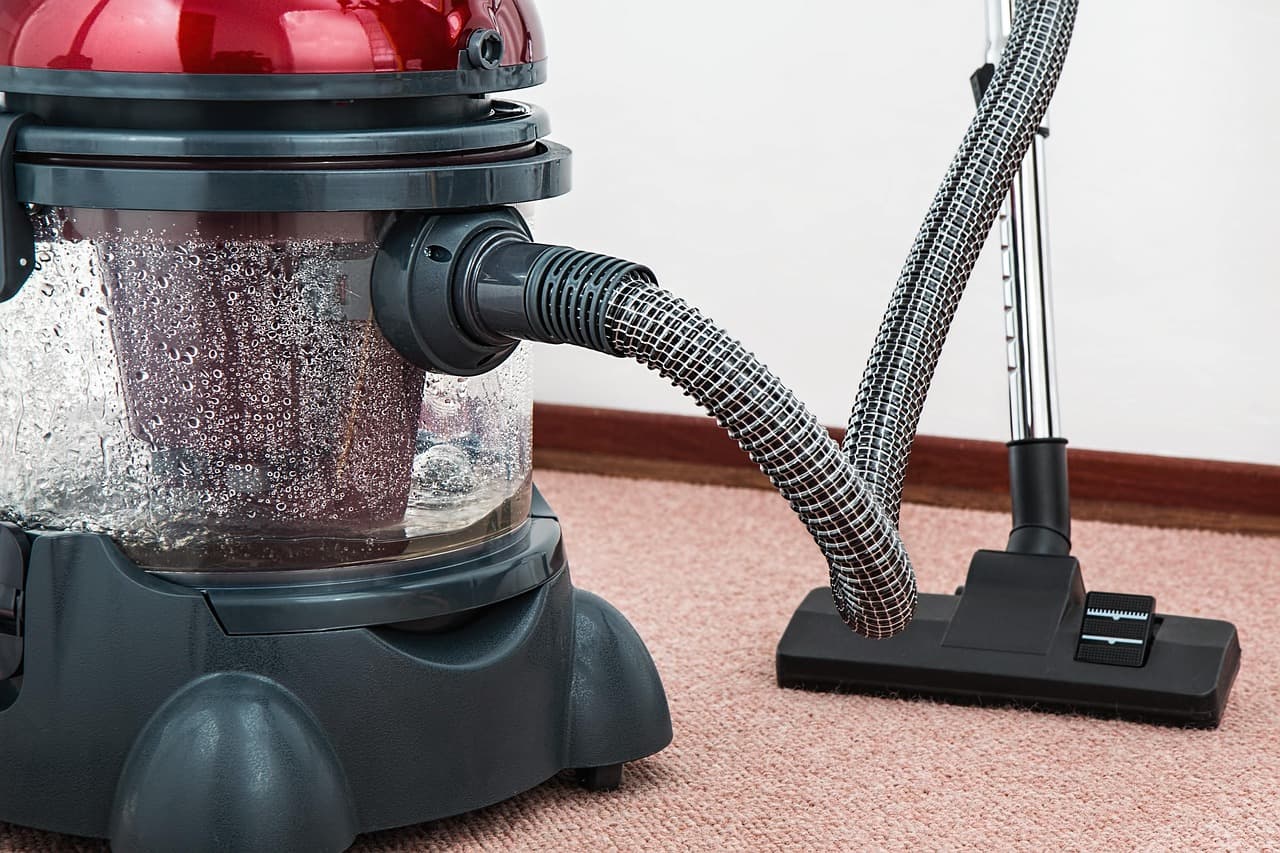
Industrial vacuum with HEPA filter—core equipment
A standard domestic vacuum cannot handle construction dust: its filters clog within minutes, the motor overheats, and fine metal particles risk damaging the impeller. An industrial vacuum of class L or M (per EN 60335-2-69 standard) fitted with HEPA H13 or H14 filter retains ≥99.95% of particles ≥0.3 µm in diameter.
In practice, the Reefa team uses devices with suction power ≥250 AW (Air Watt) and tank capacity of 30–50 liters. For installations involving gas or electrical systems, we perform additional antistatic housing checks to prevent sparking near metal shavings. Carbon fiber brushes in suction tips further minimize damage to newly installed outlet boxes and trim strips.
Average industrial vacuum runtime for a 50 m² apartment: 1.5–2 hours net, assuming one tank emptying midway through the cycle.
Additional mechanical techniques
Metal shavings, especially from threading steel pipes, are efficiently collected using neodymium magnets on telescopic poles. A single pass over flooring or tile grout captures 70–80% of ferromagnetic debris. This solution proves particularly valuable in spaces with textile flooring—metal contamination can cause rust stains and discoloration in contact with moisture.
Steam mops with vapor temperature ≥100°C are deployed only after mechanical removal of the main dust mass. Steam effectively dissolves greases and assembly compounds while disinfecting surfaces—a method especially important in medical facilities, where HVAC replacement must maintain microbiological standards.
How much time and personnel for specific areas?
Completion time depends on three variables: floor area, installation type, and containment level of the work zone. Below are indicative timeframes from Reefa's experience—for properties in Cracow and Katowice, 2026.
50 m² apartment after electrical installation replacement
Typical scope: grooves in 3–4 rooms, new outlet boxes, panel upgrade. Contamination: gypsum dust, cable remnants, spackling residue.
→ 1–2 person crew, 4–6 hours.
200 m² office after HVAC installation (indoor units, refrigerant lines, condensate drainage)
Contamination: suspended ceiling penetrations, concrete dust, grease from quick couplers, carpet flooring (added challenge).
→ 2–3 person crew, 1 full working day (8 hours).
4-story apartment building, water and sewage riser replacement
Contamination dispersed: corridors, stairwell, inter-floor penetration points. Higher ceramic rubble, cement dust, sealant smudges.
→ 3–4 person crew, 2 working days.
Our post-renovation cleaning offering in Katowice also covers larger facilities—schools, health centers—where heating or electrical system replacement may span weeks, requiring cyclical cleaning interventions.
Step-by-step execution protocol
- Initial inspection with coordinator — QR photo reports document pre-work condition (available for all Reefa assignments since 2020).
- Waste segregation — electrical waste (cables, boxes), construction (rubble), and municipal waste separated per Waste Act.
- Rough vacuuming — removal of primary dust mass, including particles >1 mm.
- Precision HEPA vacuuming — airborne dust, metal fines, cabinet and drawer interiors.
- Wet surface cleaning — steam mops or alkaline agents (pH 8–10) on greases.
- Final inspection and photo reports — before handover protocol signature.
Actual cleaning rates after installation replacement, 2026
Pricing depends on floor area, contamination severity, media access (water, power during work), and location. Rates below apply to Cracow and Katowice, net values.
| Property type | Area | Scope | Net rate (2026) |
|---|---|---|---|
| Apartment | 50 m² | Electrical rewiring in 3–4 rooms | 800–1,200 PLN |
| Apartment | 80 m² | Hydraulic replacement (bathroom, kitchen) | 1,200–1,600 PLN |
| Office/clinic | 100 m² | HVAC installation (2–3 units) | 1,500–2,200 PLN |
| Office | 200 m² | Full LED lighting upgrade + structured cabling | 2,500–3,500 PLN |
| Residential community | 4-level stairwell | Riser replacement, corridors | 2,000–3,000 PLN |
Every quote includes public liability insurance up to PLN 500,000 and a dedicated on-site coordinator—standard practice at Reefa since inception. For recurring contracts (e.g., residential communities undertaking phased modernization), we offer subscription packages with preferential rates.
How individual quotations are prepared
Our team conducts video or in-person inspection (in Cracow and Katowice, travel time included in price). We assess:
- Construction rubble volume for removal (if in scope)
- Flooring type (PVC, panels, carpet, tiles)
- Elevator and evacuation route access for equipment
- Microbiological requirements (medical facilities, childcare)
For residential communities and apartment blocks, we also provide community cleaning services in Cracow, where installation replacement is just one element of cyclical facility management.
How post-installation cleaning differs from standard post-construction cleaning
Installation work is localized and invasive—concentrated in specific zones (conduit routes, fixture assembly points) but demands high precision. Post-construction cleaning (learn more about post-construction cleaning) typically involves the entire volume with thick dust layers, mortar remnants, and plastic sheeting.
After installation replacement, finishing details matter: clean trim strips, no smudges on tiles around radiators, removal of masking tape adhesive marks. Class A offices also expect window and glass partition cleaning, which may have been soiled during ceiling work.
Another aspect is preserving operational functionality. An apartment or office after electrical rewiring is often inhabited or in use the next day—we must ensure complete cleanliness with minimal noise and without strong-smelling agents (potential allergens).
Health & Safety and GDPR in occupied premises
Per occupational safety regulations, vacuuming above 85 dB requires zone warning signs. Our team—formally employed and insured—undergoes training for work in inhabited spaces, including access protocols for enclosed areas and personal data protection (GDPR) in medical and educational facilities.
For clients such as Diamed (medical center), we apply additional protocols: aseptic zones require only bactericidal and fungicidal agents, and cleaning staff wear disposable protective apparel in designated rooms.
Magnets, brushes, steam mops—complete tool set
Below is the complete list of tools deployed by Reefa for post-installation cleaning (as of 2026):
- Industrial vacuum 1400–1600 W with HEPA H13 filter, dust class M, tank ≥30 l
- Neodymium magnet on telescopic pole 80–120 cm — iron shavings, lost fasteners
- Steam mop 1500 W, vapor temperature ≥100°C — greases, compounds, disinfection
- Carbon fiber brushes — vacuum tips, electrostatic charge elimination
- Microfiber cloths density ≥300 g/m² — smooth surfaces, glass, laminates
- Alkaline agents pH 8–10 — grease removal, silicone sealant residue
- Citrus-based cleaners (d-limonene) — masking tape adhesive remnants
- Cyclone dust separators — pre-filter coarse dust before HEPA (extends filter life)
Some tools—particularly industrial vacuums with power tool sockets—enable synchronized work: dust capture during groove cutting. Reefa does not employ this method, preferring phase separation: first dirty work (installer), then rough cleaning, then finishing trades (painter, electrician installing fixtures) and final cleaning.
Chemical agents and environmental standards
For properties with BREEAM, LEED, or Well Building certifications, we use only EU Ecolabel or Nordic Swan products. In practice, this means preparations >90% biodegradable in 28 days (OECD 301 test) and phosphate-free. For industrial grease removal, we employ ester-based emulsifiers that leave no lasting marks on flooring.
Who cleans after installation work—in-house crew or subcontractor?
The market offers three models:
- Installer with "cleaning included" — typically minimal scope, no specialist tools. Results often need supplementation.
- Ad hoc cleaning firm — one-off assignment, no work schedule coordination, site access must be negotiated.
- Professional B2B cleaning firm with renovation experience — Reefa Sp. z o.o. fits this category: since 2020 we execute post-renovation and post-construction assignments in Cracow, and since 2024 in Katowice, always with photo reports and dedicated coordinator.
For facility managers overseeing commercial buildings, it is essential that the cleaning firm have experience in occupied spaces. Implementing a QR ticketing system (Reefa standard) allows space users to report issues in real time—e.g., overlooked dust in an electrical cabinet or smudges on corridors.
Collaboration with a general contractor (GC) sometimes raises liability questions: does damage to a newly installed system during cleaning rest with the GC or the cleaning firm? Public liability insurance up to PLN 500,000, which Reefa holds, protects both parties—covering material damages and third-party property loss.
How much do post-renovation cleaning rates run? (People also ask)
Post-renovation cleaning rates—including after installation replacement—in 2026 in Cracow and Katowice range from 15 to 35 PLN net per m², depending on contamination severity and work scope. For small apartments (50–80 m²), a flat rate is often used to avoid difficulty assessing complexity level.
Typical billing:
- Light contamination (dust only, no rubble) → 15–20 PLN net/m²
- Moderate contamination (dust, greases, fine elements) → 20–28 PLN net/m²
- Heavy contamination (rubble, mortar traces, waste removal required) → 28–35 PLN net/m²
Every Reefa quote adds travel costs within Cracow and Katowice (up to 15 km from city center included), as well as insurance and coordinator supervision. Discounts for residential communities signing cyclical common-area cleaning contracts—up to 15% on assignments >12 months.
Frequently asked questions
How much do post-renovation cleaning rates run?
Post-renovation cleaning (including after installation replacement) costs 15 to 35 PLN net per m² depending on contamination severity and surface type. For a 50 m² apartment after electrical rewiring, the flat rate is 800–1,200 PLN net; for a 200 m² office after HVAC installation, 2,500–3,500 PLN net (Cracow, Katowice, 2026). Pricing includes flooring type, rubble removal, and timing requirements (weekend or nighttime work adds 20–30%). Reefa provides a dedicated coordinator, QR photo reports, and public liability insurance up to PLN 500,000 in every quote.
What is the best way to clean after renovation?
The most effective tool is an industrial vacuum class L or M with HEPA H13 filter, which retains ≥99.95% of particles ≥0.3 µm—including metal fines and mineral dust. For ferromagnetic shaving removal, use neodymium magnets on telescopic poles; for greases and assembly compounds, steam mops at ≥100°C. Standard domestic vacuums are not recommended, as their filters clog within minutes and fine metal particles can damage the motor. Additionally, use alkaline agents (pH 8–10) on oily surfaces and citrus-based preparations to remove masking tape adhesive residue.
Who cleans after renovation?
Specialized cleaning firms with post-construction or post-renovation experience handle post-work cleaning, equipped with industrial HEPA vacuums, steam mops, and agents for specific debris (greases, compounds, adhesives). Reefa Sp. z o.o. has executed such projects in Cracow since 2020 and in Katowice since 2024, always with a dedicated coordinator, QR photo reports, and public liability insurance to PLN 500,000. While some general contractors include cleaning in their package, it is usually basic scope—a professional B2B firm guarantees higher standards, GDPR/OSH compliance, and punctuality.
Do I need to report electrical installation replacement in an apartment?
Per the Minister of Infrastructure Regulation on technical building conditions, rewiring a residential unit does not require municipal notification if you are not changing connection capacity or main panel layout. If work includes capacity changes or affects building common areas (e.g., riser replacement in a tenement), community consent and potential utility company notice are needed. Always obtain a measurement and inspection certificate from a licensed electrician after electrical work (per standard PN-HD 60364), documenting compliance with occupational safety and fire-prevention rules. From a cleaning perspective, the electrical system handover protocol must be signed before final cleaning to avoid liability disputes if defects are later discovered.
How long does cleaning take after electrical installation replacement in an apartment?
In a standard 50 m² apartment where electrical rewiring spans 3–4 rooms (wall grooves, new outlet boxes, panel upgrade), cleaning takes 4–6 hours with 1–2 workers. Time includes rough vacuuming (main dust removal), precision HEPA vacuuming, debris and element collection, wet surface cleaning, and final inspection with photo report. If carpet flooring or furniture movement is needed, duration may extend to 7–8 hours. For a 100 m² office with HVAC installation (ceiling penetrations, refrigerant lines), a full working day (8 hours) with a 2–3 person crew is typical.
Can I clean after installation work myself?
Self-cleaning after installation replacement is technically possible but requires specialist equipment—a domestic vacuum will not retain fine mineral and metal particles, and secondary airborne redistribution can persist for weeks. Gypsum dust is hygroscopic and forms stubborn coatings on grout and panels when combined with moisture. Most homeowners lack steam mops (essential for greases) or magnets for metal shavings. A professional cleaning firm, like Reefa, also provides public liability insurance (PLN 500,000) should newly installed systems be damaged—self-work places that risk on the owner. From a time and cost perspective, hiring a professional crew (from PLN 800 net for 50 m²) is usually more economical than purchasing or renting equipment and spending a weekend.
Summary—why trust a professional team
Installation replacement is an investment raising property value and safety—it deserves professional finishing, including premium-level cleanliness. The Reefa team has specialist tools (industrial HEPA vacuums, steam mops, magnets), occupational safety and GDPR protocols, public liability insurance to PLN 500,000, and QR photo reports enabling transparent documentation of each phase.
We operate in Cracow since 2020 and Katowice since 2024, serving both residential clients (apartments, tenements) and B2B (Class A offices, medical facilities like Diamed, residential communities). A dedicated coordinator oversees each project, synchronizing schedules with installation crews and ensuring handover without defect claims.
Contact the Reefa team for an individual quote—in Cracow and Katowice, response time to inquiries is <24 hours. More information on the full range of services is available on our post-renovation cleaning in Cracow and post-renovation cleaning in Katowice pages.