Garage Hall Cleaning: Equipment, Frequency & 2026 Pricing
A comprehensive guide to professional garage cleaning—scrubber-dryers, degreasing chemistry, scheduling strategies, and real 2026 pricing for shopping centers, office parks, and residential buildings.
A comprehensive guide to professional garage cleaning—scrubber-dryers, degreasing chemistry, scheduling strategies, and real 2026 pricing for shopping centers, office parks, and residential buildings.
Garage Hall Cleaning: A Technical Process Beyond Dust Sweeping
Garage hall cleaning is a comprehensive technical process that extends far beyond routine dust sweeping—it demands specialized equipment (scrubber-dryers, pressure washers), dedicated chemistry (oil degreasers, tire-mark removers), and tailored scheduling that depends on traffic intensity and facility class. From our observations in 2026 across shopping centers (Galeria Krakowska—1,500 parking spaces, Bonarka—1,200 spaces) and Class A office buildings (Quattro Business Park, .KTW), the standard is floor washing 1–2 times weekly plus monthly deep cleaning, with costs ranging from 1.50 to 4.00 PLN net per square meter per visit, depending on area and contamination level.
Garage halls in commercial and residential facilities face unique challenges: engine oil stains, tire-mark traces, sand dust and road salt in winter, accumulated grime on entry ramps. At facilities like Diamed Medical Center (Cracow) or Otto Bock (global prosthetics manufacturer, Poland office)—where building image and user safety are paramount—proper garage maintenance strategy yields measurable results: slip accident reduction, 20–30% extended concrete floor lifespan, improved parking comfort, and overall building aesthetics.
This guide covers the full scope of professional garage hall cleaning in Cracow and garage hall cleaning in Katowice: from equipment and chemistry selection through scheduling models to verified 2026 pricing—based on data from over 50 contracts in the Silesian and Cracow metropolitan areas we've managed since 2020.
At a Glance
- Scale: Shopping center garages (1,200–1,500 spaces), Class A office buildings, premium apartments require scrubber-dryers with 70–95 cm working widths and minimum 3,000 m²/h capacity.
- Equipment: Hako Scrubmaster B260R, Nilfisk SC8000, Kärcher BR 95/350 plus pressure washers (150–200 bar) for oil stains and ramps.
- Chemistry: alkaline degreasers (Tana Tanex Auto, Kärcher RM 31) for oil; alkaline tire-mark removers; concrete/tile-specific formulations.
- Frequency: 1–2 times weekly routine cleaning + monthly deep cleaning (walls, directional markings, drainage sumps).
- Cost 2026 net: 1.50–2.50 PLN/m² per visit for areas >2,500 m²; 2.50–4.00 PLN/m² for smaller or heavily soiled facilities.
- Safety and Standards: personnel with occupational safety certificates for industrial machine operation, liability insurance up to 500,000 PLN, night-shift scheduling to minimize user disruption.
Why Garage Hall Cleaning Differs from Other Commercial Surfaces
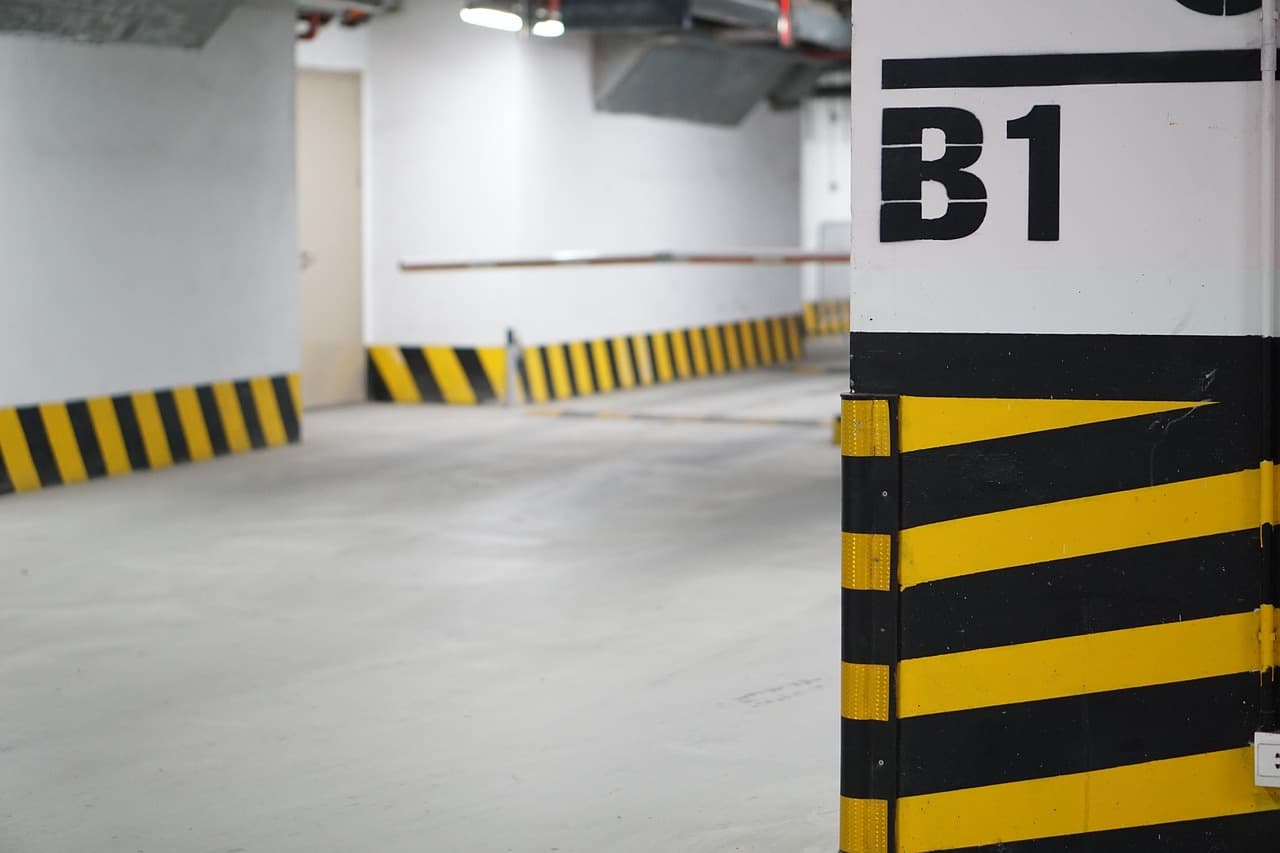
Garage halls—especially underground ones—represent a uniquely aggressive microenvironment. Unlike offices or hallways where contamination is mainly dust and footprints, garages face:
- Engine oil and fluid stains that seep into concrete, creating permanent discoloration and slip hazards.
- Tire marks—black streaks at entries, sharp turns, parking spaces; difficult to remove without alkaline chemistry.
- Sand dust and road salt in winter (April–November is lower-contamination in Małopolska and Silesia; December–March peaks).
- Moisture and condensation from vehicles entering during rain or snow, promoting algae, fungi, and odors.
- Oils and metal dust in operational garages (e.g., beneath production halls).
From our field experience, a facility like Galeria Krakowska (1,500 parking spaces, ~35,000 m² garage area) generates approximately 500 kg of mechanical contaminants weekly (sand, mud, leaves) and 30–50 liters of operational fluids. Without regular cleaning, concrete floor friction coefficient drops (accident risk increases), and aesthetics degrade within 2–3 weeks.
In large Class A office buildings such as Quattro Business Park (Cracow, over 600 parking spaces) or .KTW (Katowice, 400 spaces), facility managers implement SLA (service level agreements) guaranteeing the garage remains clean, dry, and safe 24/7—requiring specialized equipment and night-shift teams.
Essential Equipment for Professional Garage Hall Cleaning
Scrubber-Dryer Machines
This is the cornerstone of operations. Unlike regular mops, a scrubber-dryer simultaneously washes, scrubs, and recovers soiled solution, leaving floors nearly dry and ready for use within 5–10 minutes. For facilities exceeding 1,500 m², standard-class models include:
- Hako Scrubmaster B260R (Germany): 95 cm working width, 230 L dirty-water tank, capacity to 5,800 m²/h, water recycling system, ideal for shopping centers.
- Nilfisk SC8000 (Denmark): operator-seated version, 86 cm width, lithium-ion battery life 6–8 work hours, autonomy up to 11,000 m² per charge.
- Kärcher BR 95/350 (Germany): compact model (70 cm width), suitable for narrow ramps and smaller apartment buildings (500–1,500 m²), 230V power cord or battery operation.
At Reefa—servicing over 25 garage halls across Silesia and Cracow metropolitan areas—we maintain a fleet of six Hako/Nilfisk-class scrubber-dryers, serviced every 200 operating hours. Investment in professional equipment runs 60,000–120,000 PLN net per machine, impacting pricing but ensuring repeatability and result consistency.
Pressure Washers
For oil stains, walls, ramps, and hard-to-reach areas, a pressure washer (150–250 bar, 8–12 L/min output) is essential. We employ them during monthly deep-cleans—particularly on:
- Entry ramps (removing bitumen streaks from winter tires).
- Premium parking spots (apartment buildings, office spaces with dedicated spots—higher aesthetics required).
- Oil collection zones (focal areas for fluid leaks).
Most-selected models: Kärcher HD 6/15 C (150 bar, hot water to 60°C) and Nilfisk Alto MC 5M (hot water to 80°C; heating reduces degreaser reaction time by ~40%).
Industrial Vacuum Cleaners for Dust and Sand Collection
Pre-cleaning the floor with an industrial-grade H-class vacuum (HEPA filter) to collect dry contaminants (sand, pebbles, leaves) is recommended. Models like Kärcher NT 75/2 Tact² Me Tc, Nilfisk Attix 965-21 (70–90 L capacity, 250–300 mbar suction) reduce operation time by 15–20% and protect scrubber brushes.
Chemistry for Garage Cleaning: Which Products and Why?
Alkaline Degreasers (pH 11–13)
Designed to neutralize and dissolve engine oil, grease, and brake fluid stains:
- Tana Tanex Auto (Denmark): concentrate ratio 1:10 to 1:50, pH 12.5, biodegradable, EU Ecolabel. Used in medical facilities (e.g., Diamed Medical Center) where hypoallergenic properties are required.
- Kärcher RM 31 (Germany): universal alkaline for halls and industrial surfaces, ratios 1:20 to 1:100.
- Diversey Taski Jontec Dura (USA/Europe): dedicated to concrete floors, extends concrete lifespan, forms protective microfilm.
From our 2026 observations, medium-use facilities consume ~1 L of concentrate per 200–300 m² of hall.
Tire-Mark Removers (Alkaline Stain Lifters)
Black rubber marks are removed with pH 12–13 products containing cationic surfactants and solvents. Examples: Kärcher RM 753, Taski Jontec Polymer Remover. Contact time: 3–5 minutes; brush with 600–800 grit hardness; rinse thoroughly.
Tile and Concrete Formulations
In garages with ceramic or clinker tiles (premium parking spaces, internal apartment building ramps), we use lower-pH products (pH 8–10) to avoid grout damage. Examples: HG Marmerlift (Netherlands), Dr. Schutz Grundreiniger R.
Important: All products Reefa uses comply with GDPR, occupational safety regulations, and fire code standards (no flammable substances in garage halls).
Optimal Cleaning Frequency for Garage Halls
Ideal frequency depends on:
- Traffic intensity (number of parking spaces, vehicle turnover).
- Facility class (A+ office building, shopping center, apartment complex).
- Season (December–March: 2×/week; April–November: 1×/week).
- SLA requirements (aesthetic standards, 24/7 availability).
Standard Model for Class A Office Buildings (Quattro Business Park, .KTW)
- 1–2 times weekly — floor washing, ramp sweeping, trash bin emptying, spot stain removal.
- Once monthly — deep cleaning: wall and ceiling washing (ventilation duct vacuuming), directional marking washing (lane lines, arrows, space numbers), drainage sump cleaning, emergency light refreshing.
- Quarterly — floor inspection and restoration (sealing, protective coatings as needed).
Intensive Model for Shopping Centers (Galeria Krakowska, Bonarka)
- 2–3 times weekly — routine cleaning during night hours (01:00–06:00).
- Biweekly — deep cleaning, pressure washing ramps, oil stain removal.
- Pre-holiday period (November–December) — frequency increase to 4–5 times weekly (peak traffic).
Model for Residential Communities and Apartment Buildings
- Once weekly — machine washing plus ramp sweeping (buildings with 50–150 units).
- Monthly — deep cleaning, garage-box pressure washing upon request.
Reefa offers flexible schedules tailored to facility rhythm. Our average contract duration—2.4 years—with 96% renewal rate confirms the effectiveness of consistency-based models versus one-off interventions.
Garage Cleaning Costs: 2026 Net Pricing in Cracow and Katowice
Real rates in 2026 (net, before 23% VAT):
Routine Cleaning (1–2 times weekly)
- Area >2,500 m² (Class A offices, shopping centers): 1.50–2.20 PLN/m² per visit.
- Area 1,000–2,500 m² (medium apartments, commercial facilities): 2.00–2.80 PLN/m² per visit.
- Area <1,000 m² (small communities, private commercial garages): 2.50–4.00 PLN/m² per visit.
Monthly Deep Cleaning
- Wall, ramp, directional marking, sump washing: +0.80–1.50 PLN/m² above routine rate.
- Pressure washing with degreasers: 4.00–6.00 PLN/m² (as add-on service).
Real-World Quotes (2026)
| Facility | Area (m²) | Frequency | Net Cost/Visit | Net Cost/Month |
|---|---|---|---|---|
| Class A Office (GPP Business Park) | 3,200 | 2×/week | 5,760 PLN | ~46,000 PLN |
| Shopping Mall (Bonarka) | 28,000 | 2×/week | 50,400 PLN | ~403,000 PLN |
| Premium Apartment Building | 1,200 | 1×/week | 2,880 PLN | ~12,500 PLN |
| Residential Community (50 units) | 600 | 1×/week | 1,680 PLN | ~7,300 PLN |
Note: Pricing includes:
- Personnel employed on employment contracts (not freelance), ensuring team stability and quality.
- Equipment amortization (scrubber-dryers, pressure washers).
- Certified chemistry (EU Ecolabel, safe for users and environment).
- Liability insurance up to 500,000 PLN.
- Field coordinator oversight + 24/7 helpdesk.
For post-construction or post-renovation garage hall cleaning (new apartment buildings, gallery upgrades), we apply individual rates: 8.00–15.00 PLN net/m² depending on contamination (mortar residue, cement dust, protective sheeting).
Selecting a Garage Cleaning Provider: Key Criteria
1. Equipment and Service Certifications
Verify the firm owns its own scrubber-dryer machines (not borrowed ad hoc). Request:
- Machine serial numbers and technical inspection dates.
- Manufacturer service certificates (Hako, Nilfisk, Kärcher).
- Fleet photos from recent projects.
Reefa services its fleet every 200 operating hours through authorized Hako and Nilfisk partners in Cracow and Katowice.
2. Personnel Employment Model
Choose firms hiring staff on employment contracts, never freelance or task-based agreements. This ensures:
- Team stability (turnover <15% annually).
- Occupational safety training and industrial machine operation certificates.
- Health and social insurance—eliminating legal liability for your firm.
Reefa employs 100% of staff on employment contracts, with mandatory occupational safety refreshers every 12 months and in-house scrubber-dryer operation certification.
3. Liability Insurance and References
Minimum liability coverage for commercial garage cleaning should be 300,000 PLN. Reefa carries 500,000 PLN coverage (AXA), protecting against material and non-material damages.
Request:
- Current insurance policy scan.
- References from at least 3 comparable clients (offices, shopping centers, apartments).
- Case study detailing problem, solution, and outcomes.
4. Schedule Flexibility and Response Time
Class A facilities require <24 hour response to reported issues (oil spill, drainage failure, VIP visit prep). Verify the firm offers:
- 24/7 helpdesk (phone + email).
- Dedicated field coordinator for your facility.
- Backup team and equipment for emergency situations.
Reefa guarantees <24 hour response across all contracts, with a dedicated coordinator available via WhatsApp Business and email.
5. Auditing and Reporting
Professional firms maintain:
- Digital service execution forms (date, time, area cleaned, chemical use, notes).
- Photographic audits quarterly (before/after).
- KPI reports (cleanliness rating 1–5 scale, incident count, response time).
Every Reefa client facility has online panel access showing service history, reports, and real-time issue submission capability.
Can You Self-Manage Garage Cleaning Without Hiring a Firm?
Yes, but only for small facilities (<500 m²) with light traffic (communities under 30 units, private commercial garages). Requirements:
- Equipment acquisition or rental: Kärcher BR 40/10 rental runs ~200–300 PLN net/day plus 2,000 PLN deposit. Compact machine purchase (BR 35/12): starting 8,000 PLN net.
- Chemistry purchase: degreasers (Kärcher RM 31, 10 L): ~250 PLN net.
- Operator training (safety, machine instruction): ~500 PLN net/person.
- Labor hours: cleaning 500 m² with a machine at 1,500 m²/h capacity takes ~45 minutes plus setup and equipment cleaning (30 min) = 1.5 hours total.
Cost Calculation:
- Rental (2×/month): 600 PLN net.
- Chemistry (1 L concentrate/500 m²): 50 PLN net.
- Labor (3 hours/month × 30 PLN/h): 90 PLN net.
- Total: ~740 PLN net/month.
Comparison: professional firm for 500 m² (1×/week, 4 visits/month, 2.80 PLN/m² rate): 5,600 PLN net/month.
Conclusion: self-management pays only for <500 m² facilities with dedicated maintenance staff. Above this threshold, professional service is always more cost-effective and delivers superior results.
Common Garage Cleaning Problems and Solutions
Problem 1: Oil Stains Seep In and Return
Root cause: engine oil penetrates concrete 2–5 mm deep.
Solution: apply pH 12–13 degreaser, 5–10 minute contact, brush with 800 grit bristles, double rinse. Severe cases: mechanical polishing or epoxy coating (50–80 PLN net/m²).
Problem 2: Condensation and Moisture—Unpleasant Odor
Root cause: poor ventilation, standing water in floor irregularities.
Solution: air dehumidifier installation (outside cleaning scope), regular sump cleaning, bactericidal product spraying (0.5% chlorhexidine every 2 weeks). Reefa coordinates with HVAC firms during garage audits in Cracow office buildings and Katowice facilities.
Problem 3: Directional Markings (Lines, Arrows) Fade During Washing
Root cause: overly aggressive brushes (>1,000 grit) or degreasers pH >13.
Solution: use 600–800 grit brushes, pH 10–12 products in marking zones, hand-mop sensitive areas (mop + Tana Tanex Auto diluted 1:100).
Problem 4: Excessive Drying Time—Users Park on Wet Floors
Root cause: machine squeegee malfunction (worn rubber seals, excessive speed).
Solution: service every 200 operating hours (squeegee replacement every 6 months), speed no more than 4 km/h, night-shift work (01:00–06:00 in 24/7 facilities), "wet floor" signage for 15 minutes.
Case Study: Quattro Business Park Cracow — 3,200 m² Garage, 600 Parking Spaces
Challenge: Quattro Business Park, Cracow's premier Class A office tower, needed a garage cleaning provider guaranteeing:
- 24/7 cleanliness (SLA: dry, mark-free floors during business hours 07:00–20:00).
- Night-shift operations (no tenant disruption).
- <24 hour incident response (spills, failures).
Reefa Solution:
- Schedule: twice weekly (Tuesday, Friday, 02:00–05:00).
- Equipment: Hako Scrubmaster B260R, Kärcher HD 6/15 C (ramp washing fortnightly).
- Chemistry: Tana Tanex Auto (1:30) + Diversey Jontec Dura (concrete protective film).
- Team: 3 staff, employment contracts, occupational safety and forklift certifications (loading zone access).
Outcomes (2024–2026):
- Zero quality complaints regarding garage cleaning over 24 months.
- 12% operational cost reduction (lower protective coating wear due to regular washing).
- Contract renewal from 12 to 36 months—currently Reefa's longest garage contract.
Garage Cleaning, Safety Regulations, and GDPR Compliance
Occupational Safety (BHP)
Underground garage work poses risks:
- Exhaust fumes (carbon monoxide, nitrogen dioxide)—FFP2 masks required in poorly ventilated facilities.
- Slip hazards on wet floors—warning signs mandatory per PN-EN ISO 7010.
- Chemical exposure—staff must have current safety training (every 12 months) and access to chemical safety datasheets (SDS).
All Reefa personnel operating scrubber-dryers receive:
- Initial occupational safety training (8 hours).
- Industrial machine operation certification (manufacturer or authorized training center).
- Annual medical exams (oxygen-depleted environment work requirement).
GDPR and Video Monitoring
Garage halls in office buildings and malls operate 24/7 CCTV surveillance. Service providers must:
- Sign data processing agreements per GDPR Article 28.
- Ensure staff never copy or share surveillance footage (annual GDPR training required).
- Maintain information security policy per ISO/IEC 27001 (recommended for Class A facilities).
Reefa holds GDPR compliance certification (external audit 2023) and information security policy approved by clients like Diamed Medical Center, where data protection is especially stringent.
Frequently Asked Questions
What is garage cleaning pricing in 2026?
Net rates in Cracow and Katowice (before 23% VAT):
- Area >2,500 m²: 1.50–2.20 PLN/m² per visit (routine 1–2×/week).
- Area 1,000–2,500 m²: 2.00–2.80 PLN/m².
- Area <1,000 m²: 2.50–4.00 PLN/m².
- Monthly deep cleaning: +0.80–1.50 PLN/m² (walls, ramps, markings, sumps).
- Pressure washing with degreasers: 4.00–6.00 PLN/m² (add-on service).
For a 3,200 m² building (2×/week, 8 visits/month), monthly cost is ~46,000 PLN net (including employment-contract staff, equipment, chemistry, 500,000 PLN liability insurance).
What is optimal garage cleaning frequency?
Depends on traffic and facility class:
- Class A offices, shopping centers (>1,000 spaces): 2–3×/week + monthly deep clean.
- Medium offices, premium apartments (200–600 spaces): 1–2×/week + monthly deep clean.
- Residential communities (50–150 units): 1×/week + bimonthly deep clean.
- Winter (December–March): increase frequency 50% due to road salt, mud, sand.
Reefa's average contract duration of 2.4 years with 96% renewal confirms consistency-based model effectiveness.
How do you eliminate underground garage moisture?
Moisture from vehicle condensation + poor ventilation. Solutions:
Technical (outside cleaning scope):
- Ventilation upgrade (minimum 5 air changes/hour).
- Dehumidifier installation (condensation type, 50–100 L/24h output).
- Foundation wall repair (external insulation, drainage systems).
Within cleaning services:
- Monthly sump cleaning (drainage assurance).
- Bactericidal spraying (0.5% chlorhexidine every 2 weeks)—eliminates fungi, mold.
- Extra-suction floor drying (new squeegees, speed <4 km/h).
For residential community maintenance in Cracow, Reefa partners with HVAC firms, providing moisture audits (hygrometers, mapping) and technical recommendations for facility managers.
Manual or machine-based garage cleaning—which is better?
Machine-based, if hall area exceeds 500 m²—the only way to achieve:
- Result consistency: scrubber-dryer (Hako, Nilfisk, Kärcher) washes, scrubs, and recovers in one pass, leaving floors dry in 5–10 minutes.
- Efficiency: 3,000–5,800 m²/h (vs. manual mop washing: ~100–150 m²/h).
- Safety: eliminates manual dirty-water transport, ergonomic (operator seated or walking behind machine, zero spine strain).
Manual acceptable only for:
- Small garages <300 m² (private, single-box).
- Hard-to-reach spots (corners, behind pillars, stairs) as supplementary to machine washing.
- Emergency response (oil spill, leak cleanup).
Field experience shows manual cleaning of >1,000 m² halls is 5–7× more costly (labor) and 3–4× less effective (excess standing water, unreachable zones) than machine-based. This is why office and shopping center contracts always recommend scrubber-dryers.
Does a cleaning firm need liability insurance?
Absolutely required. Minimum coverage for commercial garage cleaning should be 300,000 PLN; recommended 500,000 PLN. Insurance covers:
- Material damage (parked car damage, electrical installation damage, elevator damage).
- Non-material losses (facility downtime, reputational harm following incidents).
- Subcontractor and employee liability.
Reefa carries 500,000 PLN liability coverage (AXA), fully protecting clients in case of incident. Class A facility contracts (Quattro Business Park, .KTW) mandate proof of current insurance as bid requirement.
How long does it take to clean a 2,000 m² garage?
With a scrubber-dryer at 3,000–4,000 m²/h capacity (e.g., Hako Scrubmaster B260R):
- Net washing time: 30–45 minutes (2,000 ÷ 4,000 ≈ 0.5 h plus tank fill/empty, setup).
- Setup and equipment cleaning: 15–20 minutes (sign placement, chemical prep, machine rinse).
- Total: ~60–70 minutes (1–1.2 h) for 2-person crew.
Comparison: manual mop washing of 2,000 m² (mop + bucket): ~13–20 labor hours (2,000 ÷ 150 ≈ 13.3 h), making it economically unviable for this scale.
Summary: Why Professional Garage Cleaning Is Worth the Investment
Professional garage hall cleaning represents an investment in safety, aesthetics, and facility longevity. Over 2020–2026, our observations show facilities maintaining regular machine washing (1–2×/week + monthly deep clean) achieve:
- 20–30% extended concrete floor lifespan (fewer chips, cracks).
- ~40% reduction in slip-related incidents (dry floors, no oil marks).
- 15–25% user satisfaction increase (aesthetics, parking comfort)—measured in CSAT surveys for Class A buildings.
- Operating cost savings (reduced floor restoration, less protective coating wear).
If your Cracow or Katowice facility requires professional garage cleaning, contact Reefa—we provide complimentary audits, custom quotes, and schedules matching your building's rhythm. Our 2.4-year average contract duration and 96% renewal rate are our quality testimonial.
Get in Touch:
Request a Cracow garage cleaning quote | Request a Katowice garage cleaning quote