Facade Cleaning After Renovation — Industrial Climbers vs. Lift Platforms
Comparison of two main facade cleaning methods: industrial rope access technicians and mobile elevated work platforms. Learn the costs, safety considerations, and when to choose each approach.
Comparison of two main facade cleaning methods: industrial rope access technicians and mobile elevated work platforms. Learn the costs, safety considerations, and when to choose each approach.
Facade cleaning after renovation requires choosing between two proven methods: industrial rope access technicians working on ropes and mobile elevated work platforms (MEWPs). Each technology offers distinct advantages—rope access specialists provide flexibility and access to difficult-to-reach areas, while lifts ensure higher productivity on large, regular surfaces. The decision depends on building architecture, site accessibility, budget, and the type of soiling left by renovation work.
After construction or renovation, facades are covered with layers of mortar, adhesive, paint, protective film residue, dust, and mineral salt efflorescence. Professional removal of these contaminants requires not only appropriate equipment but also precise selection of chemical agents—acidic products for cement mortar, alkaline solutions for fats and silicone traces, pressure washing for stubborn deposits. Reefa's team handles facade cleaning projects as part of comprehensive post-renovation cleaning in Cracow and post-renovation cleaning in Katowice, working with certified industrial rope access technicians and having access to mobile elevated work platforms.
Quick overview
- Industrial rope access technicians: 50–80 PLN net/hour, ideal access to parapets, cornices, architectural alcoves, no large staging area required
- Lifts/MEWPs: 300–600 PLN net/day rental + operator, fast cleaning of large flat surfaces, require stable ground and space for positioning
- Cleaning agents: acidic products (e.g., F5, F9) for cement mortar, alkaline solutions for oils and silicone, pressure washers 80–150 bar
- Method selection depends on building geometry, surroundings (vegetation, sidewalks, parking), project timeline, and budget
- Reefa coordinates facade cleaning as part of post-construction cleaning services in Cracow, providing a dedicated project manager and photo reports at each stage
Why does facade cleaning after renovation require specialist treatment?
Renovation work leaves characteristic marks on facades: mortar residue, adhesive remnants, paint splatter, white salt efflorescence (lime bloom), masking film, and particularly fine mineral dust that adheres to the plaster or clinker structure. These contaminants not only detract from the building's appearance but can also accelerate surface degradation—cement mortar left on the facade absorbs water, leading to discoloration and structural damage.
Removing soiling goes beyond simple water washing. It requires precisely selected chemistry and high-altitude work techniques. Professional teams apply acidic agents (e.g., hydrochloric acid at controlled concentration, products like F5 or F9) to break down cement mortar, alkaline solutions to remove oil, silicone, and assembly grease traces, and pressure washers at 80–150 bar intensity. Improperly executed cleaning can damage the facade surface, especially acrylic renders, wooden elevations, or architectural concrete walls.
Reefa's team has delivered comprehensive post-renovation cleaning since 2020, including specialized facade washing as part of project handover preparation. Each project includes a technical site survey, health and safety plan development (HSP), method selection (rope access/lifts), and verification of cleaning agents against the facade's technical documentation.
Industrial rope access technicians — flexibility and access to difficult areas
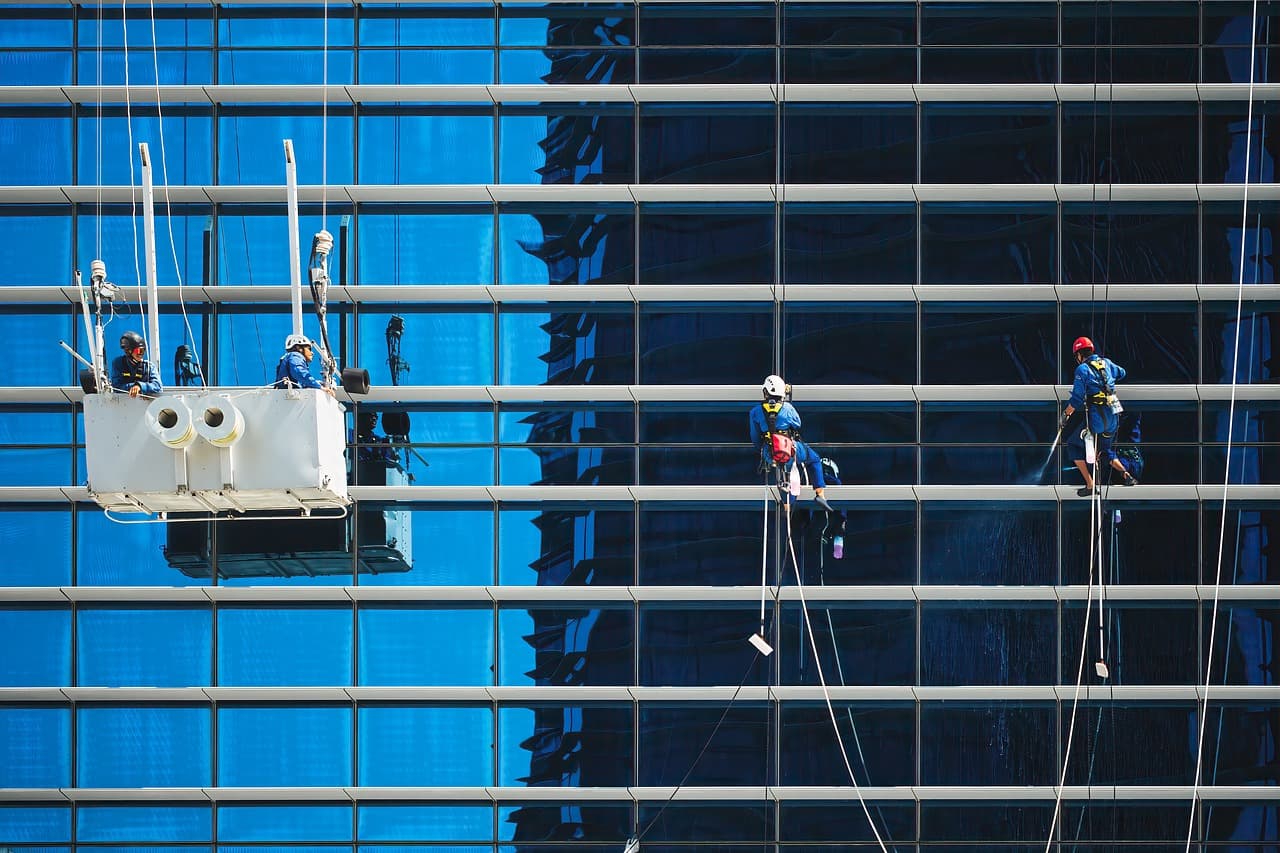
Industrial rope access (rope work technique) involves working at height using specialized harnesses, static ropes, descent devices, and safety systems compliant with EN 361, EN 353-2, and EN 12841 standards. Technicians are suspended on ropes anchored to the roof (anchor points per EN 795) and descend along the facade, washing it in sections from top to bottom. This method is especially valued for buildings with complex architecture: parapets, cornices, recesses, bay windows, balconies, and facades with sculptural details.
Advantages of industrial rope access technicians
- Access to every point on the facade — no geometric limitations
- No space requirements — roof or alternative anchor point sufficient; no need for access roads or stabilized areas
- Lower cost for small to medium projects — technician rate is 50–80 PLN net/hour (Cracow, Katowice, 2026); a single-day project may cost 800–1,200 PLN net total
- Minimal disruption to building operations — work from individual points without blocking building access
- Opportunity for concurrent inspection — visual assessment of facade condition, cracks, window seals possible during cleaning
Limitations of rope access work
Rope access technicians are efficient on surfaces up to approximately 500–800 m² per workday (two-person team). For larger projects (e.g., residential building facades over 2,000 m²), execution time increases and hourly cost may exceed lift rental. Technicians cannot work in wind speeds exceeding 10 m/s, during heavy rainfall, or at temperatures below –5°C (safety and EN 365 compliance requirements).
Reefa works with certified industrial rope access technicians holding current SPL certifications, liability insurance, and training in high-altitude work. Each project includes a rescue plan, visual monitoring, and photo reports from each stage—accessible to clients via QR code system.
Mobile elevated work platforms and lifts — efficiency and safety for large surfaces
Mobile elevated work platforms (MEWPs) are self-propelled or towed machines with telescopic or articulated booms, reaching working heights from 12 to over 50 meters. The operator works from a safe platform with 200–300 kg capacity, equipped with pressure washer connections, water and chemical tanks, and safety systems compliant with EN 280. Lifts are the preferred solution for large, regular facades of office buildings, commercial properties, production halls, and residential complexes.
Advantages of mobile elevated work platforms
- High productivity — two-person team (operator + assistant) cleans 1,000–1,500 m² of facade daily
- Enhanced operator safety — stable platform, protective railings, tilt-over protection
- Simpler logistics management — single lift rental covers entire building height without repositioning anchor points
- Capability in adverse weather — larger platforms (e.g., basket-type lifts) offer rain covers, extending the working window
When are lifts not optimal?
MEWPs require stable, hardened ground with minimum 10 tons/m² bearing capacity (or stabilizer plates) and road access of at least 2.5 m width. They are unsuitable for:
- Historic townhouses with narrow courtyards
- Buildings surrounded by tall vegetation (trees, hedges) or infrastructure (fencing, lighting)
- Structures with atypical architecture (bay windows, cornices, balconies projecting > 1.5 m)
- Locations without ability to restrict pedestrian/vehicular traffic
Lift rental cost in Cracow and Katowice (2026) is 300–600 PLN net per workday (8 hours), depending on working height. Add operator costs if rental excludes operation: 150–250 PLN net/day—plus transport: often 200–400 PLN flat fee. Example project: 4-story office building, 1,200 m² facade, 2-day execution, total rental + operator cost: 1,800–2,400 PLN net.
What agents and techniques are used for post-renovation facade cleaning?
Effective facade cleaning requires conscious selection of chemistry based on soiling type and wall material. Most commonly used product categories:
Acidic cleaning agents (F5, F9, 5–10% hydrochloric acid, phosphoric acid)
Break down cement mortar, adhesive residue, lime efflorescence. Action time: 5–15 minutes, then pressure rinse. Avoid contact with unglazed clinker—may cause discoloration.Alkaline detergents (pH 10–13)
Remove fats, assembly oils, silicone traces, organic dust. Used on HPL panels, glass, composite panels. Safe for most coatings.Pressure washers (80–150 bar)
Mechanical removal of dust, loose mortar, masking film. Lower pressure (to 100 bar) for acrylic and silicate renders, higher (120–150 bar) for architectural concrete and clinker. Always use rotary or slot nozzles to prevent localized damage.Neutralizing agents
After acid application, surface neutralization is necessary—thorough water rinse or alkaline product. Prevents subsequent efflorescence and corrosion.
Reefa uses exclusively approved products for public utility buildings, containing no substances hazardous to health or GDPR-regulated (e.g., no volatile organic compounds exceeding EU limits). Each project receives chemical specification sheets, enabling documentation for building certification (e.g., BREEAM, LEED).
When to choose rope access technicians vs. lifts? Decision matrix
| Criterion | Industrial rope access | Lifts/MEWPs |
|---|---|---|
| Architecture | Complex, parapets, details | Regular, flat |
| Facade surface area | < 1,000 m² | > 1,000 m² |
| Site access | Limited, narrow courtyard | Access road ≥2.5m, hardened |
| Surroundings | Vegetation, infrastructure close | Open spaces |
| Budget | 50–80 PLN/h net | 300–600 PLN/day + operator |
| Execution time | Medium (flexible) | Short (high productivity) |
| Safety requirements | Roof anchoring, EN ropes | Stable ground, plates |
Example: townhouse in central Cracow, 4 stories, ornamental facade with bay windows, no lift space, surroundings: narrow street + trees on sidewalk → optimal choice: industrial rope access technicians, 2–3 workdays, cost 2,400–3,600 PLN net.
Example: Class A office building on Ruczaj estate (Cracow), 8 stories, glass-aluminum facade, parking in front, large 3,500 m² area → optimal choice: telescopic lift, 3 days execution, rental + operator + transport cost: 3,000–4,200 PLN net.
Reefa's team conducts free technical surveys and provides cleaning method recommendations within 48 hours of inquiry. The decision considers not only unit cost but project timeline, infrastructure availability, and liability insurance requirements (Reefa holds coverage to 500,000 PLN, including high-altitude work).
Case study: Office building on Ruczaj estate, Cracow
Project: facade cleaning of a 6-story office building following facade renovation and window frame replacement. Area: 2,400 m², facade: silicone render + clinker elements, soiling: mortar, masking film, adhesive traces, mineral dust.
Selected method: telescopic lift 22 m (2-day rental) + industrial rope access technicians (1 day for parapets and details).
Schedule:
- Days 1–2: main facade surface cleaning from lift platform, F5 acidic agent (1:5 dilution), 120 bar pressure rinse, neutralization with water
- Day 3: rope technicians—parapet details, balcony sills, ventilation enclosures, alkaline agent + hand brushing
Result: complete soiling removal, no coating damage, handover approved by property manager without issues. Photo reports delivered same day via Reefa's QR system.
Cost: 4,800 PLN net (lift rental 1,200 PLN + operator 400 PLN + rope technicians 1,600 PLN + chemicals and transport 1,600 PLN). Execution as part of comprehensive post-renovation cleaning in Cracow, including interior office cleaning.
High-altitude work safety — standards and certifications
Work by industrial rope access technicians and lift operators is subject to strict occupational safety regulations. Key European standards:
- EN 365 — general requirements for personal protective equipment against falls from height
- EN 361 — safety harnesses
- EN 12841 — rope access systems, self-braking devices
- EN 795 — anchor devices
- EN 280 — mobile elevated work platforms, safety requirements and testing
Each rope technician in Reefa projects holds:
- Current high-altitude work training (certificate valid minimum 3 years)
- SPL certifications (if working near electrical installations)
- Medical clearance for high-altitude work
- Accident insurance
Lift operators hold UDT (Technical Inspection Office) qualifications category II or III, depending on machine type. Each lift undergoes technical inspection before project start, stabilizer verification, and safety testing.
Reefa provides a dedicated health and safety coordinator for each facade cleaning project, overseeing procedure compliance, atmospheric condition verification (wind speed, temperature, rainfall), and maintains work logs. This system is part of our quality policy in force since 2020.
How to choose a post-renovation facade cleaning contractor?
Selecting a facade washing company is a decision affecting aesthetics, coating durability, and resident/user safety. Key contractor verification criteria:
- Liability insurance — minimum 200,000 PLN, preferably 500,000 PLN or more. Policy should cover high-altitude work and facade damage.
- Technician/operator certificates — request training documentation, UDT qualifications, medical clearances.
- Portfolio and references — verify similar project experience, ideally with named buildings (offices, estates, public utilities).
- Safety plan — professional contractors present HSP (Health and Safety Plan) before work commencement.
- Chemical documentation — specification sheets, certificates, EU compliance declarations.
- Cost transparency — detailed quotation with breakdown: labor, equipment rental, materials, transport. Avoid vague offers.
Reefa operates in Cracow since 2020 and Katowice since 2024, delivering facade cleaning projects as part of post-construction cleaning and post-renovation cleaning services. Each client receives:
- Detailed quotation within 48 hours of technical survey
- Dedicated project manager (business hours phone availability)
- Photo reports at each stage, accessible via QR system
- Liability insurance to 500,000 PLN
- Invoice with stage-based settlement (payment after handover option)
How much does professional facade cleaning cost? 2026 Price table
The following rates apply to Cracow/Katowice market, net prices, as of 2026:
| Service | Net rate | Notes |
|---|---|---|
| Industrial rope technician (work hour) | 50–80 PLN/h | 2-person team: 100–160 PLN/h |
| Lift rental 12–18 m | 300–400 PLN/day | Operator not included |
| Lift rental 20–30 m | 450–600 PLN/day | Operator not included |
| Lift operator | 150–250 PLN/day | If rental excludes operation |
| Lift transport (flat fee) | 200–400 PLN | Depends on distance |
| Acidic/alkaline cleaning agents | 15–30 PLN/liter | Consumption: ~50 ml/m² facade |
| Pressure washing (service) | 8–15 PLN/m² | No chemicals, equipment + water only |
| Comprehensive facade cleaning | 18–35 PLN/m² | Chemistry + washing + neutralization |
Sample calculation for 4-story building, 800 m² facade area:
- Rope access option: 800 m² × 22 PLN/m² = 17,600 PLN net, 3–4 day execution
- Lift option (2 days) + rope technicians (1 day detail): 14,400 PLN net, 3 day execution
Reefa offers individual quotations considering facility specifics, infrastructure availability, and project timeline. Contact our team for free technical survey and detailed quotation.
Frequently asked questions
How much does a post-renovation cleaning crew charge?
Comprehensive post-renovation cleaning cost (including facade washing) ranges from 18 to 45 PLN net/m² of usable area, depending on soiling severity, building access, and facade cleaning method. For a 500 m² office building, total post-renovation cleaning (interiors + facade) typically costs 12,000–18,000 PLN net. Industrial rope technician hourly rate is 50–80 PLN net, while lift rental with operator runs 450–850 PLN net daily. Reefa prepares detailed quotations after technical survey, considering facade area, soiling types (mortar, adhesive, paint), access methods, and required completion timeline. Quotation includes consumables, cleaning agents, and photo reports at each stage.
Should facade cleaning proceed from bottom to top?
Facades after renovation are cleaned from top to bottom—a fundamental facade cleaning principle. Top-to-bottom washing prevents contaminated water and chemical solutions from flowing onto already-cleaned sections, eliminating work effectiveness and leaving streaks. Industrial rope technicians start from the parapet or top floor and descend in sections, rinsing chemicals immediately after application. Lift operators also work "top-down"—positioning the boom at maximum working height, gradually lowering the platform. The exception is preliminary wetting before acidic agent application—this may begin at bottom to ensure even water absorption, preventing premature drying (especially in temperatures above 25°C).
How do you remove white dust after renovation?
White post-renovation dust is a mixture of mineral dust (silica oxide, lime), gypsum residue, cement, and salt efflorescence. Removal requires combined mechanical and chemical approach. Indoors: industrial HEPA-filter vacuum (captures particles below 0.3 μm), then wash surfaces with alkaline agent or vinegar (1:3 water dilution)—neutralizes lime efflorescence. On facade: pressure wash 80–120 bar with rotary nozzle to avoid render damage, then acidic agent (F5, 5% hydrochloric acid) for 10 minutes and thorough water rinse. Multiple rinsing is critical—white dust tends to resettle if dissolved but not removed. Reefa employs a three-step system: preliminary wash (loose particle removal), chemistry application (mortar breakdown), rinse + neutralization (efflorescence elimination).
How much does facade cleaning of a building cost?
Facade cleaning cost after renovation is 18–35 PLN net/m² in Cracow and Katowice (2026), depending on access method, soiling type, and wall material. For a 4-story building with 1,000 m² facade area, total cost is 18,000–28,000 PLN net. The rate includes: labor (rope technicians or lift operator), equipment rental (ropes/lift), cleaning agents (acidic, alkaline), water, transport, and health and safety coordinator oversight. Price factors: building height (over 20 m requires higher-reach lifts or additional rope anchoring), soiling severity (thick mortar layer requires repeated chemistry application), site accessibility (absent access roads = rope technician necessity = higher hourly cost), timeline (emergency/weekend projects incur 20–30% premium). Reefa offers individual quotations guaranteeing cost transparency—each line item is described and priced separately.
Can you clean facades in winter?
Winter facade cleaning is possible but requires specific atmospheric conditions. Minimum ambient temperature is –5°C (EN 365 for rope work) with no snow or heavy rain. Below this temperature, pressure washer water freezes in hoses and chemical agents lose effectiveness (acidic products work optimally at +10 to +25°C). Additionally, rope becomes stiff and less safe, and lift operators risk stabilizer icing. In practice, the Polish facade cleaning season runs March through November. For winter project necessity, heated water solutions (heaters warming to 60°C), protective foil tents around facade sections, and special non-freezing agents are used. Such measures increase costs by 40–60%, so most investors schedule facade cleaning for spring or early autumn.
What documents should the facade cleaning contractor provide?
The professional contractor provides before work start: liability insurance policy (minimum 200,000 PLN, preferably 500,000 PLN), industrial rope technician certificates (high-altitude work training, valid minimum 3 years), lift operator UDT qualifications (if MEWP used), Health and Safety Plan (HSP) compliant with Infrastructure Ministry building safety regulations, chemical specification sheets (safety data sheets for acids, detergents, neutralizers), equipment compliance declaration with EN standards (ropes, harnesses, lifts), contract with schedule, and handover protocol upon completion. Reefa provides clients complete documentation before contract signature, including 500,000 PLN liability insurance and sample photo report. Each project has an assigned coordinator responsible for documentation completeness and occupational safety/GDPR compliance (staff and client data protection).
Need post-renovation facade cleaning? Reefa's team has delivered projects in Cracow and Katowice since 2020, providing dedicated project management, photo reports, and 500,000 PLN liability insurance. Request free quotation and technical survey—we respond within 48 hours.