Shopping Center Cleaning — Daily Mall Operations
Shopping malls require continuous operational service: 3-shift teams, real-time interventions, and discreet staff presence across 100,000+ m² surfaces.
Shopping malls require continuous operational service: 3-shift teams, real-time interventions, and discreet staff presence across 100,000+ m² surfaces.
Shopping center cleaning is continuous operational service: teams work in 3 shifts from early morning until the mall closes, respond to real-time incidents (spilled beverages, scattered merchandise) and maintain cleanliness across surfaces often exceeding 80,000–120,000 m² of rentable space plus common areas. In Cracow, facilities like Galeria Krakowska, Bonarka City Center, Galeria Kazimierz, M1, and Serenada operate on a 6:00–23:00 schedule with requirements for discreet staff presence and maintained visual standards across hundreds of thousands of monthly visitors.
Shopping mall cleaning differs from office building cleaning or medical facility cleaning primarily in scale and operational mode. Office cleaning typically occurs after tenant working hours; in a shopping center, the team must operate throughout business hours, invisibly to mall customers, with readiness for immediate intervention in high-traffic zones — food courts, restrooms, main corridors. On weekends and holiday seasons, visitor numbers peak at tens of thousands daily, requiring reinforced crew composition and adjusted rotation schedules.
In brief
- Shopping mall requires continuous operations (6:00–23:00) with 3-shift teams and real-time incident response.
- Typical Cracow mall scale: 80,000–120,000 m² rentable space + corridors, food court, restrooms, underground parking.
- Critical zones: food court (food waste, sauces, spilled ice cream), public restrooms (30–60 minute rotation), main entrances.
- Equipment: cleaning carts, scrubber-dryer machines, industrial vacuums, detergent dispensing systems compliant with EU Ecolabel.
- Service cost: 18,000–35,000 PLN net/month for ~50,000 m² mall (3 shifts, 5–8 staff), scaled linearly for larger facilities.
- Requirements: uniformed team with ID badges, BHP and HACCP training (especially food zones), minimum 1,000,000 PLN liability insurance, dedicated facility coordinator.
How does shopping mall cleaning differ from other commercial facilities?
The fundamental difference lies in operational mode. While office buildings and most office facilities are cleaned after tenant hours, a shopping mall requires staff presence throughout business hours — from early morning when space is prepared before opening (floor washing in corridors, restroom supply restocking, trash removal) through the entire day when the team responds to real-time events, until evening when main zones are finalized after stores close.
In a 100,000 m² shopping mall, a typical crew consists of 5–8 staff per shift, working in rotating patterns: some team members cover corridors and main entrances, some handle the food court, some manage public restrooms. Work is organized in 3 shifts: morning (6:00–14:00), afternoon (14:00–22:00), evening (22:00–23:00 or until actual closing). On weekends when mall traffic peaks, crew size increases by 20–30%, and rotation intervals in critical zones (e.g., food court) shrink from 90 to 60 minutes.
The second distinguishing factor is scope and surface variety. A shopping mall comprises:
- Rentable space (shops, service points) — cleaned by tenants or their contractors,
- Common areas (corridors, entrance halls, traffic zones, inter-level passages) — mall management responsibility,
- Food service zones (food court, corridor cafés) — typically handled by main management team with reinforcement during peak hours,
- Public restrooms — requiring 30–60 minute rotation during business hours,
- Underground parking — cleaned once daily (typically at night) or every 2–3 days, similar to garage washing,
- Technical areas (back rooms, safety facilities, ventilation chambers) — serviced on monthly or quarterly basis.
Another distinctive feature: emergency interventions. During a typical day in a mid-size mall, the team performs 10–20 interventions: spilled beverages (coffee, juice, soft drinks), scattered merchandise (ice cream, popcorn, candy), sanitary emergencies (clogged toilets, water spillage), mud or snow tracks at entrances during winter. Each intervention must be completed within 10–15 minutes of report to avoid damaging mall image and preventing safety hazards (e.g., slippery floors).
What are the critical zones in shopping mall operations?
Food court and dining zones represent the highest concentration of organic contamination. During peak hours 12:00–15:00 and 18:00–21:00 (lunch and dinner), food court traffic peaks: hundreds of people simultaneously, plastic trays, sauces, crumbs, spilled beverages, melted ice cream. Floors — typically glazed ceramic or terrazzo — become covered with grease stains, caramelized sugar, and fruit acid marks (juices, cocktails). Tables require wiping after each use; trash bins require emptying every 30–60 minutes. Permanent presence of at least one team member in the food court during peak hours is standard in professional operations.
Technology: cleaning carts equipped with two buckets (clean detergent solution + dirty water), microfiber mops, cordless vacuums for debris collection. At night — machine washing using scrubber-dryer (50–70 cm path width), alkaline solution pH 10–11 (for grease) or enzymatic (for proteins and sugars). Drying time: 5–10 minutes with mechanical ventilation.
Public restrooms serve 500–2,000 people daily depending on traffic. Maintenance protocol includes 30-minute rotation during business hours: toilet paper, soap, paper towel checks and restocking, toilet and sink cleaning, mirror and floor washing. On weekends and holidays, intervals reduce to 20–30 minutes. Each restroom is equipped with disinfectant sets (minimum EN 14476 standard — antiviral effectiveness), disposable mops or microfiber with color rotation (color assigned exclusively to restrooms to prevent cross-contamination).
Staff assigned to restrooms must complete hygiene and HACCP training — while HACCP formally applies to food-contact areas, mall managers increasingly require certification for restroom teams near food courts to minimize pathogen transmission risk.
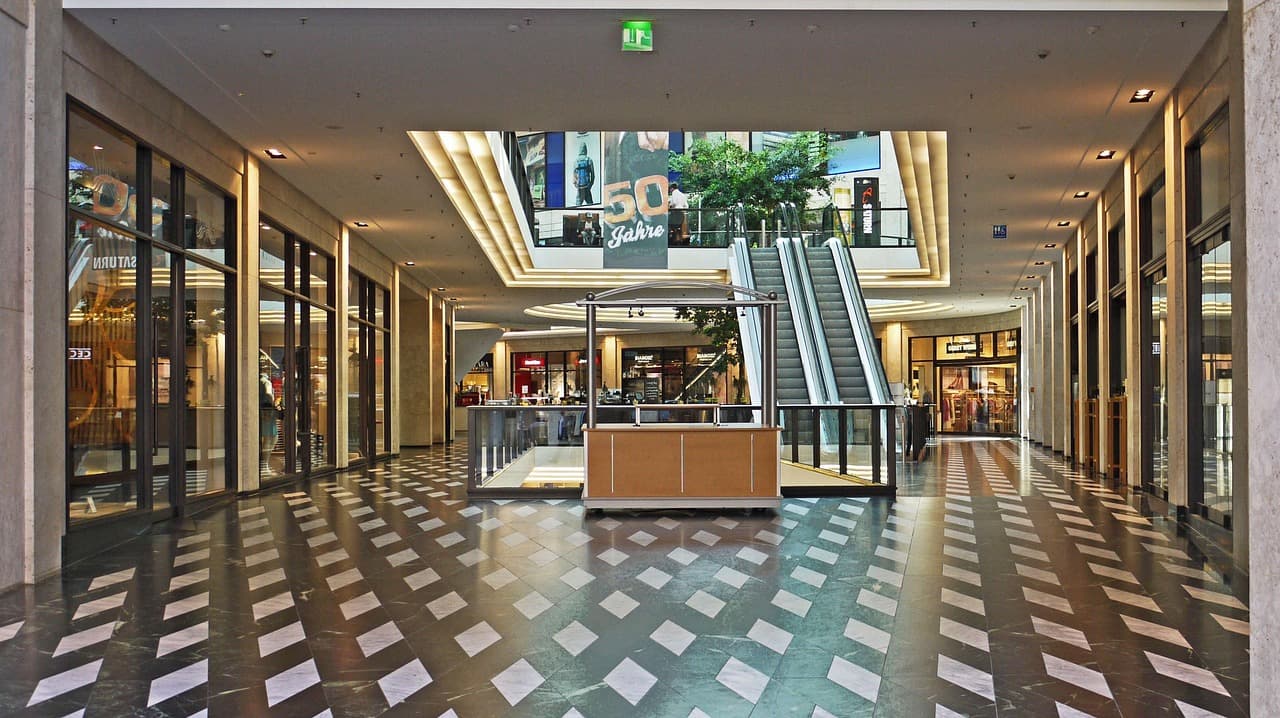
Corridors and traffic zones — the mall's main arteries — span hundreds of meters in large facilities. Floors are typically glazed ceramic, terrazzo, marble, or natural stone requiring daily washing (at night), supplemented by routine daytime cleaning (sweeping, vacuuming, spot removal). On weekends with traffic of 30,000–50,000 daily visitors, floors lose shine within hours of opening — primarily due to dust, sand, and moisture from shoes.
Quarterly or semi-annual deep cleaning is performed: mechanical stripping of old polymer layer, high-pressure washing, reapplication of polish (2–3 coats). Service typically occurs at night after mall closure; for 10,000 m² of corridors, 1–2 nights are required with 4–6 staff and 2–3 machines.
Main entrances and vestibules — particularly vulnerable to mud, snow, and road salt during fall and winter. Entry mats (rubber or textile) require daily vacuuming and washing; during heavy precipitation — replacement or cleaning every few hours. Glass entrances (often 4–6 m high) are cleaned weekly from inside, monthly from outside (using lifts or telescopic ladders).
Underground parking — 20,000–40,000 m² in large malls — requires different scheduling. Cleaning occurs at night (23:00–6:00) when traffic is minimal. Scope: sweeping-collection (sweeper), ramp and elevator washing, trash bin emptying, oil stain removal. Frequency: 1–2 times weekly for entire parking, daily for entrance ramps and elevator shafts. Similar to garage washing, high-capacity equipment is essential (sweepers with 100–200 l tank capacity, 120–150 cm path width).
What equipment and chemicals are used in shopping malls?
Due to scale and daytime operation requirements, equipment must be mobile, quiet, and visually unobtrusive. Typical crew equipment set:
- Cleaning carts (janitorial cart) — two- or three-tier construction equipped with: two buckets (clean solution + dirty water), mops, microfiber cloths, waste bags (segregated: organic, plastic, paper, glass), detergents in dispensing bottles, gloves, apron. Cart moves discreetly through mall in neutral colors (gray, beige), with quiet wheels.
- Cordless scrubber-dryer machines — quiet operation (below 65 dB), emission-free, 50–70 cm path width (narrow corridor models) or 80–110 cm (wide corridors and central areas). Capacity: 2,000–3,500 m²/h. Runtime per charge: 3–4 hours.
- Cordless sweepers — for underground parking and large open surfaces (entrance forecourts, external terraces). Tank capacity: 100–200 l, path width: 100–150 cm.
- Industrial vacuums — cordless backpack models (backpack vacuum) for corridors and retail zones during business hours (quiet, mobile) and drum vacuums for nighttime cleaning (higher suction, 15–30 l capacity).
- Microfiber mops and cloths — color rotation system: blue (general surfaces), red (restrooms), green (food court), yellow (glass and mirrors). Mop replacement every 2–3 work hours or after each emergency intervention.
- Detergent dispensing systems — stationary stations (in mall technical rooms) with dosing pumps, enabling controlled-concentration working solutions. Detergents: neutral (pH 6–8) for routine floor washing, alkaline (pH 10–12) for food court grease, acidic (pH 2–4) for stone and rust in restrooms, disinfectant (EN 1276, EN 14476 standards) for restrooms.
Chemicals used in malls must meet environmental standards — mall managers increasingly require EU Ecolabel or Nordic Swan certificates for all common-area detergents to minimize indoor air impact and reduce allergy risk for visitors.
In facilities partnering with international retail chains (H&M, Zara, Media Markt), additional chemical safety standards apply: safety data sheets (SDS) for all products, staff training in GHS (Globally Harmonized System of Classification and Labelling of Chemicals), detergent storage in locked rooms with controlled access.
What is the cost of shopping mall cleaning and how is pricing determined?
Shopping mall service cost comprises several variables: common area square footage (m²), number of shifts, crew size per shift, rotation frequency in critical zones, specialized scope (e.g., high window washing, floor deep cleaning), additional requirements (e.g., photo reports, QR reporting system, dedicated facility coordinator).
Typical cost structure for ~50,000 m² common area mall (corridors + restrooms + food court + entrances):
- 3 shifts, 5–6 staff per shift (15–18 staff/day in weekly rotation) → approximately 18,000–25,000 PLN net/month.
- 3 shifts, 7–8 staff per shift (weekend reinforcement) → 25,000–35,000 PLN net/month.
- Additional services: window washing (weekly, ~500 m² glass) → +1,500–2,500 PLN net/month, floor deep cleaning (quarterly, ~10,000 m²) → 8,000–12,000 PLN net one-time.
For larger malls (80,000–120,000 m² rentable space, roughly 30,000–50,000 m² common area) costs scale linearly: 35,000–60,000 PLN net/month for basic 3-shift operations.
Reefa has operated in Cracow since 2020 and in Katowice since 2024, serving commercial and institutional facilities using the dedicated facility coordinator per site model. For shopping malls we offer:
- Legally employed and insured staff, trained in BHP and HACCP (food service zones),
- Liability insurance up to 1,000,000 PLN,
- Photo reports after each cleaning (key zones: corridors, restrooms, food court, entrances),
- QR system for real-time incident reporting by mall managers or tenants,
- Facility coordinator available by phone 6:00–23:00 weekdays, 8:00–20:00 weekends.
Our client retention rate stands at 91% — a critical metric in commercial facility segment where cleaning team stability correlates with facility familiarity, tenant trust, and reduced implementation costs.
Pricing is prepared following site inspection: Reefa coordinator conducts facility audit (area, zone division, traffic intensity, floor specifications, existing technical rooms, water/power access, mall hours), then designs shift schedule and crew composition. Proposal includes cost breakdown by zone, weekly schedule, equipment and detergent list, and KPI metrics (Key Performance Indicators): incident response time, monthly reports, mystery-shop quality scores.
For mall managers seeking facility management support, consider collaboration under SLA (Service Level Agreement) defining quality parameters and penalties/bonuses for achievement. Example shopping mall SLA KPIs:
- Incident response time: max 10 minutes from report (95% of cases),
- Restroom rotation: minimum every 60 minutes weekdays, every 30 minutes weekends,
- Mystery-shop quality score: minimum 4.0/5.0 (quarterly),
- Tenant complaints: maximum 5/month.
How is the cleaning team managed in a shopping mall?
Managing a mall cleaning team is essentially real-time operational management. The facility coordinator — a dedicated person assigned to the mall — acts as liaison between cleaning staff, mall management, and tenants. During business hours (6:00–23:00), the coordinator is available by phone, monitors reports via QR system or mobile app, delegates interventions to specific crew members, oversees zone rotation schedule compliance.
Typical coordinator daily schedule:
- 6:00–8:00 — morning shift oversight: space preparation before opening (corridor floor washing, restroom supply restocking, trash bin emptying from previous day), critical zone inspection, photo report to management.
- 8:00–14:00 — real-time incident monitoring, intervention coordination, tenant communication (e.g., storefront contamination reports), post-cleaning quality checks.
- 14:00–16:00 — crew changeover (morning → afternoon shift), new shift briefing, priority communication (e.g., reinforced food court cleaning during 18:00–21:00 peak).
- 16:00–22:00 — afternoon shift oversight, pre-closing inspection, evening shift task planning.
- 22:00–23:00 — evening shift: finalize corridor cleaning, machine floor washing post-closure, daily report preparation.
Management support tools:
- QR system — codes placed in critical mall zones (corridors, restrooms, food court, entrances), enabling managers or tenants to instantly report issues (dirty floor, missing restroom supplies). Reports reach coordinator as push notifications on mobile app.
- Photo reports — images taken after each cleaning cycle (e.g., corridors at 8:00, restrooms at 10:00, 12:00, 14:00), archived in cloud with manager access. For complaint verification, manager can check facility condition at specific times.
- Digital checklist — mobile app for crew with task list per shift, zone-divided and time-scheduled. Each task requires confirmation (checkbox) and optional photo. Post-shift system generates schedule compliance percentage report.
- Internal messenger — dedicated channel (Slack, Microsoft Teams, WhatsApp Business) for coordinator and crew enabling quick communication without phone calls.
Staff recruitment and training: at Reefa, each mall-assigned crew member undergoes:
- Initial BHP training (6 hours) including high-traffic facility specifics (e.g., evacuation procedures, customer communication),
- HACCP training (4 hours) — especially for food court and nearby restroom staff,
- Specialized equipment training (scrubber-dryer, sweepers) — 2 hours practical,
- QR system and mobile app training — 1 hour.
Following training, new staff completes a 2-week onboarding period under coordinator supervision, paired with experienced team member. Only after positive evaluation is staff assigned to independent zone coverage.
What are the most common challenges in shopping mall cleaning?
Real-time interventions — in a 30,000-visitor mall, emergency events (spilled beverages, scattered merchandise, sanitary failures) occur 10–20 times daily. Each must resolve within 10–15 minutes to preserve mall image. Requires constant availability of at least one crew member per critical zone and efficient communication between team and coordinator.
Discretion and image — mall visitors prefer not seeing cleaning staff "everywhere." Team must operate efficiently yet invisibly: carts parked in niches or technical rooms, mop changes and bin emptying during off-peak hours (when possible), neutral uniforms (gray, beige, navy), ID badges with mall logo. Some facilities prohibit crew movement through main corridors during peak hours (12:00–15:00, 18:00–21:00) — staff then use service corridors.
Staff turnover — 3-shift work, weekends and holidays, physical demands (constant walking, equipment moving, bending) generate 20–30% annual turnover industry-wide. Reefa minimizes this through:
- Employment contracts (vs. freelance agreements), full social and health insurance,
- Attendance bonuses (no absences in month → 200–300 PLN gross bonus),
- Training access and advancement paths (crew member to facility coordinator),
- Flexible scheduling for staff with family obligations.
Seasonality and retail peaks — pre-holiday period (November–December), seasonal sales (January, July), and long weekends generate 30–50% traffic increases. Mall managers expect crew reinforcement (additional afternoon/evening shifts) and shortened zone rotation intervals. Service priced as optional contract clause: "seasonal reinforcement: +2 staff weekend Novembers/Decembers, +1,500 PLN net/week".
GDPR compliance and data protection — cleaning staff access technical rooms including mall and tenant server rooms. Each team member signs an NDA (non-disclosure agreement) and GDPR training (1 hour) covering:
- No photographing documents, computer screens, password sheets,
- No removal of data storage devices (USB drives, disks, paper documents),
- Found items (wallets, phones, documents) must immediately go to mall customer service.
NDA violation results in immediate contract termination and potential damages claim by mall manager.
What technologies and innovations are entering mall cleaning services?
Recent years show facility managers experimenting with automation solutions:
Cleaning robots — autonomous scrubber-dryer machines navigating programmed routes (main corridors, central areas), equipped with LIDAR sensors and cameras avoiding obstacles (mall customers, shopping carts, children). Available European models (e.g., Tennant T380AMR, Nilfisk Liberty SC50) achieve 2,000–3,000 m²/h and operate 4 hours per charge. Investment cost: 150,000–250,000 PLN net per unit. In Cracow, several malls are testing robots during night hours (23:00–6:00) when corridor traffic is zero — results show 10–15% labor cost reduction but require operator presence (monitoring, detergent refill, dirty water tank emptying).
IoT sensors — sensors placed in restrooms monitoring toilet paper, soap, paper towel levels and traffic intensity (booth entries). Data transmits real-time to coordinator app enabling rotation planning based on actual consumption (vs. rigid 60-minute schedules). System cost: 500–1,000 PLN net per sensor + 50–100 PLN/month data subscription. ROI: 6–12 months through crew optimization.
Enzymatic detergents — enzyme-based formulas (proteases, lipases, amylases) replacing traditional alkaline detergents, breaking down organic soils (grease, proteins, starch) without harsh chemicals. Advantages: lower pH (6–8), safer for staff, lower environmental impact, effectiveness at low temperatures (15–20°C). Disadvantages: 30–50% higher cost vs. alkaline, longer action time (5–10 min vs. 1–2 min). Primarily used in food courts and tenant kitchens.
Mystery shopping audits — mall managers hire external firms for "secret shopper" quality audits: auditor visits incognito, rates cleanliness of restrooms, corridors, food court per standardized checklist (e.g., 50 criteria, 1–5 scale), photographs violations, issues report. Audit result impacts SLA bonus/penalty. Cost: 800–1,500 PLN net per audit; recommended quarterly frequency.
How to select a cleaning company for shopping mall operations?
Shopping mall operator selection is strategic, impacting facility image, tenant satisfaction, and operational costs. Facility manager should evaluate vendor across dimensions:
- Commercial high-traffic facility experience — does company portfolio include shopping malls, airports, convention centers, sports facilities? Years in market? (Reefa: operating Cracow since 2020, Katowice since 2024.)
- Team stability and employment — are staff employed under work contracts with full insurance or freelance agreements? Staff turnover rate? (Reefa: all staff on employment contracts, below-average industry turnover via bonuses and training.)
- Liability insurance — guarantee sum? For malls where single incident (e.g., slippery floor → customer fall → injury) may generate six-figure claims, minimum is 1,000,000 PLN. (Reefa: OC to 1,000,000 PLN.)
- Dedicated facility coordinator — does company assign one person per site, available by phone during mall hours? Does coordinator personally know facility, staff, and manager or rotate between contracts? (Reefa: each facility has dedicated coordinator conducting pre-start audit and attending quarterly manager meetings.)
- Photo reports and quality monitoring — does company provide work proof (post-cleaning photos, mobile app logs, internal audit reports)? Does manager access online status and schedules? (Reefa: photo reports post-cleaning, QR reporting system, digital task checklists.)
- Environmental and BHP compliance — do detergents hold EU Ecolabel, Nordic Swan, or equivalent? Has staff completed BHP and HACCP training? Does company hold ISO 9001 (quality), ISO 14001 (environment), ISO 45001 (BHP) certification? (ISO optional but increasingly required by international mall operators.)
- References and case studies — can company provide comparable-facility references (size, traffic, type)? Are these active contracts (ongoing) or completed?
Before contract signing, conduct pilot phase (trial period) 1–3 months where vendor operates full schedule while manager assesses quality, flexibility, and communication. Post-pilot — decision on long-term contract (typically 12–36 months) with renewal option.
Contact Reefa: Cracow team available at /krakow/kontakt. We offer free site inspection and proposal within 5 business days of audit.
Frequently asked questions
How much does one hour of mall cleaning cost?
Hourly labor cost in shopping mall is 35–50 PLN net, depending on scope (corridor basics, emergency response, restroom coverage, food court) and facility scale. In practice, billing occurs monthly as team ratchet for full schedule, not hourly — typical ~50,000 m² common area mall requires 15–18 staff in weekly rotation (3 shifts × 5–6 staff), totaling 18,000–35,000 PLN net/month. Reefa prepares pricing following site inspection; contact: /krakow/kontakt.
What is hourly mall cleaning price in 2026 for commercial facilities?
Commercial high-traffic facilities (shopping malls, airports, transit hubs) typically command 35–50 PLN net/hour in 2026 on Cracow and Katowice markets. Smaller or lower-standard facilities (neighborhood shops, market pavilions) — 25–35 PLN net. Difference reflects quality requirements, staff certifications (BHP, HACCP), liability insurance, and daytime operation demands with discreet presence.
What are the rules for shopping mall cleaning?
Basic principles: continuous operations (6:00–23:00) with 3-shift crew rotation, discreet staff presence (neutral uniforms, carts parked in niches), emergency interventions within 10–15 minutes of report, restroom rotation every 30–60 minutes per traffic intensity, post-closure machine floor washing (typically 22:00–6:00), waste segregation per manager/tenant requirements, environmentally-certified detergents (EU Ecolabel). Staff must complete BHP and HACCP training (food zones), and company must hold minimum 1,000,000 PLN liability insurance.
What are tricks for mall cleaning efficiency?
Professional mall operations rely on best practices, not shortcuts. Key efficiency elements: color-coded mop rotation (separate colors for restrooms, food court, corridors) preventing cross-contamination, QR reporting enabling real-time intervention, photo documentation protecting against complaints, IoT restroom sensors optimizing rotation per actual consumption vs. fixed schedules, enzymatic detergents outperforming traditional alkaline on organic food court soils. Reefa also uses attendance bonuses reducing staff turnover and improving service quality.
Does a shopping mall require specialized certifications from cleaning company?
International mall operators (ECE, Unibail-Rodamco-Westfield, Atrium European Real Estate) increasingly require ISO 9001 (quality), ISO 14001 (environment), ISO 45001 (BHP) certificates plus HACCP training for food-zone teams. Mandatory: minimum 1,000,000 PLN liability insurance (Reefa: OC to 1,000,000 PLN), employment contracts for staff (legal hiring/coverage), detergent environmental compliance (EU Ecolabel, Nordic Swan). Tender phases may require comparable-facility references and technical audit (equipment, procedures, schedules).
What does a typical shopping mall cleaning schedule look like?
Schedule divides into 3 shifts: morning (6:00–14:00) — corridor and restroom floor washing, supply restocking, pre-opening preparation; afternoon (14:00–22:00) — emergency interventions in corridors and food court, 30–60 minute restroom rotation, bin emptying, routine cleaning; evening (22:00–23:00 or to actual closing) — corridor cleanup finalization, post-closure machine floor washing in main zones, next-day preparation. Weekends and holidays see 20–30% crew increases with rotation intervals in critical zones reducing to 20–30 minutes. Underground parking is cleaned 1–2 times weekly at night (23:00–6:00), similar to garage washing.
Need professional shopping center operations in Cracow? Contact Reefa team: we'll conduct facility audit, design shift schedule, and provide detailed pricing within 5 business days. Contact: /krakow/kontakt.