Call Center Cleaning: High Turnover and Hygiene Standards
Call centers with hot-desking and 24/7 shift operations require specialized cleaning: frequent equipment disinfection, strict hygiene protocols, and flexible scheduling adapted to operational needs.

Call centers with hot-desking and 24/7 shift operations require specialized cleaning: frequent equipment disinfection, strict hygiene protocols, and flexible scheduling adapted to operational needs.
Call center cleaning requires a fundamentally different approach than standard office maintenance. Rotational workstations—known as hot-desking—combined with 24/7 shift operations and intensive use by hundreds of employees mean that hygiene standards must be rigorous and cleaning schedules must align with the operational reality of BPO (Business Process Outsourcing) and SSC (Shared Service Center) environments.
This guide covers the full scope of call center facility services: from the unique characteristics of these spaces through disinfection protocols to real costs and service models for 500+ workstation facilities in Cracow and Katowice in 2026. Our recommendations are based on extensive experience in office cleaning in Cracow and Katowice, where we serve BPO and shared services clients.
Key points
- Call centers with hot-desking require daily disinfection of headsets, keyboards, and high-touch surfaces—especially critical in 24/7 shift environments.
- Optimal cleaning frequency combines daily surface work (evening/night) with inter-shift interventions (15–30 minutes).
- Critical zones: agent workstations (headset disinfection is essential!), social areas (kitchens, restrooms), corridors, and quiet rooms.
- Estimated cost for a 500+ workstation facility in Cracow/Katowice 2026: approximately 8–13 PLN net/m²/month for 1500–2500 m², depending on frequency and protocols.
- Enhanced protocols during flu season and pandemic periods—increased disinfection frequency, antiviral agents, photographic documentation after each shift.
- Flexible SLA (Service Level Agreement) with <24-hour response time and a dedicated facility coordinator is the minimum standard for non-stop operations.
Why Are Call Centers High-Risk Hygiene Environments?
Call centers, particularly those operating under hot-desking models (workstations not assigned to individual employees), are characterized by extremely high usage frequency. A single desk may be used by 3–4 different people daily across shifts. Headsets, keyboards, mice, touchscreens—everything is shared, and personal hygiene practices vary widely.
Additionally, the nature of call center work creates unique risks: agents often spend 6–8 hours daily wearing headsets that contact their faces and mouths directly. Intensive voice communication increases the risk of microbial transmission—especially during fall and winter when influenza viruses, RSV, and SARS-CoV-2 circulate.
In a standard office, one comprehensive evening cleaning may suffice. In a 24/7 call center, a multi-layered strategy is essential: daily evening service, short inter-shift interventions (waste removal, disinfection supply refills, social area checks), and ad hoc response to incidents—spills, unexpected contamination.
Hot-Desking and Shared Equipment—Organizational Challenges
Rotational workstations mean there is no "single owner" responsible for maintaining desk cleanliness. This responsibility diffusion results in desks becoming dirty faster and employees reporting issues less frequently. The cleaning company's role extends beyond cleanliness maintenance to serving as the facility manager's "operational eyes"—reporting damage, restocking supplies, monitoring standards.
In our BPO client services, we implement a QR-code reporting system on each floor, allowing agents to quickly report problems (missing supplies, spills, maintenance needs). A dedicated facility coordinator receives these reports in real-time and dispatches the cleaning team within <24 hours—within one hour for urgent issues.
Critical Zones in Call Center Cleaning
Call center environments consist of several functional zones, each requiring distinct approaches and service frequencies.
Agent Workstations (Open Space)
This is the facility's core—large, open spaces with hundreds of workstations arranged in rows or clusters. Key tasks:
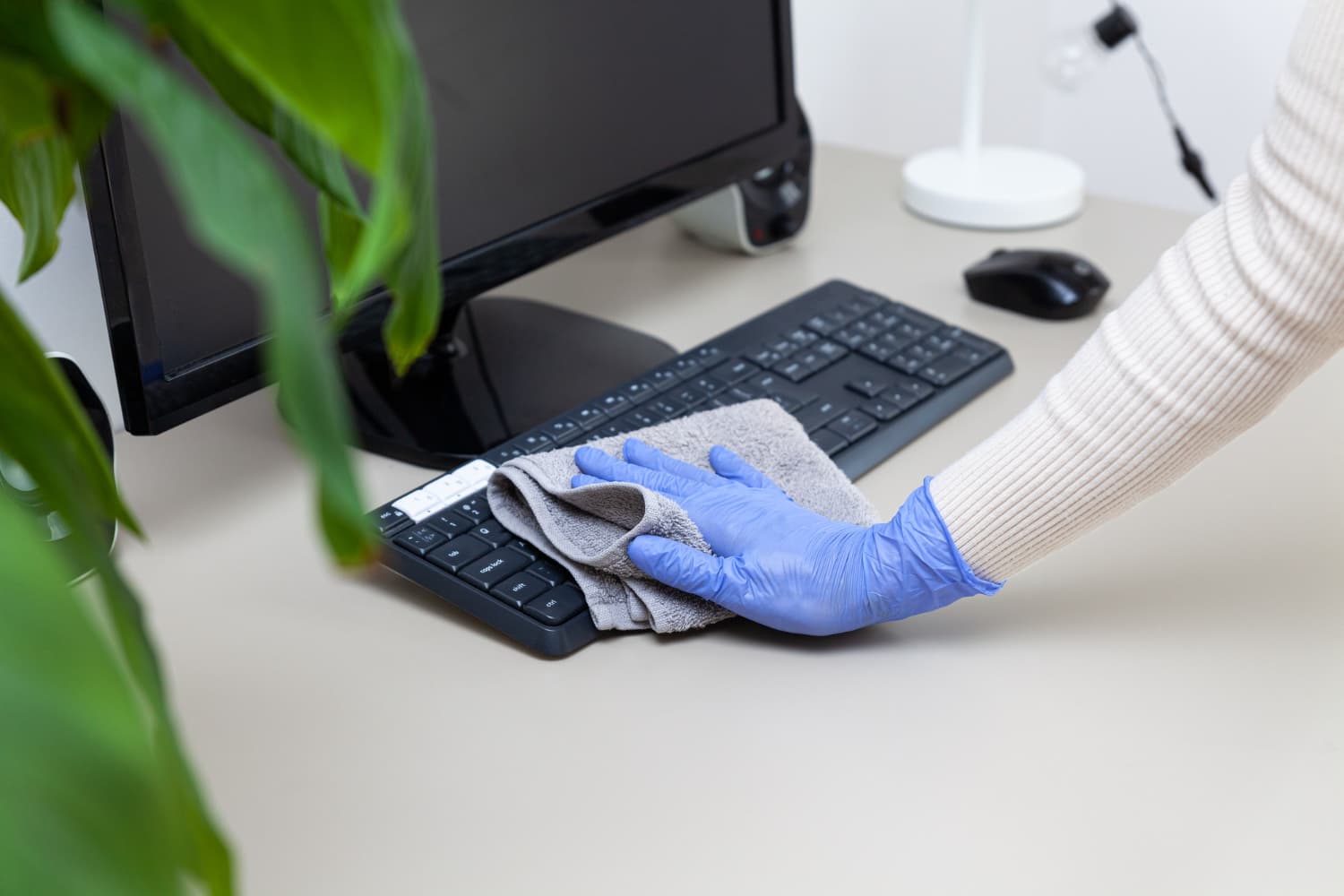
- Headset disinfection—priority number one. We apply antiviral agents compliant with EN 14476 standard (effective against enveloped viruses). Daily or inter-shift intervention is recommended depending on workstation density.
- Keyboard and mouse cleaning—compressed air + antistatic agent, removing crumbs and dust. Minimum 2× weekly.
- Desk surface wiping—microfiber + furniture polish. Daily after the final shift.
- Carpet vacuuming/floor cleaning—daily in corridors, 2–3× weekly under desks (carefully to avoid disconnecting cables).
In hot-desking facilities, we recommend color-coded microfibers (e.g., red = high-touch surface disinfection, blue = desk wiping, yellow = restrooms)—this prevents cross-contamination and aligns with HACCP methodology.
Social Areas—Kitchens, Breakout Rooms
In call centers, relaxation areas are where employees eat, drink coffee, and socialize during short breaks. Usage intensity is very high—a kitchen may serve 50–100 people per shift. In practice, this means:
- Wiping counters, sinks, coffee makers—multiple times daily (inter-shift interventions).
- Emptying waste bins—2–3× daily with waste segregation.
- Cleaning microwaves, refrigerators—at least 1× weekly, during weekends or at night.
- Disinfecting handles, refrigerator handles, coffee machine buttons—daily.
One practice we've implemented in several facilities is a check-list posted in each kitchen confirming the last intervention (date, time, cleaner's signature). This gives employees peace of mind and allows facility managers to monitor SLA compliance.
Restrooms and Sanitary Facilities
In a 500+ person per-shift environment, restrooms can become a hygiene bottleneck. Our recommendations:
- Basic cleaning (toilet bowls, sinks, mirrors, restocking paper and soap)—minimum 2× daily, preferably between shifts (morning and afternoon).
- Disinfecting door handles, flush buttons, touchless faucets—with every cleaning.
- Floor washing and disinfection—daily using bactericidal and fungicidal agents.
- Supply inventory checks (toilet paper, liquid soap, paper towels)—continuous, with on-demand restocking.
Installing touchless dispensers (automatic soap and towel dispensers) is worthwhile—it reduces touch points and enhances user comfort. While we don't manufacture these products, we recommend proven systems and ensure compliance with EU Ecolabel standards, which is important for facilities pursuing environmental certifications (BREEAM, LEED).
Corridors, Lobbies, Conference Rooms
Though not as heavily used as open spaces, these areas require care—they're the facility's public face. Daily cleaning includes vacuuming, wiping surfaces, and cleaning interior windows (e.g., at entrances, in glass-walled conference rooms). Conference rooms are cleaned after each meeting or daily depending on the schedule.
For multi-story facilities, we recommend a rotating deep-cleaning schedule: each week a different floor receives deep cleaning (chair upholstery cleaning, light fixture washing, wall cleaning). This distributes workload and maintains standards without operational disruptions.
Disinfection Protocols During Epidemics and Flu Season
The COVID-19 pandemic made facility managers acutely aware of the critical importance of implementing enhanced hygiene protocols rapidly. This applies especially to high-traffic environments like call centers.
What This Means in Practice
- Increased disinfection frequency—from daily to frequent (every 4–6 hours in high-touch areas: handles, railings, elevator buttons, headsets).
- Broad-spectrum antiviral agents—products containing isopropyl alcohol ≥70%, hydrogen peroxide, or quaternary ammonium compounds, compliant with EPA (USA) or EN (EU) standards.
- Photographic documentation—after each cleaning, we send clients photo reports with timestamps confirming work completion. In case of suspected facility contamination, the report serves as proof of sanitary compliance.
- Communication with occupants—labels reading "Disinfected [date, time]" on restroom doors, kitchens, and meeting room entrances. This raises awareness and discipline.
It's important to remember that cleaning and disinfection are not the same. Cleaning removes dirt and dust; disinfection reduces pathogenic microorganism counts. In call center environments, both processes must work in tandem.
Case Study: BPO in Cracow—600 Workstations, 24/7 Shifts
In 2023, we began partnering with an international BPO service provider in Cracow operating 600 workstations across three shifts. Main challenges:
- Facility operates continuously—no "silent night" for cleaning.
- Hot-desking—100% rotational workstations, zero permanent assignments.
- High employee turnover (typical for call centers)—constant entries/exits requiring cleaning schedule adaptation to group onboarding.
Our solution included:
- Night team (23:00–07:00)—6 people, comprehensive open space, restroom, and social area cleaning.
- Inter-shift interventions (08:00, 16:00)—2 people, 30 minutes: waste removal, headset disinfection in designated clusters, restroom and kitchen checks.
- Dedicated facility coordinator—available by phone 7:00–18:00, <2-hour response time for urgent issues or <24 hours for planned work.
- QR-based photo reports—after each night cleaning, the system generates a report with 8–10 photos (open space, restrooms, kitchens, lobby) sent via email to the client's facility manager.
Result: after 12 months, the client reported zero employee complaints about hygiene standards (previously 2–3 complaints per month). The contract was renewed for another 24 months. This case demonstrates that aligning the schedule to operational reality matters more than scope alone.
Cleaning Frequency vs. Employee Count—Selecting the Optimal Model
There is no universal model. Frequency depends on:
- Workstation count and per-shift staffing—a 100-workstation facility with one shift requires less than 500 workstations with three shifts.
- Hot-desking model type—"pure" hot-desking (each agent sits at a different desk daily) vs. partially assigned workstations (agents have "their" desk but rotate weekly).
- Certification and industry standards—clients in finance, insurance, or pharmaceuticals (e.g., BPO handling RODO-sensitive processes) may have stricter requirements.
- Client budget and priorities—not every facility manager has unlimited discretionary spending.
Sample Models for a 500-Workstation, 1800 m² Facility, Cracow 2026
| Model | Frequency | Scope | Estimated Cost (net/m²/month) |
|---|---|---|---|
| Standard | 5× weekly evening | Open space (vacuuming, desk wiping, waste removal), restrooms 1× daily, kitchens 1× daily | 8–10 PLN |
| Intensive | Daily evening + 2× daily inter-shift interventions | As above + daily headset disinfection, restrooms 2× daily, kitchens 2× daily | 11–13 PLN |
| Premium 24/7 | Intensive + weekend team | As above + weekend open space cleaning (basic), restrooms, kitchens; 24/7 coordinator availability | 14–16 PLN |
These rates assume annual regular contracts, dedicated teams, chemicals and equipment provided by us, OC insurance up to 500,000 PLN, and photo reports after each cleaning. Detailed pricing is available on our pricing page—quotes are always customized based on facility specifics, loading dock availability, health and safety requirements, and client schedules.
Service Cost for 500+ Workstation Call Center—2026 Budget Analysis
For facility managers planning budgets, the total monthly cost and expense structure matter as much as unit price. Consider this example:
Facility: 2000 m² net (open space 1500 m², social/kitchens 300 m², restrooms 100 m², corridors 100 m²)
Location: Cracow, Ruczaj district (proximity to university campuses, convenient for team access)
Employees: 600 agents across three shifts (7–15, 15–23, 23–7)
Model: Intensive (daily evening + 2× daily inter-shift interventions)
Monthly Budget Estimate (net):
- Daily evening cleaning (23:00–06:00, 6 people × 7h × 22 working days × ~30 PLN/h total employer cost): ~27,700 PLN
- Inter-shift interventions (2× daily, 2 people × 0.5h × 22 days × 30 PLN/h): ~1,320 PLN
- Chemicals, consumables (bags, microfibers, paper, soap): ~2,500 PLN
- Dedicated coordinator (0.3 FTE): ~2,000 PLN
- Company margin, insurance, administration: ~6,500 PLN
Total: ~40,000 PLN net/month → 20 PLN net/m²/month
Note: These figures are indicative and based on our internal 2026 costs. Actual pricing depends on many variables (elevator availability, parking, background checks, certifications, etc.). BPO clients often negotiate volume discounts—managing multiple facilities allows logistics optimization and per-unit rate reduction.
For comparison, a standard model (5× weekly, no inter-shift interventions) for the same facility would be ~28,000–32,000 PLN net/month, or 14–16 PLN/m²/month.
Formal Requirements and Compliance—RODO, Health & Safety, Legal Employment
Call centers, particularly in finance, insurance, or telecommunications, process sensitive personal data. Cleaning teams access premises outside business hours or during operations—and may potentially access monitors, documents, or systems. Compliance is therefore critical.
RODO (General Data Protection Regulation)
Every call center cleaning contract should include:
- Data processing clause (if cleaning staff have desk access, can see monitors) or guarantee that staff do not process data (e.g., monitors are turned off, documents are closed).
- Confidentiality commitment—signed by each team member.
- Background check—for facilities with elevated requirements (e.g., serving bank clients), teams undergo criminal record verification.
At Reefa, all employees sign NDA (Non-Disclosure Agreement) clauses and receive RODO training. We do not collect, process, or document any data found on client workstations.
Health & Safety and Training
Under Polish labor law, all employees must complete basic and position-specific health and safety training. Our teams additionally receive:
- Safe chemical handling instruction (working safely with detergents, acids, chlorine products).
- Slip, trip, fall prevention training—call centers often have cables under desks, creating trip hazards.
- HACCP training (optional, for teams cleaning kitchen facilities where meals are prepared or certifications are required).
Legal Employment and Insurance
Unfortunately, the Polish cleaning industry still contends with informal labor—contractors without insurance or pseudo-employment arrangements. For corporate clients (BPO, SSC), partnering with such firms creates compliance risk—in case of ZUS, PIP, or tax authority inspections, the tenant may face joint liability.
Reefa employs all staff under employment contracts or civil-law agreements with full ZUS coverage. We maintain OC insurance up to 500,000 PLN (covering potential damage to client property) and personal accident insurance (NNW) for employees. Upon contract signing, we provide documentation confirming legal status and insurance—this is standard in B2B relationships.
How to Select a Call Center Cleaning Partner—Facility Manager Checklist
Choosing a cleaning firm for a high-turnover, multi-shift environment is a strategic decision. Low price doesn't always mean savings—if standards slip, employee satisfaction declines and turnover (already high in call centers) may increase.
10 Questions to Ask Potential Vendors
- Do you employ legally and maintain OC insurance? Request an insurance policy copy and anonymized sample employment contracts.
- Do you have experience managing 24/7, hot-desking facilities? Request references, preferably from BPO/SSC sector.
- How do you handle shift schedules? Do you offer inter-shift interventions? Is the night team dedicated or rotating?
- What chemicals do you use and are they certified? (EU Ecolabel, Nordic Swan, Safer Choice—important for client ESG policies.)
- Do you provide a dedicated facility coordinator? What is their response time for issue reports?
- Do you provide photographic documentation? In what system—PDF emails, app, or online platform?
- How do you train employees in RODO and health & safety? May we see your training program?
- What are contract termination terms and flexibility for scope changes? (Facility managers need to know if they can quickly scale up or down.)
- Do you offer a pre-audit and proposed schedule? A good partner first understands specifics, then proposes solutions.
- What is your all-inclusive rate and exactly what's included? (Chemicals? Equipment? Transport? Coordinator? Insurance?)
Reefa's standard covers all elements above. Before quoting, we always conduct a site visit—we inspect the facility, discuss priorities with the facility manager, and understand pain points. Only then do we design a schedule and provide pricing. We believe one-size-fits-all solutions don't work in demanding environments like call centers.
Sample Weekly Cleaning Schedule for a 500-Workstation Call Center
Below is a realistic schedule we've implemented at a BPO facility in Katowice. It serves as a template for facility managers planning procurements or negotiating scope.
Monday–Friday (Business Days)
23:00–06:00 (Night Team, 6 people):
- Open space vacuuming (all floors): 1500 m²
- Desk surface wiping, headset disinfection, keyboard and mouse cleaning (rotational: day 1—floor 1, day 2—floor 2, etc., so each workstation is disinfected at least 1× weekly; high-traffic areas—daily)
- Emptying all office and segregated waste bins, replacing bags
- Restroom cleaning and disinfection (10 restrooms, 2 per floor): toilets, sinks, mirrors, floors, restocking paper, soap, paper towels
- Kitchen/social area cleaning (4 kitchens): counter wiping, sink washing, coffee machine cleaning, handle disinfection, waste removal, floor washing
- Corridor and lobby floor washing: 400 m²
- Reporting technical damage (broken chairs, non-functional lights, etc.)
08:00–08:30 (Morning Intervention, 2 people):
- Restroom supply checks and restocking (paper, soap, towels)
- Kitchen waste bin emptying
- Brief kitchen counter wiping (after night-shift coffee use)
16:00–16:30 (Afternoon Intervention, 2 people):
- Restroom checks (quick sink, mirror, supply restocking)
- High-density area waste bin emptying in open space (entry clusters, meeting zones)
- Kitchen checks and waste removal
Saturday
08:00–14:00 (Weekend Team, 3 people):
- Basic open space cleaning: main corridor vacuuming, waste bin emptying (not comprehensive coverage)
- Restrooms: full washing and disinfection (1× daily)
- Kitchens: as on weekdays
- Rotating deep cleaning: week 1: lighting and wall sconce washing in open space; week 2: conference room chair upholstery cleaning; week 3: interior glass washing in meeting rooms; week 4: carpet extraction in entry zones.
Sunday
Facility closed or minimal activity—no scheduled cleaning unless client requests (then ad hoc intervention under SLA).
Note: This schedule generates ~1,100 work hours monthly (night teams + interventions + weekends), costing ~30 PLN/h total labor = ~33,000 PLN, plus chemicals + coordination + margin = approximately 40,000–45,000 PLN net/month for 2000 m². We always provide customized quotes—contact us for your facility's specific pricing.
Benefits of Outsourcing Call Center Cleaning to a Specialized Firm
Some facility managers consider hiring in-house cleaning staff. For smaller facilities (e.g., 50–100 workstations) this may make sense. For 500+ workstation environments with 24/7 operations, outsourcing to a specialized firm delivers several advantages:
- Reduced operational risk—illness, vacation, unexpected absence? An external firm provides coverage from its own staff pool.
- Access to industry expertise and training—our team regularly attends ISSA (International Sanitary Supply Association) training, tests new products, and stays current with EN standards for disinfection.
- Scalability—increasing workstation count? Introducing weekend shifts? The firm adjusts staffing in weeks, not months.
- Compliance and insurance—legal employment, OC and personal accident insurance, health & safety—all on the vendor's side, reducing facility manager administrative burden.
- Technology and monitoring—QR-based photo reports, issue ticketing systems, SLA management platforms—building this in-house is costly.
Outsourcing is not merely "buying a service" but forming a strategic partnership. At Reefa, we treat every contract as a long-term collaboration—your operational success is our success, which is why we invest in coordination, technology, and continuous process improvement.
Frequently Asked Questions
How much per hour for call center cleaning?
Hourly rates for call center cleaning in Cracow and Katowice in 2026 range approximately from 28 to 40 PLN net per work hour, depending on scope, frequency, and standards. Under comprehensive models (long-term contracts with supplies and equipment provided by the firm), clients typically pay all-in—a monthly fee calculated as a rate per m² × total area. One-off ad hoc interventions may cost more (40–50 PLN/h net) because we don't achieve economies of scale and require immediate team mobilization. For quotes on your facility, contact us—we'll provide a customized calculation.
What is the hourly wage for cleaning employees?
From an employer (cleaning firm) perspective, the total cost of one work hour for an employee under an employment contract in 2026 is approximately 28–32 PLN gross (including net wages ~20–22 PLN/h + employer ZUS contributions + insurance + administrative overhead). Employees with longer tenure, special qualifications (e.g., machinery operator) or night shift work (night differential per Polish labor law) may cost more—up to 35–38 PLN/h total. Reefa operates in full compliance with Polish labor law: we pay wages on time, provide personal accident insurance and work clothing, and organize health & safety and RODO training for every employee.
Can an employer require employees to clean?
This question typically concerns the relationship between a call center employer and office staff (agents), not cleaning company employees. Under Polish labor law, an employer may assign tasks matching an employee's contract or job description. If an agent's employment contract doesn't include cleaning duties, the employer cannot force such work. In practice, most call centers (especially hot-desking) implement a clean desk policy—before end-of-shift, agents should clear their desk (remove trash, log off, put cups away). This isn't "cleaning" in the professional sense but reflects organizational culture and health & safety rules. Professional facility cleaning should be performed by qualified external teams—you cannot shift this responsibility to customer service agents.
What does call center office cleaning include?
Comprehensive call center office cleaning includes: carpet vacuuming or hard floor washing, desk and furniture surface wiping, disinfection of headsets, keyboards, mice, and high-touch surfaces (handles, switches), waste bin emptying with waste segregation, restroom and sanitary area cleaning and disinfection (sinks, mirrors, toilets, stalls, floors), cleaning and disinfecting social zones (kitchens, coffee makers, counters, sinks, refrigerators, microwaves), restocking consumables (toilet paper, liquid soap, paper towels), interior window cleaning in conference rooms and glass partitions, corridor and lobby cleaning (floors, surfaces), and periodic deep-cleaning tasks—carpet shampooing, upholstery cleaning, lighting fixture washing. In hot-desking environments, special emphasis is placed on workstation disinfection since they're used intensively by multiple people daily.
How often should headsets be disinfected in call centers?
In hot-desking call centers (rotational workstations), headsets should be disinfected at least once daily, preferably after the final shift or between shifts. During heightened epidemic risk (flu season, pandemics), we recommend multiple daily disinfections—after each shift (2–3 times daily). We apply antiviral agents compliant with EN 14476 standard, applied with microfiber cloths or single-use wipes, gently wiping the casing, microphone, and ear pieces. Important: after disinfection, headsets must dry briefly, so this work is best done during inter-shift breaks (15–30 minutes). Proper headset hygiene significantly reduces microbial transmission risk and improves agent comfort.
Does Reefa service BPO and SSC facilities in Cracow and Katowice?
Yes. Since 2020 in Cracow and since 2024 in Katowice, we service BPO (Business Process Outsourcing) and SSC (Shared Service Center) clients, including high-turnover call center and back-office environments. We provide a dedicated facility coordinator, flexible 24/7 scheduling, QR photo reports after each cleaning, user issue-reporting system, and full OC insurance up to 500,000 PLN. Our team is legally employed and trained in RODO, health & safety, and HACCP. For details on our call center offering or facility-specific quotes, contact our office. We're open to long-term partnerships and customizing our model to facility managers' needs in demanding hygiene environments.
Need a quote for call center or BPO cleaning?
Contact Reefa's team—we'll audit your facility, design a schedule matching your shift operations, and provide transparent pricing. We operate in Cracow and Katowice, service 24/7 environments, ensure legal employment and insurance, and maintain the highest hygiene standards. Request a quote →