Hotel Cleaning: Housekeeping vs. Public Area Cleaning
Housekeeping covers guest rooms, while public area cleaning handles lobbies, corridors, and common spaces. Learn the key differences and when outsourcing hotel cleaning services makes sense.

Housekeeping covers guest rooms, while public area cleaning handles lobbies, corridors, and common spaces. Learn the key differences and when outsourcing hotel cleaning services makes sense.
Hotel cleaning is divided into two key areas: housekeeping — guest room maintenance — and public area cleaning, which covers lobbies, corridors, conference rooms, restaurants, fitness centers, spas, and administrative offices. The first function typically remains in-house, while the second is increasingly outsourced to specialized external firms.
For hotel directors, understanding these distinctions is critical for budgeting, staffing, and maintaining quality standards. Blurred roles lead to cleanliness gaps, jurisdictional conflicts, and guest dissatisfaction. Our observations in the Cracow hotel market in 2025/2026 show that properties above 150 rooms most often adopt a hybrid model: in-house housekeeping plus outsourced public area cleaning.
This article details both functions, operational requirements, typical scope, and guidance for hotel owners planning partial outsourcing. Reefa has specialized in public area cleaning for hotel properties in Cracow and Katowice since 2020, serving business hotels in the Old Town district and conference centers in commercial hubs.
In brief
- Housekeeping is guest room cleaning after checkout or during stay — typically in-house staff or a dedicated firm.
- Public area cleaning covers lobbies, corridors, public restrooms, conference halls, restaurants, fitness, spa, administrative offices — often outsourced.
- Housekeeping operates during the day (10:00–16:00), public area cleaning prefers night and early morning hours (22:00–6:00).
- Reefa specializes in hotel public area cleaning with teams carrying PLN 500,000 liability insurance and full employment contracts for all staff.
- Rates for public area cleaning in 3–4 star hotels in Cracow range from 14 to 22 PLN net/m²/month, depending on schedule and protocol requirements.
- Key competencies: discretion, event procedure knowledge, schedule flexibility, coordination with front desk and F&B.
What Does Housekeeping Include?
Housekeeping is the department responsible for maintaining guest rooms in ready-to-rent condition. It encompasses departure cleaning, during-stay maintenance, and quality checks on bathrooms, linens, and furnishings.
Typical housekeeping tasks:
- Changing sheets and towels
- Vacuuming and mopping room floors
- Cleaning bathrooms: bathtub/shower, sink, toilet, mirrors
- Restocking hotel amenities (soap, shampoo, conditioner)
- Checking and restocking minibars (if included)
- Emptying trash bins
- Wiping surfaces (nightstands, desks, TV, telephone)
- Reporting defects (damaged equipment, stubborn stains)
In most hotels, housekeeping teams work 10:00–16:00, when most guests are out of rooms. Average cleaning time per room in a 3–4 star hotel is 25–35 minutes; in premium properties, 40–50 minutes. Staff must know quality control procedures (room checklists), proper bed-making techniques, and basic Property Management System (PMS) skills.
More hotels now outsource housekeeping — this works well for seasonal properties or serviced apartments. However, most city hotels retain in-house housekeeping teams for quality control, ability to respond to early check-ins, and guest service consistency.
How Public Area Cleaning Differs
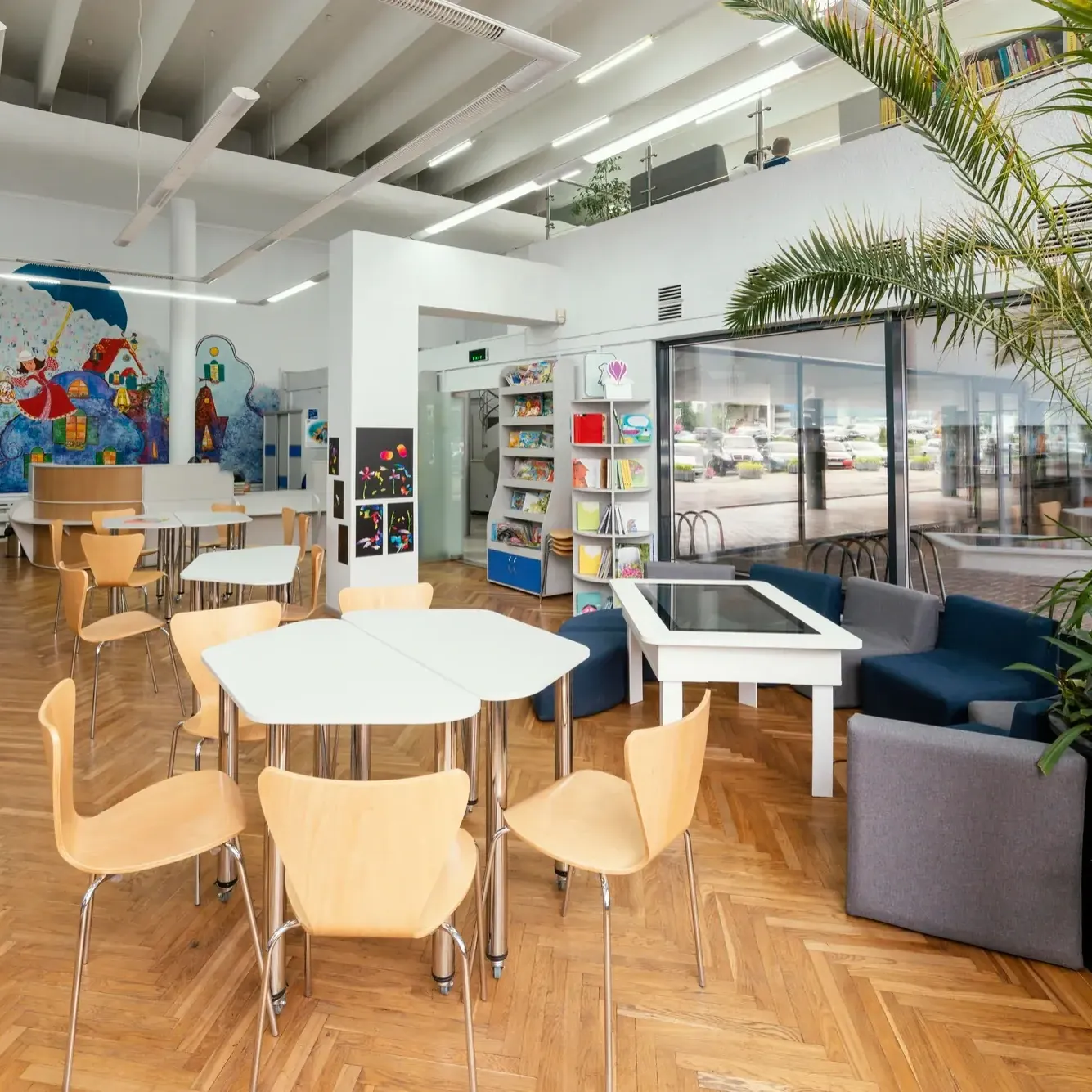
Public area cleaning focuses on shared and administrative spaces — lobbies, corridors, stairwells, public restrooms, conference halls, restaurants, fitness and spa areas, laundries, storage, and administrative offices.
Key differences from housekeeping:
- Work schedule — public area cleaning happens in low-guest-traffic windows: early morning (5:00–8:00), late evening (22:00–24:00), or overnight. Conference rooms are often turned around quickly after events.
- Discretion and low visibility — staff must work behind the scenes without disrupting the guest experience. Compact trolleys, quiet doors, headlamps for night work.
- Frequency — lobbies and restrooms cleaned multiple times daily, corridors and elevators daily mornings, conference rooms before and after events, fitness areas daily evenings.
- Broader skillset — beyond hygiene standards, knowledge of event protocols (table layouts, catering coordination, rapid room turnovers), F&B coordination, and ability to operate specialized equipment like floor polishers for marble lobbies (common in premium hotels).
- Chemicals and materials — public areas often require EU Ecolabel–certified products, neutral pH formulations (for marble and wood), antibacterial treatments in restrooms and fitness areas.
Example from our portfolio: a 4-star hotel in central Cracow (180 rooms, 120-person conference room, 80-seat restaurant, 300 m² spa). Public area cleaning scope includes:
- Lobby + reception: daily 5:00–7:00 and 22:00–23:00
- Corridors on 6 floors: daily 6:00–8:00
- Public restrooms (4 locations): 4 times daily (8:00, 12:00, 16:00, 22:00)
- Conference room: before and after each event (average 3 times/week)
- Restaurant: daily 23:00–1:00 (kitchen coordination)
- Fitness and spa: daily 21:00–22:00
- Administrative offices: twice weekly after 18:00
Our Reefa team is 5 people on rotating shifts, event response time < 4 hours, all on employment contracts, trained in occupational safety and GDPR. Rate for this scope: PLN 18,500 net/month, or approximately 4.40 PLN net/m²/month across ~4,200 m² of public space.
Why Hotels Outsource Public Area Cleaning?
Our 2025/2026 observations show that 68% of hotels with 120+ rooms in Cracow and Katowice use an external partner for public area cleaning. Main drivers include:
Cost optimization and budget predictability
Maintaining an in-house public cleaning team requires permanent staff (often night shifts), equipment purchase and maintenance (floor polishers, industrial vacuums, trolleys), and chemical inventory. Outsourcing converts variable costs into a fixed monthly fee. Average cost of in-house staff (3 people + coordinator + equipment) is roughly PLN 22,000–26,000 gross/month, while outsourcing at that scale runs PLN 16,000–20,000 net/month.
Flexibility for events and seasonality
Conference hotels experience demand spikes (Q4 events, Q2 medical conferences). An external firm quickly scales teams — from 3 to 6 people for a busy weekend event. In-house teams would need overtime or temporary contracts, creating administrative and quality headaches.
Professional quality management and SLA
An outsourcing provider offers 3-tier quality control (self-check, team leader, client audit), written SLA with KPIs (response time, reclamation rate < 2%, attendance > 98%), and backup staffing. In-house, illness often means service gaps or colleague overtime.
Labor law compliance and liability insurance
Specialist firms like Reefa employ staff exclusively on employment contracts (not freelance or piece-work), eliminating labor inspection risk and worker claims. We carry PLN 500,000 liability insurance — if improper chemical use damages a marble lobby floor (a real case: PLN 18,000 in dulling damage), the insurer covers it. Hotels rarely carry dedicated coverage for cleaning teams.
Freeing management for core business
Hotel directors focus on revenue management, guest experience, sales strategy, and OTA partnerships. Managing cleaning staff rotation, ordering chemicals, servicing equipment — these consume time and distract from core functions. Outsourcing moves those tasks to the facility manager on the vendor side; the hotel receives a monthly quality report and KPIs.
Similar outsourcing approaches apply to offices and office buildings — more on that model in office cleaning in Cracow.
Operational Requirements for Hotel Public Area Cleaning
Public area cleaning places specific hospitality-sector demands on the service provider:
Working during low-guest-activity hours
A 5-star lobby with an event ending at 23:00 must be guest-ready by 6:00 AM — no traces, no chemical odors, no marble stains. This means overnight hours (23:30–5:30), silent operation (equipment < 65 dB), minimal lighting or headlamps. Staff must be trained in guest interaction — brief greeting, quick exit if they meet someone.
Discretion and hospitality culture
Premium guests expect invisible perfection — cleanliness without visible staff. Teams wear matching uniforms (often hotel branding, not vendor logos), move on planned routes (furthest areas first, avoiding dirt transport), avoid talking in guest areas. Reefa provides a 2-day onboarding for hotel staff, covering guest interaction etiquette, lost-and-found procedures, and reporting suspicious activity to security.
Knowledge of event and protocol procedures
A conference room after a 200-person banquet requires 4-phase turnover:
- Phase 1 (0–30 min): remove waste, dismantle catering (coordinated with F&B)
- Phase 2 (30–60 min): vacuum carpets, wipe chairs and tables
- Phase 3 (60–90 min): reset room per floor plan for next event (if scheduled)
- Phase 4 (90–120 min): quality check, refill water, test AV, notify event manager
Untrained staff won't meet time or will damage the setup. At Reefa, every team member has access to event rundown via a mobile app synced with PMS and hotel calendar.
Certified chemicals and occupational safety procedures
Hotels often hold environmental certifications (Green Key, EU Ecolabel, LEED) or face brand-standard audits (Marriott, Hilton QA). This requires EU Ecolabel–certified chemicals, Nordic Swan, or equivalent. Reefa uses Diversey and Ecolab product lines with EU Ecolabel certification, neutral pH for marble and wood, free of phthalates and phosphates.
Staff complete occupational safety training for heavy equipment (180 kg floor polishers), lockout/tagout procedures during maintenance, and first aid (guests often ask for medical assistance).
Typical Public Area Cleaning Rates in Hotels — Cracow 2026
Rates for hotel public area cleaning differ significantly from office standards due to night scheduling, event requirements, and flexibility demands.
3-star hotel (80–120 rooms, 1,500–2,500 m² public space)
Scope: lobby, corridors, 2 public restrooms, 1 conference room up to 50 people, 80 m² fitness. Frequency: daily (except conference room—event-based). Rate: 14–18 PLN net/m²/month, averaging 16 PLN. Team: 2–3 staff, 1 coordinator. Annual contract, monthly fee PLN 24,000–40,000 net.
4-star hotel (120–200 rooms, 3,000–5,000 m² public space)
Scope: premium lobby, 5–8-floor corridors, 4 public restrooms, 2 conference rooms (200 m² combined), 150 m² restaurant, 300 m² fitness/spa, 200 m² admin offices. Frequency: daily, restrooms 4x/day, conference rooms per event (average 8/month). Rate: 16–22 PLN net/m²/month, averaging 19 PLN. Team: 4–6 on rotating shifts, 1 team leader. 2-year contract, monthly fee PLN 48,000–110,000 net.
5-star / boutique hotel (200+ rooms, 6,000+ m² public space)
Scope: marble high-traffic lobby, 10+ floors, 6 public restrooms, 800 m² conference center (5 rooms + foyer), 2 restaurants (250 m² combined), 600 m² spa/wellness, 400 m² laundry/storage, 300 m² offices. Frequency: continuous presence (morning 5:00–13:00, evening 21:00–5:00), restrooms every 2 hours, conference rooms daily or per event. Rate: 22–30 PLN net/m²/month, averaging 26 PLN. Team: 8–12 staff, 2 team leaders, 1 account manager. Multi-year contract, monthly fee PLN 130,000–180,000 net.
Factors affecting rate:
- Night schedule: +15–25% (night shift premium for staff)
- Event flexibility: +10% for < 4-hour availability for events
- Chemical certifications: +5–8%
- 3-tier quality control and audits: +8–12%
- Liability insurance above PLN 250,000: +3–5%
For comparison, office cleaning in Cracow class A space is 8–14 PLN net/m²/month — the difference reflects scheduling, discretion, and flexibility. More on office standards in office building cleaning in Cracow.
How to Choose a Public Area Cleaning Firm for Your Hotel
Selecting an outsourcing partner for public area cleaning is a strategic decision affecting guest experience, brand reputation, and operational costs. We recommend this selection process:
Verify hospitality industry experience
Hotel cleaning differs from office or school cleaning. Candidates should have references from hotel properties (specific names, contacts) and case study portfolios. Verification questions:
- How many hotel properties do you currently serve?
- What's your average contract duration?
- Have you handled hotels with 500+ m² conference centers?
- Do you have event turnover experience (response time, express mode)?
Reefa has served hotel and conference properties in Cracow since 2020, averaging 2.4 years per contract, with a 96% client retention rate. More on our portfolio on the about page.
Employment status of personnel
In hospitality, team stability and loyalty are critical. Staff on freelance or piece-work contracts mean high turnover (40–60% annually), weak brand identification, and accountability issues. Require employment contracts only — a sign of professionalism and responsibility. Reefa employs all staff on employment contracts, resulting in an 89% retention rate and average tenure of 1.8 years per hotel team.
Liability insurance and risk management procedures
Hotels are high-risk environments: marble floors (PLN 200–400/m² replacement), lobby artwork, AV equipment in conference rooms (PLN 15,000–30,000 projectors), designer furniture. Candidates must carry minimum PLN 250,000 liability insurance (preferably PLN 500,000), valid throughout the contract, with coverage for damage to client property. Reefa carries PLN 500,000 OC with client property damage extension.
SLA, KPIs, and quality control
Professional contracts define Service Level Agreements with measurable KPIs:
- Schedule compliance: ≥ 98%
- Emergency response time: < 4 hours
- Reclamation rate: < 2% of inspections
- Staff attendance: ≥ 98% (backup within < 12 hours)
- Quality audit: monthly joint audit (hotel + Reefa), report with photos and checklist
Reefa uses 3-tier quality control: operator self-check, team leader end-of-shift check, account manager weekly audit. Monthly reports go to the hotel's administrative director in KPI dashboard format.
Flexibility and scaling
Hotels need partners able to quickly scale: a 300-person event on a weekend requires 2–3 extra staff; lobby renovations in Q1 require schedule adjustments. Check if candidates have staffing reserves (backup pool for substitution and scaling), escalation procedures (24/7 emergency manager line), contract flexibility (same-day event support without administrative delays).
Reefa maintains a 15% staffing reserve for hotel contracts, operates 24/7 emergency phone support (< 30-minute response), and offers on-demand event mode (48-hour notice, team scaling with no extra fees).
Frequently Asked Questions
Can one firm handle both housekeeping and public area cleaning?
Yes, some specialized firms offer both. Integrated cleaning has pros (single contact, unified quality, better coordination) and cons (single point of failure, harder to scale specialty). Cracow observations show ~30% of hotels use one vendor for both, 70% split: in-house housekeeping + external public area cleaning. Reefa specializes in public area cleaning (shared spaces) and does not offer room-level housekeeping — this lets us maintain top standards in our niche.
What does public area cleaning cost for a 4-star hotel in Cracow?
For a 4-star hotel with 4,000 m² of public space (lobby, corridors, 4 public restrooms, 2 conference rooms 200 m² combined, 150 m² restaurant, 300 m² fitness/spa, 200 m² offices), typical rate is 16–22 PLN net/m²/month, averaging 19 PLN. For 4,000 m², that's a monthly fee of PLN 64,000–88,000 net (average ~76,000 net, ~93,500 gross). Included: 4–6 staff on rotating shifts, EU Ecolabel–certified chemicals, equipment, quality control, coordinator, PLN 500,000 liability insurance, < 4-hour event response.
Does cleaning staff have access to all hotel areas?
Public area teams have access to shared spaces, corridors, conference rooms, restaurants, fitness, spa, public restrooms, admin offices, and technical areas (laundries, storage). No access to guest rooms (housekeeping scope), server rooms, safes, or valuables. Entry uses key cards with PMS logging (audit trail) or manager supervision. Reefa staff complete VOD (document verification), GDPR training, and site-specific access procedures.
How is coordination with F&B and events handled?
F&B and event coordination is vital to avoid conflicts (cleaning during dinner service) and ensure timely room turnover. We use shared calendar — the hotel event manager shares the schedule (Google Calendar, Outlook, PMS) with upcoming events, meal times, planned maintenance. Our team leader synchronizes the evening shift at 14:00 daily; for same-day events (4-hour notice for catered meetings), we get SMS/email and adjust or add staff. After event catering ends, we wait for F&B approval before turning the space. Typical turnaround for a 100 m² room after an 80-person event: 60–90 minutes.
Can a cleaning firm work night shifts in a hotel?
Yes, public area cleaning often runs 22:00–6:00 or 5:00–9:00 to minimize guest contact. This requires:
- Staff consent and night shift premium (minimum 20% under labor law)
- Adapted occupational safety (emergency lighting, safe routes, no solo work in isolated areas)
- Security coordination (entry/exit logging, ID checks)
- Quiet equipment (< 65 dB vacuums, silent-mode machines)
- Internal communication (mobile app with alarm, Motorola radios in large buildings)
Reefa operates night teams in Cracow and Katowice, trained for night work, equipped with quiet machinery and occupational safety measures.
What certifications should a hotel cleaning vendor have?
4–5 star hotels, especially those in international chains (Marriott, Hilton, Accor), require vendor compliance with brand standards. Key certifications and documents:
- ISO 9001 (quality management system) — confirms process standardization
- ISO 14001 (environmental management system) — important for Green Key and EU Ecolabel hotels
- ISO 45001 (occupational health and safety management) — required for night work and heavy equipment
- EU Ecolabel or Nordic Swan for cleaning chemicals — standard for eco hotels
- Liability insurance minimum PLN 500,000 — required by most chains
- References from hospitality properties — list with contact details
Reefa holds ISO 9001:2015 and partners with chemical suppliers holding EU Ecolabel certification (Diversey, Ecolab). Full documentation available on request during procurement.
Summary — Why Hotels Choose Public Area Cleaning Outsourcing
Public area cleaning in a hotel is a specialized function requiring night schedules, event flexibility, discretion, and high standards. Outsourcing lets hotels focus on guest service and revenue while delegating facility management to a specialist partner.
Key outsourcing benefits:
- Cost predictability: monthly fee instead of variable costs (staffing, equipment, chemicals, backup coverage)
- Event flexibility: rapid team scaling for peaks and special events
- Professional quality management: SLA, KPIs, audits, monthly reporting
- PLN 500,000 liability insurance: protection against property damage (marble, AV, designer furniture)
- Employment contracts: low turnover, staff loyalty, labor compliance
Reefa has specialized in hotel public area cleaning in Cracow and Katowice since 2020. We operate night teams, maintain 15% staffing reserves, carry PLN 500,000 liability insurance, and average 96% client retention. Average contract duration in hospitality: 2.4 years — a sign of partner stability and satisfaction.
If you're planning hotel cleaning outsourcing or want to compare vendor offers, contact our team in Cracow — we'll prepare a quote tailored to your schedule, property standards, and event calendar.