Library and Reading Room Cleaning — Book-Safe Methods and Procedures
Professional library cleaning requires specialized knowledge of dust control, humidity management, and chemical safety for paper collections. Learn the procedures and best practices for protecting valuable book collections.
Professional library cleaning requires specialized knowledge of dust control, humidity management, and chemical safety for paper collections. Learn the procedures and best practices for protecting valuable book collections.
Why Library Cleaning Differs from Standard Educational Facilities
Public libraries, university libraries, and archives require a different approach than typical lecture halls and school corridors. Key risk factors include:
Book dust and allergens. Books accumulate dust — a mixture of cellulose paper particles, fabric fibers from bindings, dust mites, and their waste. In reading rooms with heavy foot traffic (dozens of visitors daily), dust becomes airborne, triggering allergic reactions among users and staff. Vacuuming must occur daily using HEPA (High Efficiency Particulate Air) vacuum cleaners with filtration efficiency >99.95% for particles ≥0.3 µm — the type of equipment we have used at Reefa since our inception.
Relative humidity control. Paper is hygroscopic — it absorbs and releases moisture depending on room microclimate. At relative humidity >60%, mold (species Aspergillus, Penicillium) develops, irreversibly destroying paper. At humidity <40%, paper dries out, becomes brittle, and cracks. During surface cleaning (shelves, floors), teams must use minimal water quantities and fast-drying preparations to avoid raising local humidity levels.
Chemical agents and paper oxidation. Ethyl alcohol, chlorine-based disinfectants, and detergents with essential oils can adsorb onto paper, accelerating cellulose degradation (yellowing, crumbling). Preferred are pH-neutral preparations (pH 6.5–7.5), fragrance-free, without residue. At Reefa, we use products bearing EU Ecolabel and Blue Angel certifications, safe for cellulose materials.
Limited access and oversight. In university library storage zones (e.g., Jagiellonian Library at UJ, Main Library at AGH in Cracow), cleaning teams work under the supervision of academic staff or conservation specialists. Staff must not touch books, move shelves, or open cases containing rare items. A dedicated Reefa coordinator — assigned to each facility — coordinates with the library director on schedule and access zones, ensuring operational continuity without risk of collection damage.
How to Clean a Library — Daily, Weekly, and Monthly Procedures
Library cleaning requires three layers of procedures at different frequencies, tailored to user traffic intensity and collection size.
Daily Procedures (5 days per week, evenings after closing)
- Floor vacuuming in reading rooms, corridors, and catalog zones — HEPA vacuum with parquet attachment (to avoid scratching PVC flooring or wood). Proceed from far zones toward the exit to prevent dust from being stirred up again. Time for 300 m² of reading space: ~1 hour for a 2-person team.
- Trash removal — segregated waste (paper, plastic, organic), biodegradable bags.
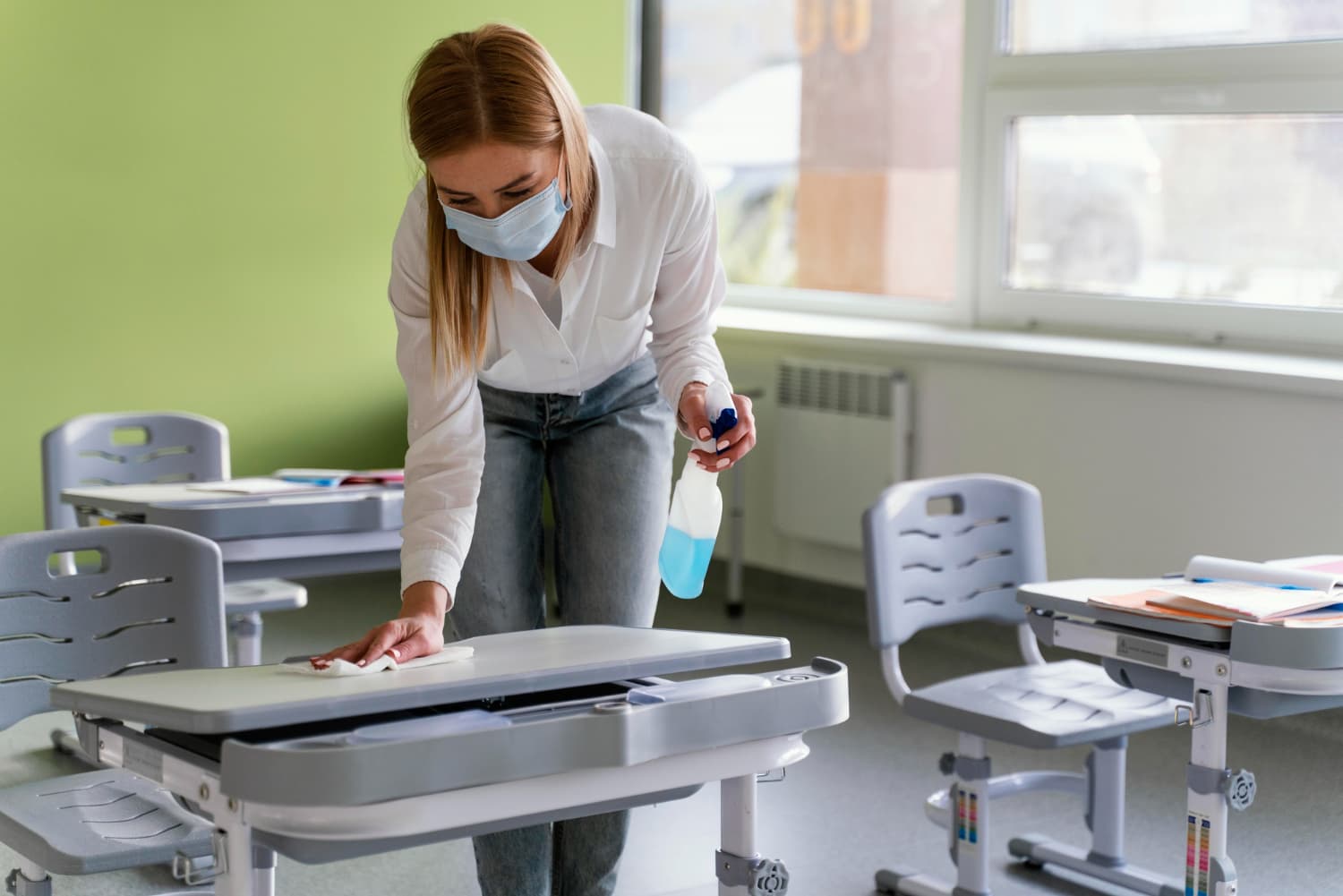
- Visual inspection of reading tables — remove crumbs (without damp wiping to prevent leaving moisture on wooden surfaces). If a table is soiled (coffee, grease), use lightly dampened (not wet) microfiber cloth and immediately dry with a clean cloth.
- Restroom and facility cleaning — standard procedure as with office cleaning, disinfectants compliant with EN 14476 (antiviral efficacy standard).
- Photo report for the library coordinator — at Reefa, after each cleaning we send a series of photos (reading room, catalogs, restrooms) to a dedicated app so the director has documentation of cleanliness status.
Weekly Procedures (once per week, e.g., Saturday morning before opening)
- Shelf wiping — top-to-bottom method: upper shelf → successive levels downward so dust falls onto lower shelves and is collected. Dry microfiber cloth (chemical-free) or lightly dampened with pH-neutral preparation. PROHIBITION on touching book spines — cloth passes only over shelf wood/metal, 2–3 cm before the book line. Time for a library shelf (6 shelves, 2 m wide): ~5 minutes. For a 1,000 m² library with ~150 shelves → ~12.5 hours for a 3-person team.
- Furniture vacuuming — upholstery attachment to remove dust particles and mites. Extraction cleaning is excluded (too much moisture, long drying time).
- Corridor and lobby floor cleaning — flat microfiber mop, pH-neutral fast-drying preparation (<10 min drying). Vinyl, tile, and terrazzo floors tolerate weekly washing; wooden parquet — consider dry cleaning or quarterly oiling (outside regular cleaning schedule).
- Glass surface cleaning — entry doors, display cases, window panes. Alcohol-free agent (alcohol evaporates but residual fumes can adsorb onto paper in nearby shelves).
Monthly Procedures (once per month, in consultation with library staff)
- Complete floor washing — including zones under movable shelves (if construction permits) and behind service desks. Vacuum the floor, then mop with minimal water (5-10 ml preparation/m²), with immediate drying.
- Baseboard, radiator, and sill cleaning — areas where secondary dust accumulates. Damp cloth, pH-neutral preparation, dry wipe after cleaning.
- Storage and archive zone cleaning — under conservator supervision. Prohibition on steam cleaners (steam raises RH in the room) and chlorine. At Reefa, before entering a climate-controlled zone, the team receives a safety briefing and procedures for collection protection, and is given a list of "no-touch zones."
- Relative humidity measurement and reporting — the Reefa coordinator reads wall hygrometers (if the facility has them) and reports deviations to the director. If RH >60%, we recommend contacting HVAC services to prevent mold development.
- High-touch disinfection — door handles, light switches, stair railings, touchscreen OPAC catalog terminals. Antiviral agent with 1-minute contact time, applied to cloth, not sprayed (aerosol would settle on books).
Cleaning Agents and Equipment Safe for Library Collections
Selecting cleaning products for a library requires consultation with a conservator or collection development manager. Prohibited:
- Chlorine bleaches and chlorine disinfectants — chlorine gas (Cl₂) and hypochlorous acid (HClO) oxidize cellulose, causing paper to crumble within years.
- Ethyl alcohol >20% — degreases book cover leather and can cause discoloration.
- Ammonia — raises surface pH, destabilizing adhesives in bindings.
- Essential and fragrance oils — absorb onto paper, leaving permanent odor and grease stains.
- Steam cleaners and steam mops — water vapor raises relative humidity locally above 80%, which is critical for paper.
Permitted (and used by Reefa):
- pH-neutral (6.5–7.5) universal detergents — e.g., products with EU Ecolabel certification (criteria: >90% biodegradability, no phosphates, limited aquatic toxicity).
- Dry or lightly dampened microfiber — split-yarn microfiber mechanically removes dust without chemicals. After each cleaning, cloths are washed at 60°C without fabric softener (which leaves residue).
- HEPA H13 or H14 class vacuum cleaners — filter retains >99.95% of particles ≥0.3 µm, preventing secondary dust emission into the air.
- Flat mops with replaceable pads — minimize water consumption and allow rapid drying.
- Dry absorbents — in case of water spillage (e.g., system failure), granular sorbent or paper towels are used to immediately absorb moisture without spreading it across surfaces.
All Reefa staff undergo internal training (1 hour) covering elements of paper and wood conservation before starting work in a library. We maintain general liability insurance up to PLN 500,000, which covers damage to library collections caused by team error.
University Library Cleaning in Cracow — References and Specifics
Cracow is home to dozens of academic libraries with combined space exceeding 100,000 m². Selected facilities with particular requirements:
Jagiellonian Library (UJ) — collections comprise >4 million volumes, including unique rare books and manuscripts. Climate-controlled storage zones (18°C, 50% RH), access only for staff and approved cleaning contractor. Requires conservation briefing, work during night hours (22:00–06:00), and signing an NDA (Non-Disclosure Agreement) regarding collection security.
AGH Main Library — modern building with open reading rooms for ~500 users, intense student traffic. Daily reading room cleaning (2,000 m²) in shift system: evening after closing (22:00) and morning before opening (06:00). Procedures also include cleaning of the internal café area (tables, espresso machine, refrigerator) — typical for office cleaning with staff facilities.
Cracow Regional Library — holdings of ~300,000 volumes including regional materials. Special emphasis on protecting cartographic collections (historical maps, city plans) from humidity and UV light. The Reefa team photographs each zone before starting cleaning, and again after completion, to document no displacement of documents.
In Cracow, we manage contracts for educational facilities under SLA (Service Level Agreement) with <24-hour response time for interventions (e.g., liquid spills, equipment damage) and a QR-based reporting system for library staff. The dedicated coordinator contacts the library director weekly to coordinate cleaning schedules for zones with changing access hours (e.g., before exam periods, during renovations).
How Much Does Library Cleaning Cost in Cracow and Katowice?
Pricing depends on area, frequency, degree of historic significance of collections, and access hours. Below are current net rates effective in 2026 for the Cracow/Katowice market (Reefa):
- Public or school library (reading room + storage <500 m²), daily evening cleaning (5 days/week): from PLN 12 net/m²/month.
Scope: HEPA vacuuming, trash removal, restrooms, floor washing 1× per week, photo reports. - University library (reading rooms 1,000–2,000 m², climate-controlled storage): from PLN 14 net/m²/month for 5 days/week + PLN 2 net/m²/month for storage zone with conservator oversight.
Additional requirements: safety and conservation training for team, NDA, liability insurance up to PLN 500,000 (included in price). - Archive or rare book library (manuscripts, incunabula): from PLN 18 net/m²/month in agreed access schedule (e.g., 2 times per month, nighttime).
Extensions: humidity measurements, photographic audit "before–after," dedicated coordinator for that facility only. - One-time or emergency cleaning (e.g., after flooding, before inspection): PLN 65–90 net/m².
Example: school library in Cracow, 400 m² (reading room 250 m², storage 100 m², restrooms + corridor 50 m²), cleaning 5 evenings per week.
Monthly cost: 400 m² × PLN 12/m² = PLN 4,800 net (~PLN 5,900 gross). Included: HEPA vacuuming, floor washing 1× per week, photo reports, dedicated coordinator, access to QR-based reporting system.
For university libraries, we offer a "fixed-price + KPI" model: fixed monthly fee, with service interruption due to provider error (e.g., no team available) resulting in a 5% credit for each day of delay. This approach is valued in contracts with facilities where cleaning schedule is critical for operations (e.g., before exam sessions).
Library Cleaning in Katowice — Service Development Since 2024
Since 2024, the Reefa team has operated in the Silesian agglomeration, offering cleaning for educational facilities in Katowice — including public and university libraries. Regional specifics:
- Dense network of municipal and branch libraries (Katowice, Chorzów, Sosnowiec, Gliwice) — average area 300–600 m², general collections, heavy user traffic (dozens of visitors daily).
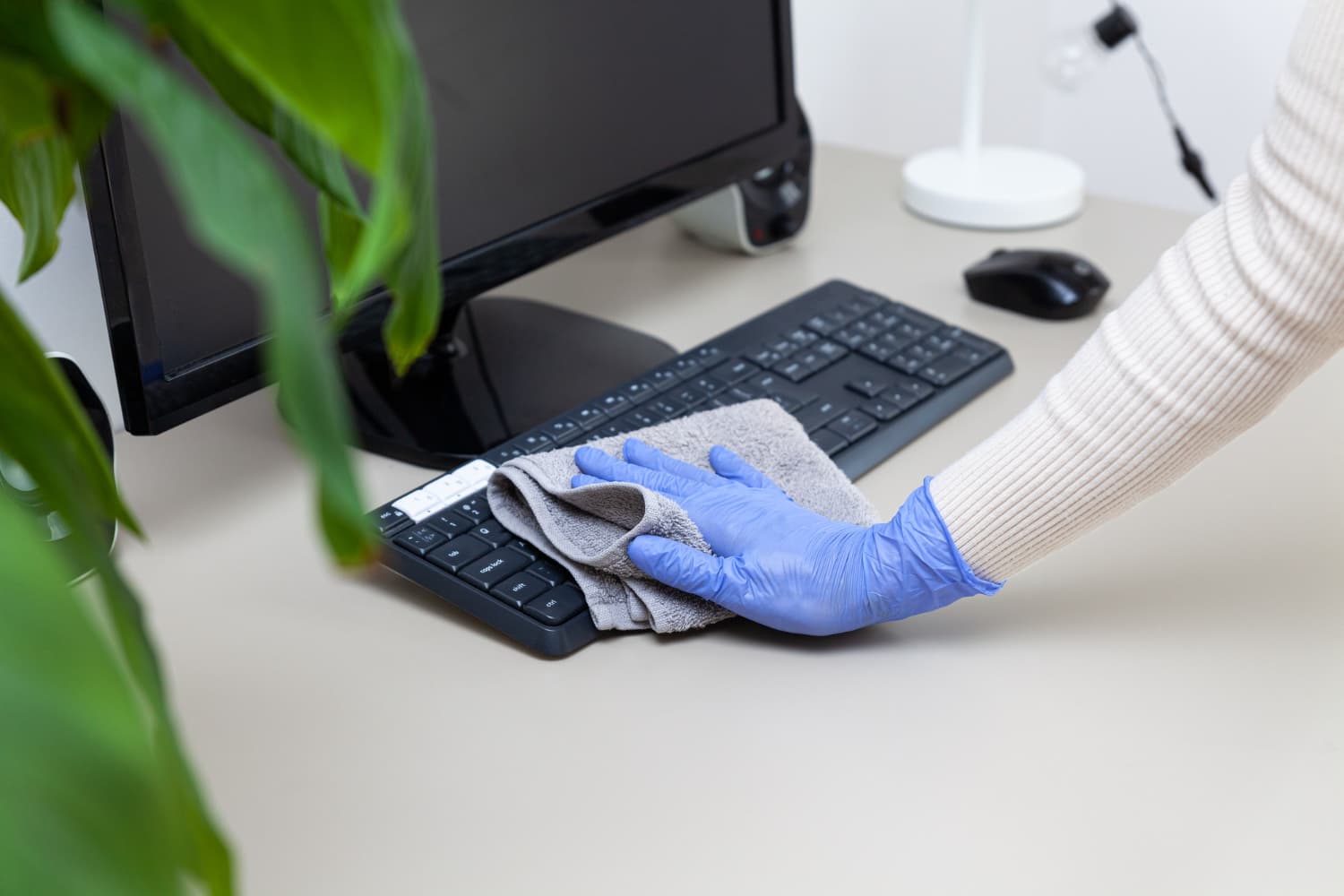
- University of Silesia — several departmental libraries, specialized collections (law, medicine, economics), zones with computers and e-book readers. Beyond standard cleaning, screen and keyboard cleaning is required (antistatic cloths, isopropyl preparation <10%).
- Upper Silesian Digital Library (digitization center) — requires ESD (Electrostatic Discharge) procedures when cleaning rooms with scanners and servers.
In Katowice, we work with facilities in a subscription model: 12-month contract with optional extension for post-renovation cleaning (e.g., flooring replacement, painting — post-renovation cleaning service also available as post-construction cleaning for newly opened libraries).
Risk Management in Library Cleaning — Insurance, Safety, Audits
Cleaning facilities with valuable collections carries elevated legal and financial risk. Key safeguards:
Liability and property insurance. At Reefa, we maintain liability coverage up to PLN 500,000 with extension for damage to library collections (book damage, water damage, document loss). The policy also covers "pure financial loss" — indirect losses (e.g., necessity to close reading rooms to users due to team error).
Safety and HACCP training. The team is trained in:
- Working in climate-controlled spaces (climate zones: dress code, exposure time, prohibition on drinks and food)
- First aid in public facilities (16-hour course with certification)
- HACCP — in libraries with staff facilities (kitchen, espresso machine) HACCP documentation is mandatory, though no food is sold
Internal audits and photo reports. A dedicated Reefa coordinator performs monthly audits (30-point checklist: reading room cleanliness, no dust on shelves, vacuum condition, humidity levels). The report is emailed to the library director with attached photos and an action plan (if deviations are found).
QR-based intervention reporting system. In each reading room we place a QR code (sticker at exit) that library staff can scan if additional cleaning is needed (e.g., coffee spill, restroom damage). The report goes to the coordinator, who responds <24 hours.
Specific Challenges: Rare Books, Archives, Preventive Conservation
Libraries with historic collections (manuscripts, incunabula, historical maps) require preventive conservation — a complex of actions preventing paper degradation. Cleaning is one pillar of this strategy.
Fine dust control. Dust particles <10 µm (PM10) penetrate paper structure, accelerating oxidation. HEPA vacuuming reduces PM10 by ~80% (compared to non-filtered bag vacuums). At Reefa, vacuums are serviced quarterly (filter replacement, seal inspection), documented by protocol.
Mold protection. In Cracow and Katowice, external relative humidity exceeds 70% for ~120 days annually (autumn, spring). In libraries without central HVAC (older buildings), we recommend:
- Evening cleaning after closing so moisture from floor washing has time to dissipate (natural nighttime ventilation)
- Hygrometer measurements (portable, digital) by the Reefa coordinator — if >60%, we inform the director and recommend a dehumidifier
Prohibition on slow-drying agents. Floors are mopped with squeezed-out (not wet) mop heads — water consumption <5 ml/m². Fast-drying preparation (isopropyl alcohol <5%, rest water + nonionic detergent) evaporates in <10 minutes.
"No-touch" zones. Display cases with rare items, cabinets with manuscripts, storage in sterile packaging (e.g., archival materials in polypropylene sleeves) — the Reefa team does not open, move, or touch. Exterior case glass wiping — once per month, alcohol-free agent, dry microfiber after washing.
Selecting a Library Cleaning Contractor — Questions and Criteria
Library directors planning to outsource cleaning should ask potential contractors these questions (and expect specific answers):
Has your team been trained in protecting paper collections?
Good answer: yes, in-house training + conservation briefing before first cleaning. Check for documentation (certificates, credentials).What vacuum cleaners do you use and how often are filters replaced?
Expected answer: HEPA H13 or H14 class vacuums, filter replacement quarterly (or per manufacturer recommendation). Ask for documentation of last replacement.Do your cleaning products have safety certifications for paper?
Best: EU Ecolabel, Blue Angel, Nordic Swan. pH-neutral (6.5–7.5), chlorine-free, alcohol <20%, no essential oils.Do you provide liability insurance covering library collections?
Good answer: yes, policy up to min. PLN 500,000 with collection damage extension, copy available before contract signing.How do you report completed work?
Standard: photo reports after each cleaning (or weekly) + monthly audit with checklist. At Reefa additionally: QR-based intervention system, dedicated coordinator, humidity measurement protocol (if in scope).What is your SLA for emergency interventions?
At Reefa: <24 hours (liquid spill, equipment failure, urgent pre-inspection cleaning). For libraries with critical schedules (e.g., before university ceremony), <6-hour SLA possible with 10% daily rate credit for each hour of delay.Can we see references from similar facilities?
Ask for contact with a library director or facility manager already using the service. At Reefa — operating since 2020 in Cracow and 2024 in Katowice, we serve educational facilities requiring climate control, legally employed and insured team.
When selecting a contractor, note the price-to-scope ratio: the cheapest offer often omits key elements (HEPA vacuums, pH-neutral products, insurance, coordinator, photo reports). A comprehensive offer at PLN 12–18 net/m²/month (for daily cleaning) is fair for the Cracow/Katowice market in 2026.
Frequently Asked Questions
How much per hour for library cleaning?
Hourly rate for library cleaning in Cracow and Katowice is PLN 35–50 net/hour per worker, depending on scope (standard vacuuming vs. climate-zone work with oversight). In a subscription model (monthly contract), per-m² per-month billing provides better value and cost predictability. Example: a 400 m² library cleaned 5 times per week costs PLN 4,800 net/month (~PLN 60 net/hour assuming 4 hours daily × 20 working days). At Reefa, we offer flexible models — both hourly rates for one-time cleanings and fixed m² per-month fees for annual contracts.
How to clean a library step by step?
Correct procedure for daily library cleaning includes:
- Ventilation (5–10 minutes) — open windows in the reading room to lower humidity accumulated during the day.
- Floor vacuuming — HEPA vacuum, movement from far zones toward exit to prevent secondary dust stirring.
- Trash removal — biodegradable bags, paper/plastic segregation.
- Table inspection — remove crumbs with dry cloth, if needed wipe damp microfiber and dry immediately.
- Restroom cleaning — disinfectants per EN 14476 standard.
- Photo report — 3–5 photos for the coordinator and library director.
Weekly: shelf wiping (dry or lightly dampened microfiber, pH-neutral preparation), floor mopping, chair cleaning. Monthly: complete floor washing and storage-zone cleaning with librarian oversight.
How much do library cleaning staff earn?
In 2026 in Cracow and Katowice, a worker directly employed by the library as a cleaner earns PLN 4,500–5,500 gross/month (employment contract, full-time). With outsourced cleaning to firms like Reefa, the team receives wages per the Labor Code (minimum ~PLN 4,300 gross for full-time in 2026), plus social and health insurance — critical for legal employment. All Reefa staff are employed under work contracts with full social insurance and liability coverage, documented with certificates for the client (requirement for public procurement). The employer cost (gross + social security) is ~PLN 6,000–7,000/month per worker — a significant budgeting element.
Can someone work in a library as a cleaner without formal qualifications?
Yes — the cleaner position in a library does not require higher or specialized education in librarianship. Required:
- Safety training (at least basic, 3 hours) — employer obligation before work starts.
- Collection protection briefing — in-house (1 hour), conducted by a librarian or conservator, covering "no-touch" rules, prohibition on harsh agents, humidity monitoring.
- HEPA vacuum and flat-mop operation knowledge — practical training (30 minutes).
Most Reefa workers have secondary education and are trained in industry procedures. We employ legally (work contracts, liability insurance), ensuring service continuity and legal security for the client.
Can floor-washing products used in libraries damage books?
Yes, if poorly selected. Chlorine bleaches, ammonia, alcohol >20%, and oil-based detergents may:
- Emit absorbable vapors that settle on paper and accelerate cellulose oxidation (yellowing, brittleness).
- Raise local relative humidity (with water-based, slow-drying products) — mold risk.
- Leave grease residue on floors, which secondarily becomes airborne and settles on book spines.
At Reefa we use only pH-neutral (6.5–7.5), fast-drying (<10 min) products certified by EU Ecolabel or Blue Angel, containing no chlorine, phosphates, or oils. Flat mops with squeezed microfiber — water consumption <5 ml/m². This ensures safety for paper collections.
How often should a university library be cleaned?
A university library with heavy traffic (hundreds of daily users) requires:
- Daily (5–7 days/week): HEPA vacuuming of reading rooms, corridors, catalogs; trash removal; restroom cleaning.
- Weekly: shelf wiping (dry microfiber), corridor floor washing, chair and table cleaning.
- Monthly: complete floor washing throughout, storage-zone cleaning under conservator supervision, high-touch disinfection, RH measurement.
For smaller libraries (branch, school) 3 times per week is possible (vacuuming every other day instead of daily) — but high-traffic zones (main reading room) always need daily vacuuming. At Reefa, we recommend an initial audit to adjust frequency to actual facility load.
Contact the Reefa Team — Quotation for Your Library
If you manage a public, university, or archive library in Cracow or Katowice and seek a professional cleaning partner with collection protection, we welcome your inquiry. Our dedicated coordinator will prepare a free quotation and propose a cleaning schedule aligned with your facility's operating hours. The Reefa team — since 2020 in Cracow, since 2024 in Katowice — provides legally employed staff, liability insurance up to PLN 500,000, photo reports after each cleaning, and a QR-based reporting system for your convenience. Contact us and see how premium B2B library cleaning looks.