Office Carpet Cleaning — Methods, Frequency, Cost 2026
A practical guide for facility managers: carpet cleaning methods, frequency, costs per m² in Cracow and Katowice, and operational planning for deep cleaning contracts.
A practical guide for facility managers: carpet cleaning methods, frequency, costs per m² in Cracow and Katowice, and operational planning for deep cleaning contracts.
Office carpet cleaning is a process that extends far beyond routine vacuuming — it encompasses periodic deep cleaning that removes embedded organic contaminants, dust mites, and allergens while restoring the aesthetic appeal of textile surfaces. In the B2B environment, it directly impacts air quality, company reputation, and the lifespan of expensive floor coverings.
For a facility manager, understanding the differences between three core methods (extraction, dry cleaning, steam cleaning), establishing optimal cleaning frequency for specific traffic zones, and calculating costs relative to a standing service contract is essential. This article presents concrete pricing, schedules, and a decision-making checklist based on Reefa's experience managing Class A offices in Cracow and Katowice.
In brief
- Office carpet cleaning divides into routine vacuuming (daily/2–3× per week) and deep cleaning (every 3–12 months depending on traffic).
- Three main methods: extraction (wet extraction, drying time 6–24h), dry cleaning (powder/foam, ready in 1–2h), and steam cleaning (180–200°C, disinfectant action, drying 4–8h).
- Deep cleaning cost in Cracow and Katowice ranges from 3–8 PLN net/m² depending on method, soil level, and contract size.
- Frequency: high-traffic zones (lobbies, main corridors) require cleaning every 3–6 months; open-plan offices every 6–9 months; conference rooms once per year.
- One-time service vs. standing contract: single interventions cost 5–8 PLN net/m²; including deep cleaning in a service contract reduces the rate by 20–30% and ensures planned scheduling without operational disruption.
- Drying time must be scheduled for weekends or outside business hours to avoid blocking workstations.
Difference between vacuuming and deep cleaning
Routine vacuuming removes loose dust, hair, and fine particles from fiber surfaces but does not penetrate the backing. For most offices, vacuuming 2–3 times per week is sufficient; in high-traffic zones, daily vacuuming is recommended. As part of a standard office cleaning contract in Cracow or Katowice, vacuuming is included in daily cleaning services.
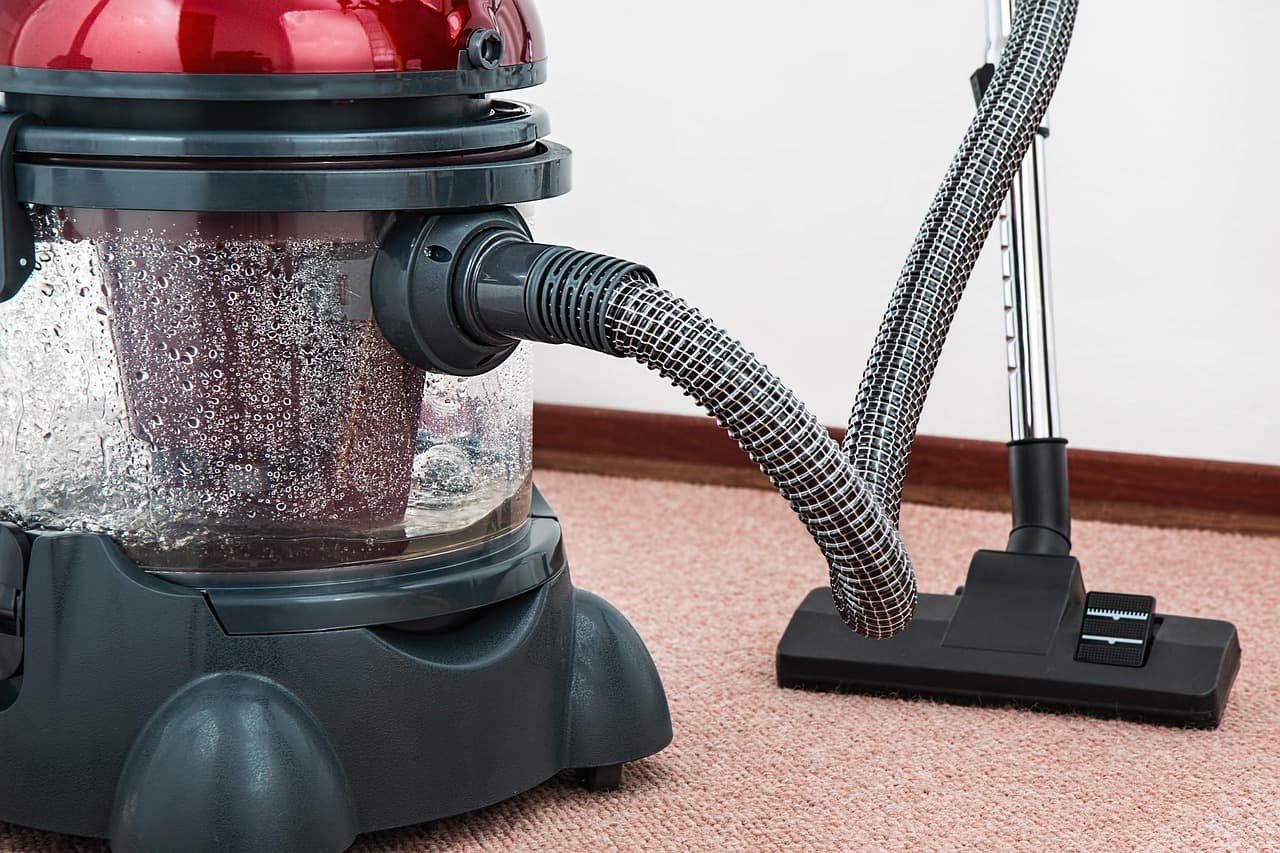
Deep cleaning (wet extraction) uses water pressure and chemical agents to extract organic soils, fats, allergens, and dust mites from deeper fiber layers and foam backing. This should be treated as periodic maintenance, similar to HVAC servicing or facade washing.
Key differences:
- Cleaning depth: vacuuming reaches surface layer (~2 mm); deep cleaning penetrates full fiber depth and backing layer.
- Stain effectiveness: a vacuum cannot remove spilled coffee, oily footprints, or organic residues.
- Impact on IAQ (Indoor Air Quality): deep cleaning reduces airborne allergen and bacterial concentration, important for allergy-prone employees.
- Frequency: vacuuming 2–7× weekly; deep cleaning 1–4× yearly.
Three carpet cleaning methods — technical comparison
1. Extraction (hot water extraction)
The most commonly used method in commercial environments. The machine injects pressurized hot water (50–70°C) at 3–6 bar pressure with detergents, then extracts the mixture along with soils into a recovery tank. A brush-head or rotary extractor penetrates the full fiber depth.
Advantages:
- Most effective for removing fats, organic stains, and allergens.
- Approved by most commercial carpet manufacturers (warranty preservation).
- Ability to apply odor-neutralizing agents (e.g., after water damage).
Disadvantages:
- Drying time 6–24 hours depending on air humidity and ventilation.
- Requires scheduling outside business hours, typically weekends.
- Not suitable for carpets on wooden or moisture-sensitive substrates.
Ideal scenario: open-plan offices over 200 m², synthetic fibers (polyamide, polypropylene) in medium to high-traffic zones.
2. Dry cleaning (encapsulation)
A method using polymer powder or foam that encapsulates soil particles; after drying, residue is vacuumed away. Fibers remain nearly dry (moisture <10%).
Advantages:
- Ready for use in 1–2 hours — ideal for offices with zero downtime tolerance.
- Minimal water use — lower risk of substrate leakage.
- Lower energy and water consumption versus extraction.
Disadvantages:
- Lower effectiveness on deep organic soils and fatty stains.
- Requires pre-treatment of stains.
- Does not fully eliminate dust mites and allergens from foam backing.
Ideal scenario: interval cleaning (every 3 months) in conference rooms, executive offices, and reception areas with low traffic where aesthetics are the priority.
3. Steam cleaning
The machine generates water vapor at 180–200°C delivered at low pressure to the fiber. High temperature deactivates bacteria, viruses, and dust mites without chemical detergents.
Advantages:
- Disinfectant action — particularly important in medical facilities, childcare centers, and wellness offices.
- Minimal water use and zero detergents (environmental certifications, e.g., EU Ecolabel).
- Drying time 4–8 hours, shorter than extraction.
Disadvantages:
- Weaker effectiveness against fatty stains and heavily soiled surfaces.
- Requires manual pre-treatment of stains with enzymatic cleaners.
- Not all fibers withstand temperatures >150°C (verify manufacturer specification).
Ideal scenario: carpets in areas requiring elevated hygiene standards (e.g., clinics, laboratories, pharmaceutical firm offices), facilities with environmental certifications (BREEAM, LEED).
Cleaning frequency — how to establish a schedule?
No single universal interval exists. Frequency depends on four variables:
- Traffic intensity (number of people passing through the zone daily).
- Carpet type (short vs. long pile, color, stain resistance).
- Seasonality (autumn-winter: mud, road salt; summer: dust).
- SLA (Service Level Agreement) requirements and company CSR policy.
Recommendations for typical office zones
| Zone | Traffic (persons/day) | Deep cleaning frequency | Priority method |
|---|---|---|---|
| Lobby, reception | >100 | Every 3–4 months | Extraction / dry cleaning (interval) |
| Main corridors | 50–100 | Every 4–6 months | Extraction |
| Open-plan offices | 20–50 | Every 6–9 months | Extraction |
| Conference rooms | <20 | Every 9–12 months | Dry cleaning / steam cleaning |
| Executive offices | <10 | Once yearly or ad hoc | Dry cleaning |
| Kitchen areas with carpet | 10–30 | Every 3 months (fatty stain risk) | Extraction + pre-treatment |
As part of an office cleaning contract in Cracow, Reefa's team proposes a schedule based on carpet condition audit and traffic zone mapping — delivered by a dedicated site coordinator.
Cost of office carpet cleaning — Cracow and Katowice rates 2026
Deep cleaning prices are quoted in PLN net per square meter. The calculation accounts for method, contract area, soil level (light / moderate / heavy), and optional stain pre-treatment.
One-time service rates (ad hoc)
| Method | Area <100 m² | Area 100–300 m² | Area >300 m² |
|---|---|---|---|
| Extraction (hot water) | 7–8 PLN/m² | 6–7 PLN/m² | 5–6 PLN/m² |
| Dry cleaning (encapsulation) | 6–7 PLN/m² | 5–6 PLN/m² | 4–5 PLN/m² |
| Steam cleaning | 8–9 PLN/m² | 7–8 PLN/m² | 6–7 PLN/m² |
Rates include travel within Cracow or the Upper Silesian agglomeration (Katowice, Sosnowiec, Gliwice, Zabrze, Tychy). Pre-treatment of intensive stains (coffee, wine, marker) is an additional 1–2 PLN/m².
Standing contract rates
When deep cleaning is scheduled in the annual facility management calendar (e.g., 2–4 interventions/year), the rate drops by 20–30%:
- Extraction: 4–6 PLN net/m²
- Dry cleaning: 3–5 PLN net/m²
- Steam cleaning: 5–7 PLN net/m²
A standing contract also guarantees:
- Priority scheduling (no queue during peak season).
- Dedicated site coordinator monitoring carpet condition and flagging cleaning needs before critical threshold.
- Photo reports before and after service (Reefa standard since 2020).
- Liability insurance up to 500,000 PLN covering carpet damage during cleaning.
Detailed cost calculation for your specific area is available in the Cracow cleaning price list.
One-time service vs. inclusion in standing contract
When to choose a one-time intervention?
- Emergency situations: water damage, fire (smoke and soot), spill of strong-smelling substance.
- Relocation or renovation: cleaning before handover or after construction completion (see post-renovation cleaning Cracow).
- One-time event: conference, internal expo, board meeting requiring elevated aesthetic standards.
- No existing cleaning contract.
Ad hoc jobs are executed within 48–72 hours of notification (depending on schedule availability). Payment by invoice; no framework agreement required.
When to include in a standing contract?
- Carpet area >200 m² in the office.
- Repeatability: office operates >6 months per year at the same location.
- Budget optimization: lower unit rate, no hidden travel costs.
- Predictability: deep cleaning scheduled in the calendar (e.g., March, September), coordinated with office downtime (holidays, vacations).
- Reporting and compliance: photo reports, certificates, service history in QR system for ISO audits or health & safety inspections.
In practice, most of our clients (including Class A offices in Cracow and medical centers such as Diamed) choose the all-inclusive model — deep cleaning as part of an office building cleaning contract, simplifying management and eliminating the risk of maintenance oversight.
Drying time and operational planning
Carpet drying time is a critical logistical factor. Employees cannot walk on damp surfaces due to slip risk, furniture impression marks, and mold formation in lower layers.
Drying time table (standard conditions: temperature 20–22°C, humidity 40–60%, mechanical ventilation)
| Method | Time to foot traffic | Full drying time |
|---|---|---|
| Extraction (hot water) | 6–8 hours | 12–24 hours |
| Dry cleaning | 1–2 hours | 2–4 hours |
| Steam cleaning | 4–6 hours | 8–12 hours |
Factors accelerating drying:
- Ventilation: open windows or activate air conditioning in dehumidification mode.
- Humidity reduction: dehumidifying units (available as add-on, cost ~150–250 PLN net/day).
- Temperature: raise to 24–25°C during drying period.
Best time windows for offices
- Friday after 6:00 PM → Sunday evening: ideal for extraction; carpet ready for Monday morning use.
- Wednesday evening (remote work Thursday): feasible for dry cleaning (ready Thursday afternoon).
- Holiday periods: Christmas, Easter, May holiday weekends — natural office downtime.
- Summer vacation (July–August): some departments are empty in rotating systems; zone-by-zone cleaning possible.
Reefa's team provides an intervention schedule coordinated with building management, accounting for event calendars, planned audits, and high-occupancy periods (e.g., finance department quarter-end closures).
Cleaning method selection checklist — decision tool
The following list helps facility managers select the optimal method based on facility criteria:
1. Can the office be taken offline for >12 hours?
- YES → extraction (highest effectiveness)
- NO → dry cleaning or steam cleaning
2. What is the soil level of the carpet?
- Light (surface dust, footprints) → dry cleaning
- Moderate (coffee stains, localized soils) → extraction or steam cleaning with pre-treatment
- Heavy (fats, embedded organics, odor) → extraction + intensive pre-treatment
3. Does the facility have environmental certifications (LEED, BREEAM, EU Ecolabel)?
- YES → steam cleaning (zero chemical detergents) or extraction with eco-certified agents
- NO → any method
4. Does the carpet have long pile (>8 mm)?
- YES → extraction (reaches backing)
- NO → dry cleaning sufficient
5. Are there allergy-prone or asthmatic employees in the office?
- YES → extraction or steam cleaning (allergen and dust mite removal)
- NO → dry cleaning acceptable
6. What is the budget and frequency?
- Premium budget, once yearly → extraction or steam cleaning
- Optimal budget, 3–6 month intervals → dry cleaning in rotation, extraction once yearly
- Limited budget → dry cleaning or increase vacuuming frequency instead of deep cleaning
7. Does the carpet manufacturer specify a method in warranty terms?
- YES → comply with recommendations (typically hot water extraction at pH 7–9)
- NO / carpet post-warranty → any fiber-safe method
Additional factors affecting selection and cost
Fiber type
- Polyamide (nylon 6, nylon 6.6): most moisture-resistant, extraction preferred.
- Polypropylene: more economical, less absorbent, suitable for dry cleaning.
- Wool: requires gentle agents at pH 5.5–7, temperature-limited (<40°C), steam cleaning not recommended above 150°C.
- Blends (wool blend): individual assessment; manufacturer typically provides detailed instructions.
Carpet color
Light shades (beige, gray heather) require more frequent cleaning — stains and soils are visible quickly. Dark colors (navy, anthracite) mask dirt but accumulate allergens and dust — important for air quality.
Substrate
Carpets on concrete tolerate any method. Wooden or parquet substrates require dry or steam cleaning with minimal water to prevent wood swelling.
Surface accessibility
Offices with heavy furniture (desks, cabinets, shelving) extend work time and may increase cost by 10–20%. Furniture relocation is optionally available as an add-on (~200 PLN net per room).
Office carpet cleaning and indoor air quality (IAQ)
Carpets act as a mechanical filter — they trap dust, pollen, and PM2.5 / PM10 particles. Without regular deep cleaning, they become reservoirs of allergens and microorganisms.
Deep cleaning (especially extraction and steam) reduces:
- House dust mites (Der p1, Der f1) — the leading office allergen.
- Bacterial endotoxins — can worsen asthma symptoms.
- Fungi and mold — develop in damp backing layers.
- Volatile organic compounds (VOCs) — some detergents contain VOCs, but eco-certified agents (e.g., EU Ecolabel) have emissions <1%.
For facilities with high IAQ requirements (e.g., pharmaceutical firm offices, clinics, call centers with large employee bases), we recommend cleaning every 3–6 months via extraction or steam.
Integration with facility management contracts
Reefa manages comprehensive FM contracts covering:
- Daily cleaning (vacuuming, surface cleaning).
- Periodic carpet deep cleaning (2–4× yearly schedule).
- Window and glazing washing.
- Outdoor area maintenance (winter: snow removal; summer: irrigation).
- Reporting systems: photo reports after each cleaning, QR-based feedback system, online dashboard for facility manager.
This all-inclusive model simplifies procurement, reduces vendor count (fewer invoices, NDAs, GDPR agreements) and ensures consistent quality. We support offices such as Say Hi! and Otto Bock (prosthetics and orthotic producer) — facilities demanding the highest standards.
If your company is considering a transition from a multi-vendor to single-vendor FM model, contact our team — facility audit and quotation are complimentary.
Frequently asked questions
How much does office carpet cleaning cost?
Office carpet cleaning in Cracow and Katowice in 2026 ranges from 3 to 8 PLN net per square meter, depending on method (dry cleaning, extraction, steam cleaning), contract area, and soil level. One-time ad hoc services cost 5–8 PLN/m², while including deep cleaning in a standing service contract reduces the rate to 3–6 PLN/m². Pre-treatment of intensive stains is an additional 1–2 PLN/m². Detailed cost calculation for your specific office area is available by contacting Reefa's team.
What is the best way to clean office carpets?
The best approach depends on traffic intensity, fiber type, and office availability. Extraction (hot water) is most effective for moderate-to-heavy soiling — it removes allergens, dust mites, and fats from deep layers but requires 6–24 hours drying. Dry cleaning (encapsulation) suits conference rooms and low-traffic areas — ready in 1–2 hours but less effective on organic stains. Steam cleaning combines disinfection with minimal detergent use, suitable for eco-certified facilities. In practice, most Class A offices choose extraction every 6–9 months, supplemented by dry cleaning in reception areas every 3 months.
How much does carpet cleaning cost per square meter?
In 2026, office carpet cleaning in Cracow and Katowice costs per square meter:
- Dry cleaning: 3–7 PLN net/m² (lower range in standing contracts, higher in one-time services).
- Extraction: 4–8 PLN net/m².
- Steam cleaning: 5–9 PLN net/m².
Cost is influenced by area (larger contracts lower unit price), soil level (stain pre-treatment +1–2 PLN/m²), and furniture accessibility (relocation requirement +10–20% to labor time). Annual contracts with 2–4 scheduled interventions guarantee rates 20–30% lower than ad hoc jobs.
Is office carpet cleaning worth the investment?
Yes, regular carpet cleaning is financially worthwhile for three reasons. First, it extends carpet lifespan — professional commercial carpet costs 80–250 PLN/m² installed; neglected cleaning reduces lifespan from 10–12 years to 5–7 years, incurring higher replacement costs. Second, it improves air quality (IAQ) — deep cleaning removes allergens, dust mites, and bacteria, reducing employee sick leave (especially autumn-winter). Third, it boosts company image — clean, fresh carpet in lobbies and meeting rooms builds professional standing with clients and business partners. Cleaning cost (3–8 PLN/m² annually) is a fraction of replacement expense or contract loss due to poor aesthetics.
How often should office carpet be cleaned?
Carpet cleaning frequency depends on traffic and zone type:
- Lobbies, receptions, main corridors (>100 people daily): every 3–6 months via extraction.
- Open-plan offices (20–50 people): every 6–9 months.
- Conference rooms, executive offices (<20 people): once yearly via dry or steam cleaning.
- Kitchen areas with carpet: every 3 months due to fatty stain and organic soil risk.
For facilities with environmental certifications (LEED, BREEAM) or high IAQ demands (medical centers, labs), cleaning every 3–6 months is advised regardless of visual condition. Reefa's dedicated site coordinator audits carpet condition during routine visits and proposes an optimal schedule aligned with facility budget.
How long does carpet take to dry after office cleaning?
Drying time varies by method and ventilation:
- Extraction (hot water): 6–8 hours to foot traffic; 12–24 hours full drying.
- Dry cleaning: 1–2 hours to foot traffic; 2–4 hours full drying.
- Steam cleaning: 4–6 hours to foot traffic; 8–12 hours full drying.
Optimal conditions: 20–22°C temperature, 40–60% humidity, mechanical ventilation (air conditioning, open windows). Dehumidifying units (available as add-on, ~150–250 PLN net/day) reduce drying time by 30–40%. Typically, cleaning is scheduled for weekends (Friday evening → Sunday) or vacation periods so carpet is fully ready Monday morning without slip risk or furniture marks.
Summary and next steps
Office carpet cleaning is an investment in asset durability, workplace environment quality, and company image. Selecting the right method (extraction, dry cleaning, steam cleaning), establishing frequency matched to traffic zones, and integrating with a facility management contract optimize costs and eliminate maintenance oversight risk.
Reefa's team serves offices in Cracow (since 2020) and the Upper Silesian region (since 2024), offering comprehensive services — from routine vacuuming to deep cleaning with photo reports and liability insurance up to 500,000 PLN. Contact our team for a complimentary carpet audit and customized quote for your facility.