Window Cleaning in Skyscrapers — Technologies and Safety Standards
Managing a high-rise or tall building? Learn the technologies, safety requirements, and cleaning frequency for window maintenance at height — from rope access to aerial work platforms.
Managing a high-rise or tall building? Learn the technologies, safety requirements, and cleaning frequency for window maintenance at height — from rope access to aerial work platforms.
Window Cleaning in Skyscrapers — Technologies and Safety Standards
Window cleaning in skyscrapers requires specialized methods, certified equipment, and above all — rigorous commitment to occupational safety and health. In buildings over 10 stories, standard cleaning methods are not an option; residential community managers, Class A office facility managers, and administrative directors must budget for high-altitude technologies, legal requirements, and schedules adapted to weather conditions.
Below is a comprehensive guide to high-altitude window cleaning methods, safety requirements, frequency, and costs — based on the experience of the Reefa team and industry standards applicable in 2026.
Quick Summary
- Window cleaning in skyscrapers requires rope access technologies, aerial work platforms, or anchoring systems — the choice depends on building architecture and roof access
- The contractor must possess high-altitude work certifications, liability insurance (minimum PLN 100,000 coverage), valid equipment inspections, and a trained safety team
- Frequency: 2–4 times per year for residential buildings, 4–6 times for Class A offices — depending on environmental contamination and tenant requirements
- Cost of industrial rope access: 15–35 PLN net/m² of window; aerial platforms: 20–50 PLN net/m²; in both cases, price increases with height and access difficulty
- Key verification aspects for contractors: references from similar buildings, list of equipment used (static ropes ∅ ≥10 mm, EN 397 helmets), liability insurance and weather schedule
- Example case: 15-story building, 400 windows (approximately 600 m² glass surface) — full cleaning cycle twice yearly costs 18,000–30,000 PLN net annually using rope access method
Why Does Window Cleaning in Skyscrapers Require Specialized Technologies?
Buildings over 10 stories present several challenges to the manager that are impossible in lower structures. First and foremost — access to the façade beyond the reach of ladders and standard platforms. Heights of 30–50 m (typical 12–16 story building) create the necessity to use rope access or specialized platforms that must comply with PN-EN 1808 standards (rope access systems) and PN-EN 280 (mobile platforms).
The second factor is the safety of workers and pedestrians below the building. Every element — from static rope through protective helmets to cleaning materials — must be secured against falling. In practice, this means establishing a protective zone at ground level, marking the work area, and cooperating with the building manager regarding roof or technical floor access.
The third aspect is weather conditions. High-altitude work can only be conducted when wind speed is below 10 m/s (approximately 36 km/h) and temperature above –5°C, which limits working windows, especially in autumn and winter. Therefore, the service schedule must include flexibility and the possibility of postponing the date — something managers often overlook when budgeting.
The Reefa team has been collaborating with certified partners providing high-altitude services since 2020, including during office building cleaning in Cracow and residential block maintenance. Each project requires an individual technical inspection and risk assessment — there are no universal solutions.
What Technologies Are Used for High-Altitude Window Cleaning?
Industrial Rope Access
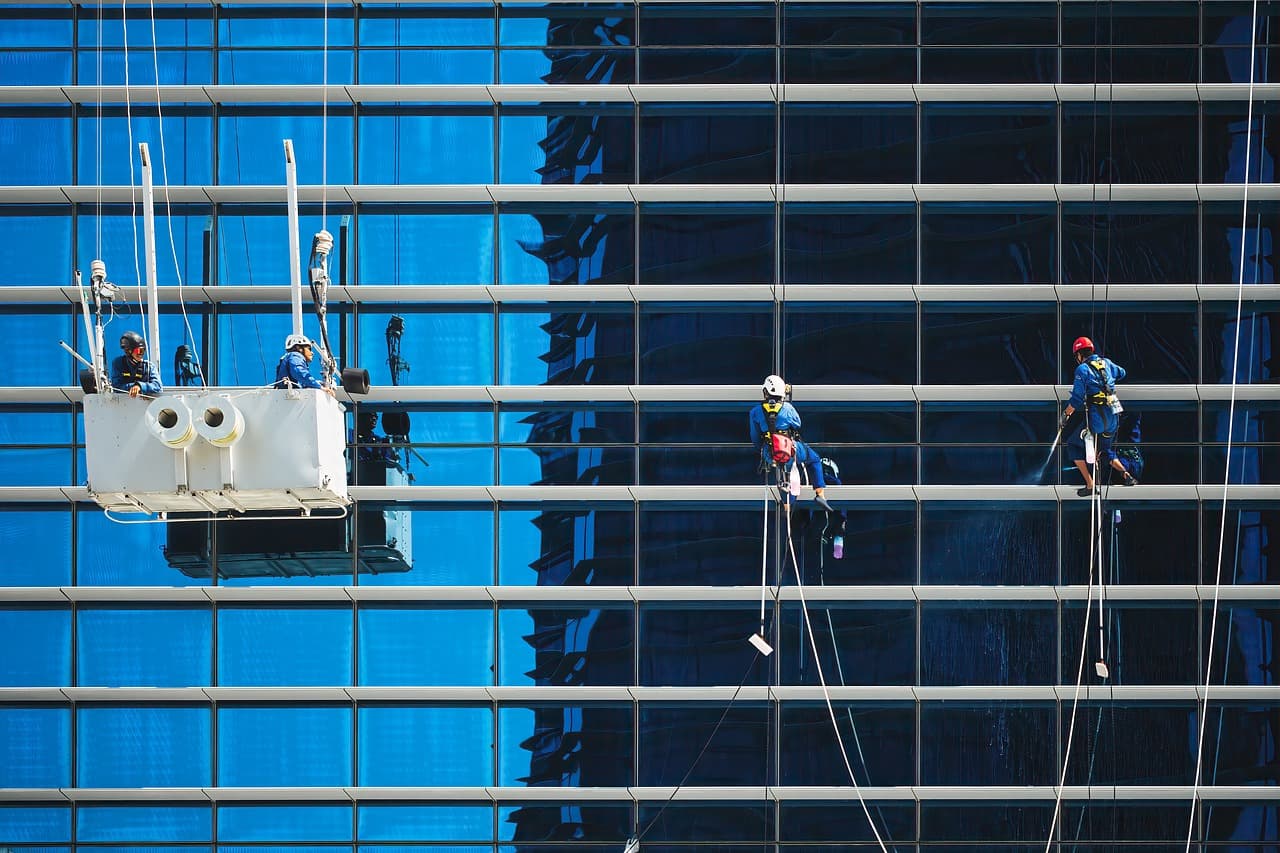
A method based on static ropes anchored to the building's roof. The worker — a certified industrial rope access technician — descends from the roof using ropes, performing work in single rope technique (SRT) or double rope technique (DRT). Industrial rope access is the most commonly used method in Poland due to its flexibility, lower cost, and ability to reach difficult areas (bay windows, balconies, non-standard glazing).
Key system elements:
- Static ropes with minimum diameter of 10 mm, certified per EN 1891
- Safety harness EN 361 with front and rear attachment points
- Protective helmets EN 397, work gloves and non-slip footwear
- Self-locking devices (carabiner, descender such as I'D, ASAP)
- Roof anchoring system (fixed points per EN 795 or portable transport anchors)
The advantage of rope access is fast mobilization and no need to rent heavy equipment. The disadvantage is weather limitations and greater subjective risk, requiring high safety standards from the contractor.
Aerial Work Platforms
Telescopic or articulated platforms enable reaching the façade from ground level. In Poland, platforms with reach of 20–40 m (covering buildings up to 12 stories) are most commonly used. This method is preferred at locations with hardened surfaces around the building and good access — e.g., office buildings with parking areas, new developments with wide green spaces allowing platform setup.
Requirements:
- UDT (Technical Inspection Office) operator certification for the platform
- Work platform complying with EN 280
- Equipment liability insurance (minimum PLN 100,000 value)
- Soil load capacity assessment (geotechnical testing required for unstable ground)
Platforms provide greater work comfort and stability, but generate higher costs (rental PLN 800–1500 net/day depending on reach) and require maneuvering space, which is often impossible in dense urban areas. In Katowice during residential block cleaning, we frequently encounter infrastructural limitations preventing platform use.
Fixed Anchoring Systems (Building Maintenance Units, BMU)
Some modern high-rises are equipped with permanent rail systems or hoists on the roof, from which service gondolas are lowered. This is a premium solution, typical for Class A+ office towers (e.g., 20+ stories). An anchoring system requires annual UDT inspections and a dedicated operator, but over the long term reduces window cleaning costs and improves timeliness (independence from external equipment rental).
In practice, buildings managed by residential communities rarely have BMU systems — these are installed during design and operation by the developer or commercial manager.
Health and Safety Requirements and Certifications — What Must the Contractor Possess?
Safety in high-altitude work is non-negotiable. The employer (service provider company) is responsible for worker equipment, equipment inspections, and staff training. The building manager — as the client — must verify document completeness and permit only companies meeting requirements.
Mandatory certificates and documents:
- High-altitude work qualification certificate for each worker (IRATA, FISAT or equivalent national standard)
- Health booklet with current medical examinations (including psychological assessment for high-altitude work)
- Business liability insurance policy — minimum PLN 100,000 coverage, optimally PLN 500,000 (the Reefa team standardly maintains liability coverage up to PLN 500,000)
- Equipment inspection protocols: ropes (every 12 months or after 500 hours of use), harnesses (every 12 months), self-locking devices (every 12 months per manufacturer instructions)
- Occupational risk assessment for the specific building — document prepared before work begins
- Evacuation plan — procedure in case of worker injury while suspended on rope
When selecting a contractor, request copies of current certificates and a reference list from buildings of similar height. Experienced contractors should be able to present a work schedule accounting for weather conditions — a professional contractor will never guarantee a date without a weather caveat.
Additionally — in accordance with the Regulation of the Minister of Family, Labor and Social Policy from 2017 regarding safety and health at work related to fall-from-height hazards — the employer must provide a supervision system (person on roof monitoring anchoring and rope condition, and person on ground responsible for the protective zone).
How Often Should Windows Be Cleaned in a Skyscraper?
Frequency depends on building function, location (air pollution, proximity to roads), and expectations of residents or commercial tenants.
Residential buildings (communities, apartment buildings):
2–4 times per year. Typical schedule: spring (March–April), summer (July), autumn (September–October), optionally winter (January, if weather permits). In urban agglomerations — Cracow, Katowice — traffic dust and industrial pollution may require increased frequency to 4 times.
Class A and B+ offices:
4–6 times per year. Commercial tenants expect maintenance of façade aesthetics throughout the year, reflected in rental agreements (SLA — Service Level Agreement). In practice, facility managers schedule cleaning every 8–10 weeks, with flexibility ±2 weeks depending on weather.
Medical and educational facilities:
Similar to offices — 4–6 times yearly, sometimes more frequently in cases of operating room windows or laboratories requiring elevated hygiene standards (HACCP, ISO 14644 standards for room cleanliness).
It is worth noting that infrequent cleaning (e.g., 1–2 times per year) leads to permanent settling of contaminants, which over time shortens the lifespan of window seals and may cause discoloration on glass. As a result, regular preventive maintenance is cheaper than emergency restoration.
How Much Does Window Cleaning Cost in a Skyscraper? Method Comparison
Costs of high-altitude services depend on the method, building height, access, window condition, and frequency of contracts (annual contracts reduce unit rates).
Industrial Rope Access
Rates 2026 (Cracow, Katowice):
- Buildings 10–15 stories: 15–25 PLN net/m² window surface
- Buildings 16–20 stories: 25–35 PLN net/m²
- Post-renovation cleaning (heavy cement/mortar soiling): +50–100% markup
Example: 15-story building, 400 windows with average surface of 1.5 m² = 600 m². Cost per cleaning: 600 m² × 22 PLN/m² = 13,200 PLN net. At 2 cycles yearly: 26,400 PLN net/year.
Advantage: scheduling flexibility, quick team mobilization (2-person team completes 600 m² in 1–2 working days).
Aerial Work Platforms
Rates 2026:
- Buildings up to 12 stories (reach 20–30 m): 20–35 PLN net/m²
- Buildings 13–18 stories (reach 30–40 m): 35–50 PLN net/m²
- Platform rental: 800–1500 PLN net/day (charged separately or included in m² rate)
Example: Same 600 m² in a 15-story building: 600 m² × 40 PLN/m² = 24,000 PLN net per cycle, at 2 cycles: 48,000 PLN net/year.
Platforms are more expensive, but in some situations — e.g., buildings with difficult roof access, lack of anchoring points — may be the only option.
BMU Systems (Permanent Gondolas)
Gondola operating costs consist mainly of operator wages (120–180 PLN net/hour) and annual UDT inspection (2,000–5,000 PLN). Calculated per m², this comes to 10–20 PLN net/m², making BMU the most cost-effective method long-term — but only if the building already has it installed. New system installation costs PLN 200,000–500,000, rentable only for buildings over 20 stories.
What to Check With the Contractor Before Signing a Contract?
Experience and References
Request a list of at least 3 buildings of similar height, with contact details for facility managers or community managers. Verify whether the contractor has served buildings in your city — Cracow and Katowice have specific urban characteristics (narrow streets in centers, dense period building areas, traffic restrictions) requiring knowledge of local conditions.
Reefa has served residential communities and office buildings in the Cracow agglomeration since 2020, and in Katowice since 2024. We work exclusively with partners possessing IRATA or FISAT certifications and minimum 5 years of high-altitude work experience.
Equipment and Technical Documentation
Request a list of equipment used along with last inspection dates. Pay attention to:
- Static ropes: diameter ≥10 mm, manufacturing date no older than 5 years, annual inspection protocol
- Harnesses: EN 361 standard, no signs of wear at attachment points
- Helmets: EN 397, chin strap fully functional
- Self-locking devices: date of last manufacturer inspection, no corrosion
A professional contractor will provide these documents without resistance — if they object, it's a red flag.
Liability Insurance and Scope of Responsibility
Minimum PLN 100,000, optimally PLN 500,000. The policy should cover:
- Personal injury (worker injury, third parties)
- Property damage (façade damage, broken windows)
- Indirect damage (e.g., apartment flooding from window cleaning water)
The Reefa team standardly maintains liability coverage up to PLN 500,000 and additional entrusted property insurance, ensuring complete financial security for the client.
Schedule and Flexibility
Establish whether the contractor has a reserve date in case of poor weather. Best practices assume a time window of ±7 days from the planned date. Also check whether the company handles more than one building per day — an overly tight schedule can lead to delays and rushing (which in high-altitude work constitutes a safety hazard).
Emergency Procedures
Ask about the evacuation plan for a suspended worker. Standard response time is maximum 15 minutes from problem notification (injury, rope jam). The company should have a rescue kit (e.g., additional evacuation rope, rescue harness) and a trained rescue team.
Case Study: 15-Story Building, 400 Windows
Building Parameters
- Location: Cracow, Podgórze district (intensive traffic, proximity to major transport hub)
- Height: 48 m (15 residential floors + ground-floor service area)
- Number of windows: 400 pcs (balcony and fixed), average surface 1.5 m² = 600 m² glass
- Roof access: flat technical roof, anchoring points per EN 795 (installed by developer)
- Use: residential community, 120 units
Solution
Method: industrial rope access (2-person certified technician team). Choice motivated by inability to position platform (narrow sidewalk, landscaping, no parking closure consent).
Schedule: 2 full cycles yearly — April and September.
Scope of Work
- Technical inspection (1 day before start): assessment of anchoring points condition, protective zone setup, resident notification
- Interior and exterior cleaning (with access to balcony windows): demineralized water + pH-neutral agent (compliant with EU Ecolabel requirements)
- Execution time: 2 working days per cycle (2-person team + ground coordinator)
- Weather report: service conducted only at wind <10 m/s, requiring in practice 3–4 time slots per month and optimal date selection
Costs (2026)
- Rate: 22 PLN net/m²
- One cycle: 600 m² × 22 PLN = 13,200 PLN net
- Two cycles yearly: 26,400 PLN net
- Cost per unit (120 apartments): 220 PLN net/year (approx. 18.30 PLN/month in administrative fees)
Results
- Improved façade aesthetics (particularly visible from south side, most exposed to dust)
- Increased resident satisfaction (internal survey: 87% rate service positively)
- Zero safety incidents, no complaints regarding damage
The building has been served by a Reefa partner since 2022, with opportunity to coordinate comprehensive residential block cleaning in Cracow (stairwells, lobby, underground parking).
Frequently Asked Questions
How much does window cleaning cost in a skyscraper?
Window cleaning costs in skyscrapers range from 15 to 50 PLN net per square meter of glass surface, depending on method (industrial rope access is cheaper, aerial platforms more expensive), building height, and façade accessibility. A typical 15-story building with 600 m² of windows requires a budget of 13,000–24,000 PLN net for one complete cleaning cycle. At 2 cycles yearly (standard for residential buildings), annual spending is 26,000–48,000 PLN net. Costs may be lower with long-term contracts and buildings with pre-installed anchoring systems.
How much do window cleaners earn on skyscrapers?
An industrial rope access technician performing window cleaning at height in Poland in 2026 earns an average of 5,500–8,500 PLN gross monthly on an employment contract (depending on region, experience and certifications). Hourly rates range from 35 to 60 PLN net for B2B cooperation. Additional bonuses may be awarded for work in difficult conditions (height over 50 m, complex façade) and weekend or night hours. Key to earnings are certifications — an IRATA Level 3 or FISAT Advanced holder earns 20–30% more than someone with a basic certificate.
How are windows cleaned in skyscrapers?
Windows in skyscrapers are cleaned with demineralized (osmotic) water delivered through a telescopic brush system or applied manually using a rubber squeegee and microfiber mop. pH-neutral cleaning agents compliant with EU Ecolabel standards or equivalents safe for low-emission coatings (low-e) are added to the water. For heavy soiling (smog, bird droppings, cement traces after renovation), acidic agents at pH 2–4 or alkaline pH 10–12 are used, always with compatibility testing on a small area before full cleaning. Industrial rope access technicians use equipment secured to their harness to keep both hands free during work.
How much does cleaning a single window cost in a skyscraper?
Cleaning a single window in a skyscraper costs an average of 22–75 PLN net, depending on window size (typical residential: 1.2–1.8 m²) and floor height. Above the 10th floor, unit price increases due to additional access time and safety requirements. In practice, contractors charge per square meter of glass (15–50 PLN net/m²), providing greater cost transparency — e.g., a 1.5 m² balcony window × 25 PLN/m² = 37.50 PLN net. For single orders (not annual contract), contractors often set a minimum order value (e.g., 2,000 PLN net), making individual requests less cost-effective than collective action by the entire residential community.
How often should windows be cleaned in a tall residential building?
Residential buildings over 10 stories should have windows cleaned 2–4 times yearly. A minimum of 2 cycles (spring and autumn) suffices in low-pollution locations (peripheries, proximity to green areas). In city centers, at major traffic arteries and in industrial regions (e.g., Katowice agglomeration), 4 cycles are recommended to prevent permanent settling of smog and traffic dust. Frequency can be agreed in a community resolution and recorded in the annual budget — remember that regular cleaning extends window seal lifespan and improves façade aesthetics, translating to property value.
Does the contractor need special permits for high-altitude window cleaning?
Yes. Every worker performing window cleaning above 3 m height (the threshold for high-altitude work under labor law) must possess a high-altitude work qualification certificate — in Poland, IRATA (Industrial Rope Access Trade Association) or FISAT (Fédération Internationale des travailleurs sur cordes — Accès et Travaux sur cordes) certifications are recognized. Additionally required are a current health booklet with entry permitting high-altitude work (medical examinations: internist, ophthalmologist, psychologist), occupational safety training, and knowledge of evacuation procedures. The building manager has the right and obligation to demand copies of these documents before permitting contractor access — in case of a labor inspection authority inspection, absence of certifications risks a fine up to 30,000 PLN for the employer and work suspension.
Window Cleaning in Skyscrapers — Investment in Safety and Image
Maintaining cleanliness of glass façades in tall buildings is a process requiring not only technical competence, but above all safety culture and consistency. Residential community managers, facility managers, and administrative directors are responsible for contractor selection, verification of safety documentation, and a schedule that balances aesthetic requirements with weather realities and budgets.
The Reefa team has supported clients in Cracow since 2020 and in Katowice since 2024 with comprehensive cleaning maintenance — from stairwell cleaning in residential blocks to coordinating high-altitude services with certified partners. We provide a dedicated building coordinator, photo reports after each cleaning, legally employed and insured staff, and liability insurance up to PLN 500,000.
If you manage a high-rise and seek a reliable partner for window cleaning or comprehensive maintenance — contact our team. We will conduct a free technical inspection, advise on the optimal method, and provide a transparent quote.